Ch. 5 - Integration
Briggs - Calculus: Early Transcendentals 3rd Edition
Briggs3rd EditionCalculus: Early TranscendentalsISBN: 9780136847243당신이 사용하는 게 아니라요?교과서 변경
5장, 문제 5.4.35

Average velocity The velocity in m/s of an object moving along a line over the time interval [0,6] is v (t) = t² + 3t. Find the average velocity of the object over this time interval.

검증된 단계별 안내
1
Step 1: Recall the formula for average velocity over a time interval [a, b]. It is given by: vavg=1b-aab
Step 2: Substitute the given time interval [0, 6] into the formula. The average velocity becomes: vavg=16-006
Step 3: Write the integral expression for the velocity function v(t) = t² + 3t. The integral becomes: 06(t²+3t)dt
Step 4: Compute the integral of the function t² + 3t. Use the power rule for integration: dt=3 and 3tdt=3t²2. Combine these results to find the antiderivative.
Step 5: Evaluate the definite integral by substituting the limits of integration (0 and 6) into the antiderivative. Then divide the result by the length of the interval (6 - 0) to find the average velocity.

비슷한 문제에 대한 검증된 영상 답변:

이 영상 해법은 위 문제에 도움이 된다고 튜터들이 추천한 것입니다.
영상 길이:
4m

주요 개념

질문에 올바르게 답하기 위해 반드시 이해해야 하는 핵심 개념들은 다음과 같습니다.

Average Velocity

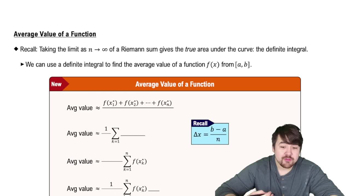
Average velocity is defined as the total displacement divided by the total time taken. In calculus, it can be calculated using the formula: average velocity = (s(b) - s(a)) / (b - a), where s(t) is the position function and [a, b] is the time interval. For the given problem, we need to integrate the velocity function over the interval and then divide by the length of the interval.
추천 영상:
가이드 코스
06:37
Average Value of a Function

Velocity Function

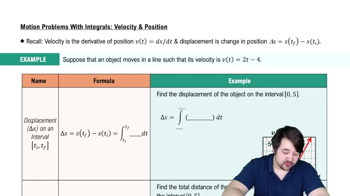
The velocity function describes how the velocity of an object changes over time. In this case, the velocity is given by v(t) = t² + 3t, which is a polynomial function. Understanding this function is crucial for determining the object's behavior over the specified time interval, as it provides the rate of change of position with respect to time.
추천 영상:
가이드 코스
10:17
Using The Velocity Function

Integration

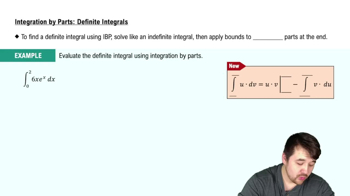
Integration is a fundamental concept in calculus used to find the area under a curve, which in the context of motion, represents the total displacement. To find the average velocity, we need to integrate the velocity function v(t) over the interval [0, 6] and then divide the result by the length of the interval. This process allows us to calculate the total change in position over the given time period.
추천 영상:
가이드 코스
06:18
Integration by Parts for Definite Integrals
관련 실천
교과서 질문

Indefinite integrals Use a change of variables or Table 5.6 to evaluate the following indefinite integrals. Check your work by differentiating.                                                                                  


 ∫ 𝓍eˣ² d𝓍

71
views

교과서 질문

Suppose an object moves along a line at 15 m/s, for 0 ≤ t < 2 and at 25 m/s, for 2 ≤ t ≤ 5, where t is measured in seconds. Sketch the graph of the velocity function and find the displacement of the object for 0 ≤ t ≤ 5.

47
views
교과서 질문

Explain why ∫ₐᵇ ƒ ′(𝓍) d𝓍 = ƒ(b) ― ƒ(a)

85
views
교과서 질문

Definite integrals from graphs The figure shows the areas of regions bounded by the graph of ƒ and the 𝓍-axis. Evaluate the following integrals.


∫ₐᶜ ƒ(𝓍) d𝓍

102
views
교과서 질문

A midpoint Riemann sum Approximate the area of the region bounded by the graph of ƒ(𝓍) = 100 ― x² and the x-axis on [0, 10] with n = 5 subintervals. Use the midpoint of each subinterval to determine the height of each rectangle (see figure).

111
views
교과서 질문

Indefinite integrals Use a change of variables or Table 5.6 to evaluate the following indefinite integrals. Check your work by differentiating.                                                                                  


 ∫ 𝓍³ (𝓍⁴ + 16)⁶ d𝓍

56
views