

Ch. 5 - Integration
Briggs - Calculus: Early Transcendentals 3rd Edition
Briggs3rd EditionCalculus: Early TranscendentalsISBN: 9780136847243당신이 사용하는 게 아니라요?교과서 변경
5장, 문제 5.2.61

Definite integrals from graphs The figure shows the areas of regions bounded by the graph of ƒ and the 𝓍-axis. Evaluate the following integrals.


∫ₐᶜ ƒ(𝓍) d𝓍

검증된 단계별 안내
1
Identify the points a and c on the x-axis from the graph, which define the limits of integration for the integral \( \int_{a}^{c} f(x) \, dx \).
Observe the graph of \( f(x) \) between \( x = a \) and \( x = c \) and note the areas bounded by the curve and the x-axis. Pay attention to whether the graph is above or below the x-axis in each region, as this affects the sign of the integral.
Calculate the area of each region between the curve and the x-axis separately. If the graph is above the x-axis, the area contributes positively to the integral; if below, it contributes negatively.
Sum the signed areas of all regions between \( a \) and \( c \) to find the value of the definite integral \( \int_{a}^{c} f(x) \, dx \).
Express the final integral as the algebraic sum of these areas, which represents the net area between the curve and the x-axis over the interval \( [a, c] \).

비슷한 문제에 대한 검증된 영상 답변:

이 영상 해법은 위 문제에 도움이 된다고 튜터들이 추천한 것입니다.
영상 길이:
2m
도움이 되었나요?

주요 개념

질문에 올바르게 답하기 위해 반드시 이해해야 하는 핵심 개념들은 다음과 같습니다.

Definite Integral as Net Area

A definite integral represents the net area between the graph of a function and the x-axis over a given interval. Areas above the x-axis contribute positively, while areas below contribute negatively, affecting the integral's value.
추천 영상:
가이드 코스
05:43
Definition of the Definite Integral

Interpreting Graphical Areas

When evaluating integrals from graphs, it is essential to identify and measure the areas of regions bounded by the curve and the x-axis. Understanding which parts lie above or below the axis helps determine the sign and magnitude of each area.
추천 영상:
05:06
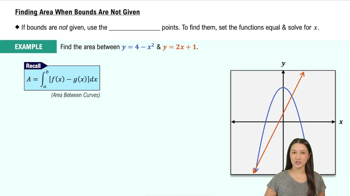
Finding Area When Bounds Are Not Given

Properties of Definite Integrals

Definite integrals are additive over adjacent intervals, meaning the integral from a to c can be split into integrals over subintervals. This property allows summing individual areas to find the total integral value.
추천 영상:
가이드 코스
05:43
Definition of the Definite Integral
관련 실천
교과서 질문

Max/min of area functions Suppose ƒ is continuous on [0 ,∞) and A(𝓍) is the net area of the region bounded by the graph of ƒ and the t-axis on [0, x]. Show that the local maxima and minima of A occur at the zeros of ƒ. Verify this fact with the function ƒ(𝓍) = 𝓍² - 10𝓍.

46
views
교과서 질문

Suppose an object moves along a line at 15 m/s, for 0 ≤ t < 2 and at 25 m/s, for 2 ≤ t ≤ 5, where t is measured in seconds. Sketch the graph of the velocity function and find the displacement of the object for 0 ≤ t ≤ 5.

47
views
교과서 질문

Explain why ∫ₐᵇ ƒ ′(𝓍) d𝓍 = ƒ(b) ― ƒ(a)

85
views
교과서 질문

Average velocity The velocity in m/s of an object moving along a line over the time interval [0,6] is v (t) = t² + 3t. Find the average velocity of the object over this time interval.

160
views
교과서 질문

A midpoint Riemann sum Approximate the area of the region bounded by the graph of ƒ(𝓍) = 100 ― x² and the x-axis on [0, 10] with n = 5 subintervals. Use the midpoint of each subinterval to determine the height of each rectangle (see figure).

111
views
교과서 질문

Indefinite integrals Use a change of variables or Table 5.6 to evaluate the following indefinite integrals. Check your work by differentiating.                                                                                  


 ∫ 𝓍³ (𝓍⁴ + 16)⁶ d𝓍

56
views