Ch. 5 - Integration
Briggs - Calculus: Early Transcendentals 3rd Edition
Briggs3rd EditionCalculus: Early TranscendentalsISBN: 9780136847243당신이 사용하는 게 아니라요?교과서 변경
5장, 문제 5.3.31

Definite integrals Evaluate the following integrals using the Fundamental Theorem of Calculus


∫₁⁸ 8𝓍¹/³ d𝓍

검증된 단계별 안내
1
Step 1: Recognize that the integral ∫₁⁸ 8𝓍¹/³ d𝓍 is a definite integral, and we will use the Fundamental Theorem of Calculus to evaluate it. The Fundamental Theorem states that if F'(𝓍) = f(𝓍), then ∫ₐᵇ f(𝓍) d𝓍 = F(b) - F(a).
Step 2: Identify the function to integrate, which is f(𝓍) = 8𝓍¹/³. To find the antiderivative, recall the power rule for integration: ∫𝓍ⁿ d𝓍 = (𝓍ⁿ⁺¹)/(n+1) + C, where n ≠ -1.
Step 3: Apply the power rule to the term 𝓍¹/³. The antiderivative of 𝓍¹/³ is (𝓍⁴/³)/(4/3) = (3/4)𝓍⁴/³. Multiply this by the constant 8 to get the antiderivative of the entire function: F(𝓍) = 8 * (3/4)𝓍⁴/³ = 6𝓍⁴/³.
Step 4: Use the Fundamental Theorem of Calculus to evaluate the definite integral. Substitute the upper limit (𝓍 = 8) and the lower limit (𝓍 = 1) into the antiderivative F(𝓍). This gives F(8) - F(1), where F(𝓍) = 6𝓍⁴/³.
Step 5: Write the expression for the result: F(8) - F(1) = 6(8⁴/³) - 6(1⁴/³). Simplify each term separately to find the final value of the definite integral.

비슷한 문제에 대한 검증된 영상 답변:

이 영상 해법은 위 문제에 도움이 된다고 튜터들이 추천한 것입니다.
영상 길이:
3m
도움이 되었나요?

주요 개념

질문에 올바르게 답하기 위해 반드시 이해해야 하는 핵심 개념들은 다음과 같습니다.

Fundamental Theorem of Calculus

The Fundamental Theorem of Calculus links the concept of differentiation with integration, stating that if a function is continuous on an interval [a, b], then the integral of its derivative over that interval equals the difference in the values of the function at the endpoints. This theorem allows us to evaluate definite integrals by finding an antiderivative of the integrand.
추천 영상:
06:11
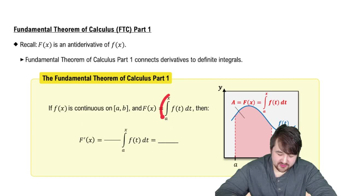
Fundamental Theorem of Calculus Part 1

Definite Integral

A definite integral represents the signed area under a curve defined by a function over a specific interval [a, b]. It is calculated using the limits of integration, which specify the interval, and provides a numerical value that reflects the accumulation of quantities, such as area, volume, or total change, over that interval.
추천 영상:
05:43
Definition of the Definite Integral

Antiderivative

An antiderivative of a function is another function whose derivative is the original function. In the context of the Fundamental Theorem of Calculus, finding the antiderivative is essential for evaluating definite integrals, as it allows us to compute the integral by substituting the limits of integration into the antiderivative and calculating the difference.
추천 영상:
05:50
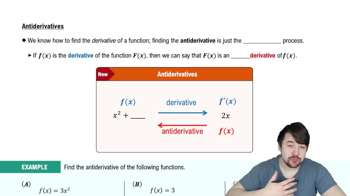
Antiderivatives
관련 실천
교과서 질문

Definite integrals Use a change of variables or Table 5.6 to evaluate the following definite integrals.                                                                                                                         


 ∫₀^π/⁴ eˢᶦⁿ² ˣ sin 2𝓍 d𝓍

104
views
교과서 질문

Derivatives of integrals Simplify the following expressions.


d/d𝓍 ∫₃ˣ (t² + t + 1) dt

87
views
교과서 질문

Mean Value Theorem for Integrals Find or approximate all points at which the given function equals its average value on the given interval.


ƒ(𝓍) = 1 ― |𝓍| on [―1, 1]

118
views
교과서 질문

Definite integrals Use geometry (not Riemann sums) to evaluate the following definite integrals. Sketch a graph of the integrand, show the region in question, and interpret your result.                                                                                                                                      


 ∫₋₁² ( ―|𝓍| ) d𝓍

48
views
교과서 질문

Let ƒ(𝓍) = c, where c is a positive constant. Explain why an area function of ƒ is an increasing function.

72
views
교과서 질문

Areas of regions Find the area of the region bounded by the graph of ƒ and the 𝓍-axis on the given interval.


ƒ(𝓍) = sin 𝓍 on [―π/4, 3π/4]

108
views