Ch. 5 - Integration
Briggs - Calculus: Early Transcendentals 3rd Edition
Briggs3rd EditionCalculus: Early TranscendentalsISBN: 9780136847243당신이 사용하는 게 아니라요?교과서 변경
5장, 문제 5.3.35

Definite integrals Evaluate the following integrals using the Fundamental Theorem of Calculus


∫₁⁹ 2/(√𝓍) d𝓍

검증된 단계별 안내
1
Step 1: Recognize that the integral ∫₁⁹ 2/(√𝓍) d𝓍 can be rewritten using exponents. Recall that √𝓍 is equivalent to 𝓍^(1/2), so the integrand becomes 2 * 𝓍^(-1/2).
Step 2: Apply the power rule for integration. The general formula for integrating 𝓍^n is ∫𝓍^n d𝓍 = (𝓍^(n+1))/(n+1) + C, where n ≠ -1. Here, n = -1/2.
Step 3: Compute the antiderivative of 2 * 𝓍^(-1/2). Using the power rule, the antiderivative becomes 2 * (𝓍^(1/2))/(1/2), which simplifies to 4 * 𝓍^(1/2).
Step 4: Use the Fundamental Theorem of Calculus to evaluate the definite integral. Substitute the limits of integration (𝓍 = 1 and 𝓍 = 9) into the antiderivative. This gives [4 * √𝓍] evaluated from 1 to 9.
Step 5: Calculate the difference between the values of the antiderivative at the upper and lower limits. Specifically, compute 4 * √9 - 4 * √1. Simplify the expression to find the final result.

비슷한 문제에 대한 검증된 영상 답변:

이 영상 해법은 위 문제에 도움이 된다고 튜터들이 추천한 것입니다.
영상 길이:
2m
도움이 되었나요?

주요 개념

질문에 올바르게 답하기 위해 반드시 이해해야 하는 핵심 개념들은 다음과 같습니다.

Definite Integrals

Definite integrals represent the signed area under a curve between two specified limits. They are calculated using the integral symbol with lower and upper bounds, indicating the interval over which the function is evaluated. The result of a definite integral is a numerical value that quantifies this area, which can be interpreted in various contexts, such as physics or economics.
추천 영상:
05:43
Definition of the Definite Integral

Fundamental Theorem of Calculus

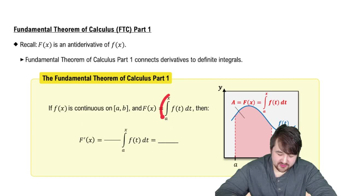
The Fundamental Theorem of Calculus links the concept of differentiation with integration, providing a method to evaluate definite integrals. It states that if a function is continuous on an interval, then the integral of its derivative over that interval equals the difference in the values of the original function at the endpoints. This theorem allows for the computation of definite integrals by finding an antiderivative of the integrand.
추천 영상:
06:11
Fundamental Theorem of Calculus Part 1

Antiderivatives

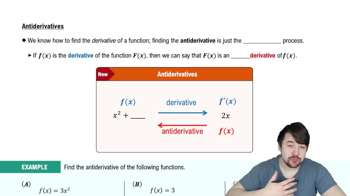
An antiderivative of a function is another function whose derivative yields the original function. In the context of definite integrals, finding an antiderivative is crucial because it allows us to apply the Fundamental Theorem of Calculus. For example, if we need to evaluate the integral of a function, we first determine its antiderivative and then compute the difference between its values at the upper and lower limits of integration.
추천 영상:
05:50
Antiderivatives
관련 실천
교과서 질문

Definite integrals Use geometry (not Riemann sums) to evaluate the following definite integrals. Sketch a graph of the integrand, show the region in question, and interpret your result.                                                                                                                                      


 ∫₀⁴ √(16― 𝓍² ) d𝓍

84
views
교과서 질문

Mean Value Theorem for Integrals Find or approximate all points at which the given function equals its average value on the given interval.


ƒ(𝓍) = 8 ― 2𝓍 on [0, 4]

110
views
교과서 질문

Variations on the substitution method Evaluate the following integrals.                                                                                                        


 ∫ 𝓍/(∛𝓍 + 4) d𝓍

54
views
교과서 질문

Evaluate ∫₃⁸ ƒ ′(t) dt , where ƒ ′ is continuous on [3, 8], ƒ(3) = 4, and ƒ(8) = 20 .

37
views
교과서 질문

When using a change of variables u = g(𝓍) to evaluate the definite integral ∫ₐᵇ ƒ(g(𝓍)) g' (𝓍) d(𝓍), how are the limits of integration transformed?

66
views
교과서 질문

Definite integrals Use a change of variables or Table 5.6 to evaluate the following definite integrals.                                                                                                                         


 ∫₁/₃^¹/√³ 4/(9𝓍² + 1) d𝓍

102
views