Ch. 5 - Integration
5์žฅ, ๋ฌธ์ œ 5.5.5

When using a change of variables u = g(๐“) to evaluate the definite integral โˆซโ‚แต‡ ฦ’(g(๐“)) g' (๐“) d(๐“), how are the limits of integration transformed?

๊ฒ€์ฆ๋œ ๋‹จ๊ณ„๋ณ„ ์•ˆ๋‚ด
1
Recognize that when performing a substitution in a definite integral, the variable of integration changes from \( x \) to \( u = g(x) \).
The original integral is \( \int_a^b f(g(x)) g'(x) \, dx \). After substitution, \( dx \) is replaced by \( \frac{du}{g'(x)} \), but since \( du = g'(x) dx \), the integral becomes \( \int_{u(a)}^{u(b)} f(u) \, du \).
To find the new limits of integration, evaluate the substitution function \( g(x) \) at the original limits: the lower limit \( a \) transforms to \( u(a) = g(a) \), and the upper limit \( b \) transforms to \( u(b) = g(b) \).
Thus, the definite integral with respect to \( x \) from \( a \) to \( b \) is equivalent to the integral with respect to \( u \) from \( g(a) \) to \( g(b) \).
This change of limits ensures the integral remains consistent under the substitution and allows you to evaluate the integral in terms of \( u \).

๋น„์Šทํ•œ ๋ฌธ์ œ์— ๋Œ€ํ•œ ๊ฒ€์ฆ๋œ ์˜์ƒ ๋‹ต๋ณ€:

์ด ์˜์ƒ ํ•ด๋ฒ•์€ ์œ„ ๋ฌธ์ œ์— ๋„์›€์ด ๋œ๋‹ค๊ณ  ํŠœํ„ฐ๋“ค์ด ์ถ”์ฒœํ•œ ๊ฒƒ์ž…๋‹ˆ๋‹ค.
์˜์ƒ ๊ธธ์ด:
1m
๋„์›€์ด ๋˜์—ˆ๋‚˜์š”?

์ฃผ์š” ๊ฐœ๋…

์งˆ๋ฌธ์— ์˜ฌ๋ฐ”๋ฅด๊ฒŒ ๋‹ตํ•˜๊ธฐ ์œ„ํ•ด ๋ฐ˜๋“œ์‹œ ์ดํ•ดํ•ด์•ผ ํ•˜๋Š” ํ•ต์‹ฌ ๊ฐœ๋…๋“ค์€ ๋‹ค์Œ๊ณผ ๊ฐ™์Šต๋‹ˆ๋‹ค.

Change of Variables (Substitution) in Integration

This technique simplifies integrals by substituting a new variable u = g(x), transforming the integral into terms of u. It helps to rewrite complex integrals into more manageable forms by changing the variable of integration.
์ถ”์ฒœ ์˜์ƒ:
04:27
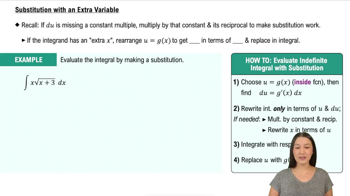
Substitution With an Extra Variable

Derivative of the Substitution Function

When substituting u = g(x), the differential dx is replaced by du = g'(x) dx. This derivative g'(x) adjusts the integrand to maintain equivalence between the original and transformed integrals.
์ถ”์ฒœ ์˜์ƒ:
04:27
Substitution With an Extra Variable

Transformation of Limits of Integration

In definite integrals, the original limits a and b in terms of x must be converted to new limits in terms of u by evaluating u = g(a) and u = g(b). This ensures the integral's bounds correspond correctly to the substituted variable.
์ถ”์ฒœ ์˜์ƒ:
5:25
Intro to Transformations
๊ด€๋ จ ์‹ค์ฒœ
๊ต๊ณผ์„œ ์งˆ๋ฌธ

Definite integrals Use geometry (not Riemann sums) to evaluate the following definite integrals. Sketch a graph of the integrand, show the region in question, and interpret your result.                                                                                                                                      


 โˆซโ‚€โด โˆš(16โ€• ๐“ยฒ ) d๐“

84
views
๊ต๊ณผ์„œ ์งˆ๋ฌธ

Variations on the substitution method Evaluate the following integrals.                                                                                                        


 โˆซ ๐“/(โˆš๐“โ€•4) d๐“

67
views
๊ต๊ณผ์„œ ์งˆ๋ฌธ

Suppose an object moves along a line at 15 m/s, for 0 โ‰ค t < 2 and at 25 m/s, for 2 โ‰ค t โ‰ค 5, where t is measured in seconds. Sketch the graph of the velocity function and find the displacement of the object for 0 โ‰ค t โ‰ค 5.

47
views
๊ต๊ณผ์„œ ์งˆ๋ฌธ

Evaluate โˆซโ‚ƒโธ ฦ’ โ€ฒ(t) dt , where ฦ’ โ€ฒ is continuous on [3, 8], ฦ’(3) = 4, and ฦ’(8) = 20 .

37
views
๊ต๊ณผ์„œ ์งˆ๋ฌธ

Definite integrals Evaluate the following integrals using the Fundamental Theorem of Calculus


โˆซโ‚โน 2/(โˆš๐“) d๐“

106
views
๊ต๊ณผ์„œ ์งˆ๋ฌธ

Definite integrals Use a change of variables or Table 5.6 to evaluate the following definite integrals.                                                                                                                         


 โˆซโ‚/โ‚ƒ^ยน/โˆšยณ 4/(9๐“ยฒ + 1) d๐“

102
views