Ch. 5 - Integration
Briggs - Calculus: Early Transcendentals 3rd Edition
Briggs3rd EditionCalculus: Early TranscendentalsISBN: 9780136847243당신이 사용하는 게 아니라요?교과서 변경
5장, 문제 5.2.45

Definite integrals Use geometry (not Riemann sums) to evaluate the following definite integrals. Sketch a graph of the integrand, show the region in question, and interpret your result.


 ∫₀⁴ ƒ(𝓍) d𝓍, where ƒ(𝓍) = {5      if 𝓍 ≤ 2                                                                                                                                                                                     
                      3𝓍 ― 1  if 𝓍 > 2

검증된 단계별 안내
1
Step 1: Understand the problem. The definite integral ∫₀⁴ ƒ(𝓍) d𝓍 involves a piecewise function ƒ(𝓍), which is defined as 5 for 𝓍 ≤ 2 and 3𝓍 - 1 for 𝓍 > 2. The goal is to evaluate the integral geometrically by sketching the graph of ƒ(𝓍) and calculating the area under the curve between 𝓍 = 0 and 𝓍 = 4.
Step 2: Sketch the graph of ƒ(𝓍). For 𝓍 ≤ 2, ƒ(𝓍) = 5 is a horizontal line at y = 5. For 𝓍 > 2, ƒ(𝓍) = 3𝓍 - 1 is a linear function with slope 3 and y-intercept -1. Plot these two segments on the graph, ensuring continuity at 𝓍 = 2.
Step 3: Identify the regions under the curve. From 𝓍 = 0 to 𝓍 = 2, the region is a rectangle with height 5 and width 2. From 𝓍 = 2 to 𝓍 = 4, the region is a trapezoid formed by the linear function ƒ(𝓍) = 3𝓍 - 1.
Step 4: Calculate the area of each region. For the rectangle (𝓍 = 0 to 𝓍 = 2), the area is given by the formula for the area of a rectangle: width × height. For the trapezoid (𝓍 = 2 to 𝓍 = 4), use the formula for the area of a trapezoid: (1/2) × (base₁ + base₂) × height, where base₁ and base₂ are the values of ƒ(𝓍) at 𝓍 = 2 and 𝓍 = 4, respectively.
Step 5: Add the areas of the two regions to find the total area under the curve. This total area represents the value of the definite integral ∫₀⁴ ƒ(𝓍) d𝓍.

비슷한 문제에 대한 검증된 영상 답변:

이 영상 해법은 위 문제에 도움이 된다고 튜터들이 추천한 것입니다.
영상 길이:
4m
도움이 되었나요?

주요 개념

질문에 올바르게 답하기 위해 반드시 이해해야 하는 핵심 개념들은 다음과 같습니다.

Definite Integrals

A definite integral represents the signed area under a curve defined by a function over a specific interval. It is denoted as ∫_a^b f(x) dx, where 'a' and 'b' are the limits of integration. The value of a definite integral can be interpreted geometrically as the area between the curve and the x-axis, taking into account the regions above and below the axis.
추천 영상:
05:43
Definition of the Definite Integral

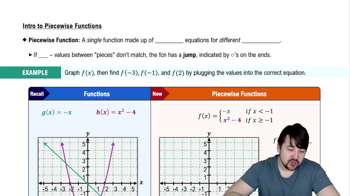
Piecewise Functions

A piecewise function is defined by different expressions based on the input value. In this case, the function f(x) has two distinct expressions: f(x) = 5 for x ≤ 2 and f(x) = 3x - 1 for x > 2. Understanding how to evaluate piecewise functions is crucial for determining the area under the curve accurately across the specified interval.
추천 영상:
05:36
Piecewise Functions

Geometric Interpretation of Integrals

The geometric interpretation of integrals involves visualizing the area under the curve of a function. By sketching the graph of the integrand, one can identify the regions contributing to the integral's value. This approach allows for a more intuitive understanding of the integral as the total area, rather than relying solely on algebraic methods like Riemann sums.
추천 영상:
가이드 코스
04:18
Geometric Sequences - Recursive Formula
관련 실천
교과서 질문

Area Find (i) the net area and (ii) the area of the following regions. Graph the function and indicate the region in question.


The region bounded by y = 6 cos 𝓍 and the 𝓍-axis between 𝓍 = ―π/2 and 𝓍 = π

103
views
교과서 질문

Average distance on a parabola What is the average distance between the parabola y = 30𝓍 (20 ― 𝓍 ) and the 𝓍-axis on the interval [0, 20] ?

123
views
교과서 질문

Evaluating integrals Evaluate the following integrals.


∫₁⁴ ((√v + v) / v ) dv

70
views
교과서 질문

Consider the function

ƒ(t) = { t      if  ―2 ≤ t < 0

t²/2    if    0 ≤ t ≤ 2                                                                                                                                                                       

and its graph shown below. Let F(𝓍) = ∫₋₁ˣ ƒ(t) dt and G(𝓍) = ∫₋₂ˣ ƒ(t) dt.

(f) Find a constant C such that F(𝓍) = G(𝓍) + C .

48
views
교과서 질문

Evaluating integrals Evaluate the following integrals.


∫₀⁵ |2𝓍―8|d𝓍

49
views
교과서 질문

Variations on the substitution method Evaluate the following integrals.                                                                                                        


 ∫ (eˣ ― e⁻ˣ)/ (eˣ + e⁻ˣ) d𝓍

42
views