Ch. 5 - Integration
Briggs - Calculus: Early Transcendentals 3rd Edition
Briggs3rd EditionCalculus: Early TranscendentalsISBN: 9780136847243당신이 사용하는 게 아니라요?교과서 변경
5장, 문제 5.3.47

Definite integrals Evaluate the following integrals using the Fundamental Theorem of Calculus


∫₁² 3/t dt

검증된 단계별 안내
1
Step 1: Identify the integral to be evaluated. The problem asks us to compute the definite integral ∫₁² (3/t) dt using the Fundamental Theorem of Calculus.
Step 2: Recall the Fundamental Theorem of Calculus, which states that if F(x) is an antiderivative of f(x), then ∫ₐᵇ f(x) dx = F(b) - F(a).
Step 3: Find the antiderivative of the integrand 3/t. The antiderivative of 1/t is ln|t|, so the antiderivative of 3/t is 3 * ln|t|.
Step 4: Apply the Fundamental Theorem of Calculus. Substitute the limits of integration into the antiderivative: F(2) - F(1), where F(t) = 3 * ln|t|.
Step 5: Simplify the expression by evaluating 3 * ln|2| - 3 * ln|1|. Note that ln|1| equals 0, so the result simplifies further.

비슷한 문제에 대한 검증된 영상 답변:

이 영상 해법은 위 문제에 도움이 된다고 튜터들이 추천한 것입니다.
영상 길이:
1m
도움이 되었나요?

주요 개념

질문에 올바르게 답하기 위해 반드시 이해해야 하는 핵심 개념들은 다음과 같습니다.

Definite Integrals

Definite integrals represent the signed area under a curve between two specified limits. They are calculated using the integral symbol with lower and upper bounds, indicating the interval over which the function is evaluated. The result of a definite integral is a numerical value that quantifies this area, which can be interpreted in various contexts, such as physics and economics.
추천 영상:
05:43
Definition of the Definite Integral

Fundamental Theorem of Calculus

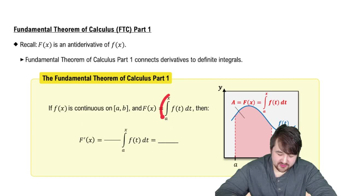
The Fundamental Theorem of Calculus links differentiation and integration, providing a method to evaluate definite integrals. It states that if a function is continuous on an interval, the integral of its derivative over that interval equals the difference in the values of the original function at the endpoints. This theorem allows us to compute definite integrals by finding an antiderivative of the integrand.
추천 영상:
06:11
Fundamental Theorem of Calculus Part 1

Antiderivatives

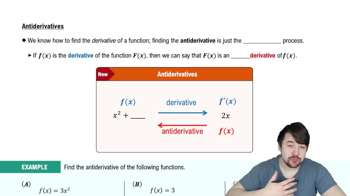
An antiderivative of a function is another function whose derivative is the original function. Finding an antiderivative is essential for evaluating definite integrals using the Fundamental Theorem of Calculus. For example, if we need to integrate a function like 3/t, we seek a function whose derivative gives us 3/t, which in this case is 3 ln|t|. Evaluating the definite integral then involves substituting the limits into this antiderivative.
추천 영상:
05:50
Antiderivatives
관련 실천
교과서 질문

Definite integrals Evaluate the following integrals using the Fundamental Theorem of Calculus. Explain why your result is consistent with the figure.


∫₀¹ (𝓍² ― 2𝓍 + 3) d𝓍


132
views
교과서 질문

Displacement from velocity The following functions describe the velocity of a car (in mi/hr) moving along a straight highway for a 3-hr interval. In each case, find the function that gives the displacement of the car over the interval [0,t], where 0 ≤ t ≤ 3.

v(t) = { 30 if 0 ≤ t ≤ 2

50 if 2 < t < 2.5

44 if 2.5 < t ≤ 3

98
views
교과서 질문

Multiple substitutions If necessary, use two or more substitutions to find the following integrals.                                                                                    


  ∫ 𝓍 sin⁴ 𝓍² cos 𝓍² d𝓍 (Hint: Begin with u = 𝓍², and then use v = sin u .)

48
views
교과서 질문

Determine the intervals on which the function g(𝓍) = ∫ₓ⁰ t / (t² + 1) dt  is concave up or concave down.

49
views

교과서 질문

Evaluate


lim [ ∫₂ˣ √(t² + t + 3dt) ] / (𝓍² ―4)

𝓍→2

45
views
교과서 질문

Definite integrals Evaluate the following integrals using the Fundamental Theorem of Calculus


∫₁² (z² + 4) / z dz

116
views