Ch. 5 - Integration
5์žฅ, ๋ฌธ์ œ 5.3.100

Determine the intervals on which the function g(๐“) = โˆซโ‚“โฐ t / (tยฒ + 1) dt  is concave up or concave down.

๊ฒ€์ฆ๋œ ๋‹จ๊ณ„๋ณ„ ์•ˆ๋‚ด
1
Step 1: Recognize that the function g(๐“) is defined as a definite integral with a variable upper limit. This means g(๐“) is a function whose derivative can be found using the Fundamental Theorem of Calculus. Specifically, g'(๐“) = ๐“ / (๐“ยฒ + 1).
Step 2: To determine concavity, calculate the second derivative g''(๐“). Differentiate g'(๐“) = ๐“ / (๐“ยฒ + 1) using the quotient rule: g''(๐“) = [(๐“ยฒ + 1)(1) - ๐“(2๐“)] / (๐“ยฒ + 1)ยฒ.
Step 3: Simplify g''(๐“). The numerator becomes (๐“ยฒ + 1) - 2๐“ยฒ = 1 - ๐“ยฒ. Thus, g''(๐“) = (1 - ๐“ยฒ) / (๐“ยฒ + 1)ยฒ.
Step 4: Analyze the sign of g''(๐“) to determine concavity. The numerator (1 - ๐“ยฒ) is positive when ๐“ยฒ < 1 (i.e., -1 < ๐“ < 1) and negative when ๐“ยฒ > 1 (i.e., ๐“ < -1 or ๐“ > 1). The denominator (๐“ยฒ + 1)ยฒ is always positive.
Step 5: Conclude that g(๐“) is concave up on the interval (-1, 1) where g''(๐“) > 0, and concave down on the intervals (-โˆž, -1) and (1, โˆž) where g''(๐“) < 0.

๋น„์Šทํ•œ ๋ฌธ์ œ์— ๋Œ€ํ•œ ๊ฒ€์ฆ๋œ ์˜์ƒ ๋‹ต๋ณ€:

์ด ์˜์ƒ ํ•ด๋ฒ•์€ ์œ„ ๋ฌธ์ œ์— ๋„์›€์ด ๋œ๋‹ค๊ณ  ํŠœํ„ฐ๋“ค์ด ์ถ”์ฒœํ•œ ๊ฒƒ์ž…๋‹ˆ๋‹ค.
์˜์ƒ ๊ธธ์ด:
5m
๋„์›€์ด ๋˜์—ˆ๋‚˜์š”?

์ฃผ์š” ๊ฐœ๋…

์งˆ๋ฌธ์— ์˜ฌ๋ฐ”๋ฅด๊ฒŒ ๋‹ตํ•˜๊ธฐ ์œ„ํ•ด ๋ฐ˜๋“œ์‹œ ์ดํ•ดํ•ด์•ผ ํ•˜๋Š” ํ•ต์‹ฌ ๊ฐœ๋…๋“ค์€ ๋‹ค์Œ๊ณผ ๊ฐ™์Šต๋‹ˆ๋‹ค.

Concavity

Concavity refers to the direction in which a function curves. A function is concave up on an interval if its second derivative is positive, indicating that the slope of the tangent line is increasing. Conversely, it is concave down if the second derivative is negative, meaning the slope is decreasing. Understanding concavity helps in analyzing the behavior of functions and their graphs.
์ถ”์ฒœ ์˜์ƒ:
05:59
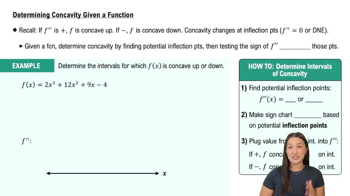
Determining Concavity Given a Function

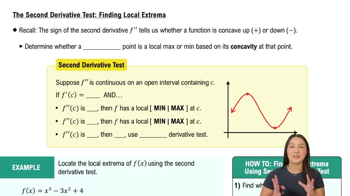
Second Derivative Test

The second derivative test is a method used to determine the concavity of a function. By taking the second derivative of a function, we can assess where the function is concave up or down. If the second derivative is positive at a point, the function is concave up; if negative, it is concave down. This test is crucial for identifying intervals of concavity in the given function.
์ถ”์ฒœ ์˜์ƒ:
06:02
The Second Derivative Test: Finding Local Extrema

Fundamental Theorem of Calculus

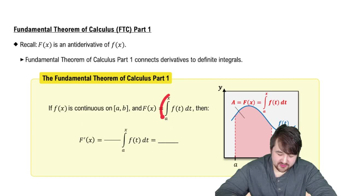
The Fundamental Theorem of Calculus connects differentiation and integration, stating that if a function is defined as an integral, its derivative can be found using the integrand evaluated at the upper limit. In this case, the function g(x) is defined as an integral, and understanding how to differentiate it will allow us to find the first and second derivatives necessary for analyzing concavity.
์ถ”์ฒœ ์˜์ƒ:
06:11
Fundamental Theorem of Calculus Part 1
๊ด€๋ จ ์‹ค์ฒœ
๊ต๊ณผ์„œ ์งˆ๋ฌธ

Limits of sums Use the definition of the definite integral to evaluate the following definite integrals. Use right Riemann sums and Theorem 5.1.


โˆซโ‚ƒโท (4๐“ + 6) d๐“

104
views
๊ต๊ณผ์„œ ์งˆ๋ฌธ

Identifying Riemann sums Fill in the blanks with an interval and a value of n.


4

โˆ‘ ฦ’ (1.5 + k) โ€ข 1 is a midpoint Riemann sum for f on the interval [ ___ , ___ ]

k = 1

with n = ________ .

63
views
๊ต๊ณผ์„œ ์งˆ๋ฌธ

Multiple substitutions If necessary, use two or more substitutions to find the following integrals.                                                                                    


  โˆซ d๐“ / [โˆš1 + โˆš(1 + ๐“)] (Hint: Begin with u = โˆš(1 + ๐“ .)  

119
views
๊ต๊ณผ์„œ ์งˆ๋ฌธ

Evaluate


lim [ โˆซโ‚‚หฃ โˆš(tยฒ + t + 3dt) ] / (๐“ยฒ โ€•4)

๐“โ†’2

45
views
๊ต๊ณผ์„œ ์งˆ๋ฌธ

Definite integrals Evaluate the following integrals using the Fundamental Theorem of Calculus


โˆซโ‚ยฒ (zยฒ + 4) / z dz

116
views
๊ต๊ณผ์„œ ์งˆ๋ฌธ

Definite integrals Evaluate the following integrals using the Fundamental Theorem of Calculus


โˆซโ‚ยฒ 3/t dt

95
views