

Ch. 5 - Integration
Briggs - Calculus: Early Transcendentals 3rd Edition
Briggs3rd EditionCalculus: Early TranscendentalsISBN: 9780136847243당신이 사용하는 게 아니라요?교과서 변경
5장, 문제 5.R.71

Evaluating integrals Evaluate the following integrals.


∫₋₅⁵ ω³ /√(ω⁵⁰ + ω²⁰ + 1) dω (Hint: Use symmetry . )

검증된 단계별 안내
1
Recognize that the integral has symmetric limits of integration (-5 to 5) and analyze the integrand for symmetry. Specifically, check if the function is odd or even. A function f(ω) is odd if f(-ω) = -f(ω), and even if f(-ω) = f(ω).
Substitute -ω into the integrand to test for symmetry. The numerator ω³ changes sign to (-ω)³ = -ω³, while the denominator √(ω⁵⁰ + ω²⁰ + 1) remains unchanged because all powers of ω in the denominator are even.
Conclude that the integrand is an odd function because the numerator changes sign while the denominator does not. For an odd function integrated over symmetric limits (-a to a), the integral evaluates to 0.
Use the property of definite integrals for odd functions over symmetric intervals: ∫₋ₐᵃ f(ω) dω = 0. Apply this property to the given integral.
State that the integral evaluates to 0 due to the symmetry of the integrand and the odd function property over symmetric limits.

비슷한 문제에 대한 검증된 영상 답변:

이 영상 해법은 위 문제에 도움이 된다고 튜터들이 추천한 것입니다.
영상 길이:
2m
도움이 되었나요?

주요 개념

질문에 올바르게 답하기 위해 반드시 이해해야 하는 핵심 개념들은 다음과 같습니다.

Definite Integrals

A definite integral represents the signed area under a curve between two specified limits. It is denoted as ∫[a, b] f(x) dx, where 'a' and 'b' are the lower and upper limits, respectively. Evaluating definite integrals often involves finding the antiderivative of the function and applying the Fundamental Theorem of Calculus.
추천 영상:
05:43
Definition of the Definite Integral

Symmetry in Integrals

Symmetry in integrals refers to the property that certain functions exhibit even or odd characteristics. An even function satisfies f(-x) = f(x), while an odd function satisfies f(-x) = -f(x). When integrating over symmetric limits, such as from -a to a, the integral of an odd function is zero, which can simplify calculations significantly.
추천 영상:
06:18
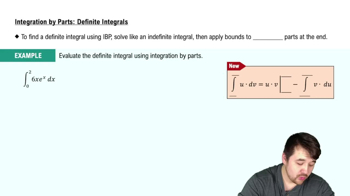
Integration by Parts for Definite Integrals

Substitution Method

The substitution method is a technique used to simplify the process of evaluating integrals. It involves changing the variable of integration to make the integral easier to solve. This is particularly useful when the integrand contains composite functions or complicated expressions, allowing for a more straightforward integration process.
추천 영상:
07:33
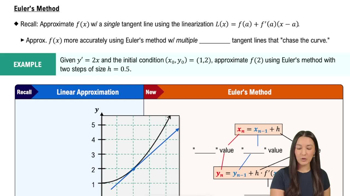
Euler's Method
관련 실천
교과서 질문

Evaluating integrals Evaluate the following integrals.


∫π/₁₂^π/⁹ (csc 3𝓍 cot 3𝓍 + sec 3𝓍 tan 3𝓍) d𝓍

42
views
교과서 질문

Displacement from velocity A particle moves along a line with a velocity given by v(t) = 5 sin πt, starting with an initial position s(0) = 0 . Find the displacement of the particle between t = 0 and t = 2 , which is given by s(t) = ∫₀² v(t) dt . Find the distance traveled by the particle during this interval, which is ∫₀² |v(t)| dt .

194
views
교과서 질문

Use geometry and properties of integrals to evaluate the following definite integrals.                                                                                          


 ∫₀⁴ √(8𝓍―𝓍²) d𝓍 . (Hint: Complete the square .)

98
views
교과서 질문

Area functions and the Fundamental Theorem Consider the function

ƒ(t) = { t      if  ―2 ≤ t < 0

t²/2    if    0 ≤ t ≤ 2

and its graph shown below. Let F(𝓍) = ∫₋₁ˣ ƒ(t) dt and G(𝓍) = ∫₋₂ˣ ƒ(t) dt.

(c) Use the Fundamental Theorem to find an expression for F '(𝓍) for 0 ≤ 𝓍 < 2.

57
views
교과서 질문

Evaluating integrals Evaluate the following integrals.


∫₋π/₂^π/² (cos 2𝓍 + cos 𝓍 sin 𝓍 ― 3 sin 𝓍⁵) d𝓍

71
views
교과서 질문

Evaluating integrals Evaluate the following integrals.                                                                                                                                         


 ∫ y² (3y³ + 1)⁴ dy

70
views