
Ch. 5 - Integration
Briggs - Calculus: Early Transcendentals 3rd Edition
Briggs3rd EditionCalculus: Early TranscendentalsISBN: 9780136847243당신이 사용하는 게 아니라요?교과서 변경
5장, 문제 5.R.1b

Explain why or why not Determine whether the following statements are true and give an explanation or counterexample. Assume ƒ and ƒ' are continuous functions for all real numbers.
(b) Given an area function A(𝓍) = ∫ₐˣ ƒ(t) dt and an antiderivative F of ƒ, it follows that A'(𝓍) = F(𝓍) .

검증된 단계별 안내
1
Step 1: Begin by understanding the problem. The area function A(𝓍) = ∫ₐˣ ƒ(t) dt represents the accumulated area under the curve of ƒ(t) from a fixed point 'a' to a variable point '𝓍'. The goal is to determine whether A'(𝓍) = F(𝓍), where F is an antiderivative of ƒ.
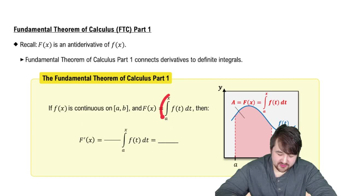
Step 2: Recall the Fundamental Theorem of Calculus, Part 1. It states that if ƒ is continuous on [a, 𝓍], then the derivative of the area function A(𝓍) with respect to 𝓍 is equal to the value of the integrand at 𝓍. Mathematically, A'(𝓍) = ƒ(𝓍).
Step 3: Understand the relationship between an antiderivative and the integrand. An antiderivative F of ƒ satisfies F'(𝓍) = ƒ(𝓍). This means that F is a function whose derivative is ƒ.
Step 4: Compare A'(𝓍) = ƒ(𝓍) (from the Fundamental Theorem of Calculus) with the statement A'(𝓍) = F(𝓍). Since F'(𝓍) = ƒ(𝓍), the statement A'(𝓍) = F(𝓍) is incorrect unless F(𝓍) = ƒ(𝓍), which is not generally true. A'(𝓍) equals ƒ(𝓍), not F(𝓍).
Step 5: Provide a counterexample to clarify. Consider ƒ(𝓍) = 𝓍². The area function A(𝓍) = ∫ₐˣ 𝓉² dt has a derivative A'(𝓍) = 𝓍². However, an antiderivative F(𝓍) of ƒ(𝓍) could be F(𝓍) = (1/3)𝓍³ + C, which is not equal to ƒ(𝓍). This demonstrates that the statement A'(𝓍) = F(𝓍) is false.

비슷한 문제에 대한 검증된 영상 답변:

이 영상 해법은 위 문제에 도움이 된다고 튜터들이 추천한 것입니다.
영상 길이:
1m
도움이 되었나요?

주요 개념

질문에 올바르게 답하기 위해 반드시 이해해야 하는 핵심 개념들은 다음과 같습니다.

Fundamental Theorem of Calculus

The Fundamental Theorem of Calculus connects differentiation and integration, stating that if F is an antiderivative of a continuous function f on an interval [a, b], then the integral of f from a to x is given by A(x) = ∫ₐˣ f(t) dt = F(x) - F(a). This theorem implies that the derivative of the area function A(x) is equal to the original function f evaluated at x, i.e., A'(x) = f(x).
추천 영상:
06:11
Fundamental Theorem of Calculus Part 1

Area Function

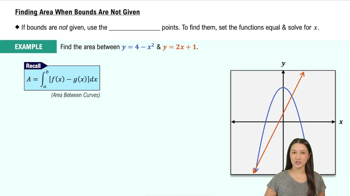
An area function A(x) represents the accumulated area under the curve of a function f from a fixed point a to a variable point x. Mathematically, it is defined as A(x) = ∫ₐˣ f(t) dt. This function is crucial in understanding how the total area changes as x varies, and its derivative A'(x) gives the instantaneous rate of change of this area, which corresponds to the value of the function f at that point.
추천 영상:
05:06
Finding Area When Bounds Are Not Given

Antiderivative

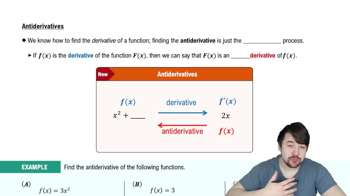
An antiderivative F of a function f is a function whose derivative is f, meaning F' = f. Antiderivatives are essential in calculus as they allow us to reverse the process of differentiation. In the context of the area function, if F is an antiderivative of f, then the area function A(x) can be expressed in terms of F, leading to the conclusion that A'(x) = F'(x) = f(x).
추천 영상:
05:50
Antiderivatives
관련 실천
교과서 질문

Evaluating integrals Evaluate the following integrals.                                                                                                                                         


 ∫ sin 𝒵 sin (cos 𝒵) d𝒵

56
views
교과서 질문

Evaluating integrals Evaluate the following integrals.


∫₀² (2𝓍 + 1)³ d𝓍

109
views
교과서 질문

Limits with integrals Evaluate the following limits.


lim ∫₂ˣ eᵗ² dt

𝓍→2 ---------------

𝓍 ― 2

62
views
교과서 질문

Evaluating integrals Evaluate the following integrals.                                                                                                                                         


 ∫ y² /(y³ + 27) dy

70
views
교과서 질문

Explain why or why not Determine whether the following statements are true and give an explanation or counterexample. Assume ƒ and ƒ' are continuous functions for all real numbers.

(f) ∫ₐᵇ (2 ƒ(𝓍) ―3g (𝓍)) d𝓍 = 2 ∫ₐᵇ ƒ(𝓍) d𝓍 + 3 ∫₆ᵃ g(𝓍) d𝓍 .

37
views
교과서 질문

Evaluating integrals Evaluate the following integrals.                                                                                                                                         


 ∫ (cos 7ω) /(16 + sin² 7ω) dω 

71
views