
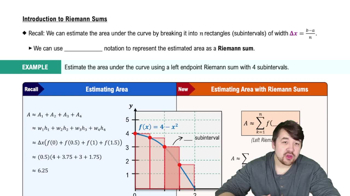


Ch. 5 - Integration
5์žฅ, ๋ฌธ์ œ 5.R.9c

Integration by Riemann sums Consider the integral โˆซโ‚โด (3๐“โ€• 2) d๐“.


(c) Evaluate the definite integral by taking the limit as n โ†’โˆž of the Riemann sum in part (b).

๊ฒ€์ฆ๋œ ๋‹จ๊ณ„๋ณ„ ์•ˆ๋‚ด
1
Step 1: Recall the formula for the Riemann sum approximation of a definite integral. Divide the interval [1, 4] into n subintervals of equal width ฮ”๐“ = (4 - 1)/n = 3/n.
Step 2: Identify the sample points within each subinterval. For simplicity, use the right endpoints of each subinterval: ๐“แตข = 1 + iฮ”๐“, where i ranges from 1 to n.
Step 3: Write the Riemann sum for the function f(๐“) = 3๐“ - 2 over the interval [1, 4]. The sum is given by Sโ‚™ = ฮฃแตขโ‚Œโ‚โฟ f(๐“แตข)ฮ”๐“, where f(๐“แตข) = 3๐“แตข - 2 and ฮ”๐“ = 3/n.
Step 4: Substitute ๐“แตข = 1 + iฮ”๐“ and ฮ”๐“ = 3/n into the Riemann sum. This gives Sโ‚™ = ฮฃแตขโ‚Œโ‚โฟ [(3(1 + i(3/n)) - 2)(3/n)]. Simplify the expression inside the summation.
Step 5: Take the limit as n โ†’ โˆž of the Riemann sum Sโ‚™. Use the properties of summation and limits to evaluate the sum, which will yield the value of the definite integral โˆซโ‚โด (3๐“ - 2) d๐“.

๋น„์Šทํ•œ ๋ฌธ์ œ์— ๋Œ€ํ•œ ๊ฒ€์ฆ๋œ ์˜์ƒ ๋‹ต๋ณ€:

์ด ์˜์ƒ ํ•ด๋ฒ•์€ ์œ„ ๋ฌธ์ œ์— ๋„์›€์ด ๋œ๋‹ค๊ณ  ํŠœํ„ฐ๋“ค์ด ์ถ”์ฒœํ•œ ๊ฒƒ์ž…๋‹ˆ๋‹ค.
์˜์ƒ ๊ธธ์ด:
5m
๋„์›€์ด ๋˜์—ˆ๋‚˜์š”?

์ฃผ์š” ๊ฐœ๋…

์งˆ๋ฌธ์— ์˜ฌ๋ฐ”๋ฅด๊ฒŒ ๋‹ตํ•˜๊ธฐ ์œ„ํ•ด ๋ฐ˜๋“œ์‹œ ์ดํ•ดํ•ด์•ผ ํ•˜๋Š” ํ•ต์‹ฌ ๊ฐœ๋…๋“ค์€ ๋‹ค์Œ๊ณผ ๊ฐ™์Šต๋‹ˆ๋‹ค.

Riemann Sums

Riemann sums are a method for approximating the value of a definite integral by dividing the area under a curve into small rectangles. The sum of the areas of these rectangles provides an estimate of the integral. As the number of rectangles increases (n โ†’ โˆž) and their width decreases, the Riemann sum approaches the exact value of the integral.
์ถ”์ฒœ ์˜์ƒ:

Definite Integral

A definite integral represents the signed area under a curve between two specified limits, in this case, from 1 to 4. It is denoted as โˆซโ‚แต‡ f(x) dx, where f(x) is the function being integrated. The value of a definite integral can be interpreted as the accumulation of quantities, such as area, over the interval [a, b].
์ถ”์ฒœ ์˜์ƒ:
๊ฐ€์ด๋“œ ์ฝ”์Šค
05:43
Definition of the Definite Integral

Limit Process

The limit process in calculus involves evaluating the behavior of a function as it approaches a certain point or value. In the context of Riemann sums, taking the limit as n approaches infinity allows us to refine our approximation of the integral, leading to the exact value. This process is fundamental in defining the concept of integration in calculus.
์ถ”์ฒœ ์˜์ƒ:
05:50
One-Sided Limits
๊ด€๋ จ ์‹ค์ฒœ
๊ต๊ณผ์„œ ์งˆ๋ฌธ

Limit definition of the definite integral Use the limit definition of the definite integral with right Riemann sums and a regular partition to evaluate the following definite integrals. Use the Fundamental Theorem of Calculus to check your answer. 


โˆซโ‚€ยฒ (๐“ยฒโ€•4) d๐“

155
views
๊ต๊ณผ์„œ ์งˆ๋ฌธ

Use geometry and properties of integrals to evaluate the following definite integrals.

โˆซโ‚„โฐ (2๐“ + โˆš(16โ€•๐“ยฒ)) d๐“ . (Hint: Write the integral as sum of two integrals.)

114
views
๊ต๊ณผ์„œ ์งˆ๋ฌธ

Area functions and the Fundamental Theorem Consider the function

ฦ’(t) = { t      if  โ€•2 โ‰ค t < 0

tยฒ/2    if    0 โ‰ค t โ‰ค 2

and its graph shown below. Let F(๐“) = โˆซโ‚‹โ‚หฃ ฦ’(t) dt and G(๐“) = โˆซโ‚‹โ‚‚หฃ ฦ’(t) dt.

(b) Use the Fundamental Theorem to find an expression for F '(๐“) for โ€•2 โ‰ค ๐“ < 0.

60
views
๊ต๊ณผ์„œ ์งˆ๋ฌธ

Evaluating integrals Evaluate the following integrals.                                                                                                                                         


 โˆซ yยฒ /(yยณ + 27) dy

70
views
๊ต๊ณผ์„œ ์งˆ๋ฌธ

Explain why or why not Determine whether the following statements are true and give an explanation or counterexample. Assume ฦ’ and ฦ’' are continuous functions for all real numbers.

(f) โˆซโ‚แต‡ (2 ฦ’(๐“) โ€•3g (๐“)) d๐“ = 2 โˆซโ‚แต‡ ฦ’(๐“) d๐“ + 3 โˆซโ‚†แตƒ g(๐“) d๐“ .

37
views
๊ต๊ณผ์„œ ์งˆ๋ฌธ

Explain why or why not Determine whether the following statements are true and give an explanation or counterexample. Assume ฦ’ and ฦ’' are continuous functions for all real numbers.

(b) Given an area function A(๐“) = โˆซโ‚หฃ ฦ’(t) dt and an antiderivative F of ฦ’, it follows that A'(๐“) = F(๐“) .

46
views