Ch. 5 - Integration
Briggs - Calculus: Early Transcendentals 3rd Edition
Briggs3rd EditionCalculus: Early TranscendentalsISBN: 9780136847243당신이 사용하는 게 아니라요?교과서 변경
5장, 문제 5.4.59b

Generalizing the Mean Value Theorem for Integrals Suppose ƒ and g are continuous on [a, b] and let h(𝓍) = (𝓍―b) ∫ₐˣ ƒ(t) dt + (𝓍―a) ∫ₓᵇg(t)dt.                                                                                                                                                                                                                                                                                                                                
(b) Show that there is a number c in (a, b) such that ∫ₐᶜ ƒ(t) dt = ƒ(c) (b ― c)                                                                                                              
                                                                                                                                                                                
(Source: The College Mathematics Journal, 33, 5, Nov 2002)

검증된 단계별 안내
1
Start by recalling the given function: \(h(\mathcal{x}) = (\mathcal{x} - b) \int_a^{\mathcal{x}} f(t) \, dt + (\mathcal{x} - a) \int_{\mathcal{x}}^b g(t) \, dt\). We are asked to show that there exists a \(c \in (a,b)\) such that \(\int_a^c f(t) \, dt = f(c)(b - c)\).
Focus on the part of the problem involving \(f\). Consider the function \(H(x) = (x - b) \int_a^x f(t) \, dt\). Notice that this is part of \(h(x)\) and involves the integral of \(f\) from \(a\) to \(x\).
Differentiate \(H(x)\) with respect to \(x\) using the product rule and the Fundamental Theorem of Calculus. Recall that if \(F(x) = \int_a^x f(t) \, dt\), then \(F'(x) = f(x)\). So, \(H'(x) = \frac{d}{dx} \left[(x - b) F(x)\right] = F(x) + (x - b) f(x)\).
Set \(H'(c) = 0\) for some \(c \in (a,b)\) to find a critical point. This gives the equation: \(F(c) + (c - b) f(c) = 0\). Rewrite this as: \(\int_a^c f(t) \, dt = f(c)(b - c)\), which is exactly what we want to prove.
To justify the existence of such a \(c\), apply Rolle's Theorem or the Mean Value Theorem to \(H(x)\) on \([a,b]\). Since \(H(a) = H(b) = 0\), there must be some \(c \in (a,b)\) where \(H'(c) = 0\), completing the proof.

비슷한 문제에 대한 검증된 영상 답변:

이 영상 해법은 위 문제에 도움이 된다고 튜터들이 추천한 것입니다.
영상 길이:
4m
도움이 되었나요?

주요 개념

질문에 올바르게 답하기 위해 반드시 이해해야 하는 핵심 개념들은 다음과 같습니다.

Mean Value Theorem for Integrals

This theorem states that if a function is continuous on [a, b], there exists a point c in (a, b) where the integral average equals the function value, i.e., ∫ₐᵇ f(t) dt = f(c)(b - a). It connects the average value of a function over an interval to a specific function value inside that interval.
추천 영상:
가이드 코스
06:11
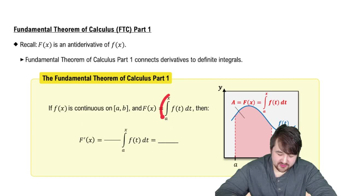
Fundamental Theorem of Calculus Part 1

Fundamental Theorem of Calculus

This theorem links differentiation and integration, stating that if F(x) = ∫ₐˣ f(t) dt, then F'(x) = f(x). It allows us to differentiate integral expressions and is essential for analyzing functions defined by integrals, like h(x) in the problem.
추천 영상:
가이드 코스
06:11
Fundamental Theorem of Calculus Part 1

Continuity and Intermediate Value Property

Continuity of functions f and g on [a, b] ensures the integrals and constructed functions are well-behaved. The Intermediate Value Theorem guarantees the existence of points where certain equalities hold, which is crucial for proving the existence of c satisfying the given integral equation.
추천 영상:
가이드 코스
06:21
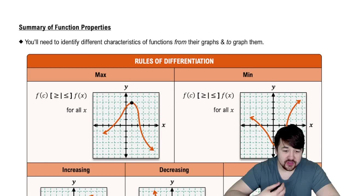
Properties of Functions
관련 실천
교과서 질문

{Use of Tech} Functions defined by integrals Consider the function g, which is given in terms of a definite integral with a variable upper limit.


(b) Calculate g'(𝓍)


g(𝓍) = ∫₀ˣ sin (πt² ) dt ( a Fresnel integral) 

69
views

교과서 질문

Explain why or why not Determine whether the following statements are true and give an explanation or counterexample. Assume ƒ, ƒ', and ƒ'' are continuous functions for all real numbers.                                                                                                                                                           


(b) ∫ (ƒ(𝓍))ⁿ ƒ'(𝓍) d𝓍 = 1/(n + 1) (ƒ(𝓍))ⁿ⁺¹ + C , n ≠ ―1 .

45
views
교과서 질문

Using properties of integrals Use the value of the first integral I to evaluate the two given integrals. 

I = ∫₀^π/2 (cos θ ― 2 sin θ) dθ = ―1

(b) ∫₀^π/2 (4 cos θ ― 8 sin θ) dθ

77
views
교과서 질문

Substitutions Suppose ƒ is an even function with ∫₀⁸ ƒ(𝓍) d𝓍 = 9 . Evaluate each integral.                                                                                                       

(b) ∫²₋₂ 𝓍²ƒ(𝓍³) d𝓍

44
views
교과서 질문

Working with area functions Consider the function ƒ and its graph.

(b) Estimate the points (if any) at which A has a local maximum or minimum.


52
views
교과서 질문

Area functions for constant functions Consider the following functions ƒ and real numbers a (see figure).

(b) Verify that .A'(𝓍) = ƒ(𝓍)


ƒ(t) = 5 , a = -5

62
views