Ch. 5 - Integration
Briggs - Calculus: Early Transcendentals 3rd Edition
Briggs3rd EditionCalculus: Early TranscendentalsISBN: 9780136847243당신이 사용하는 게 아니라요?교과서 변경
5장, 문제 5.2.83

Limits of sums Use the definition of the definite integral to evaluate the following definite integrals. Use right Riemann sums and Theorem 5.1.


∫₁⁴ (𝓍²―1) d𝓍

검증된 단계별 안내
1
Step 1: Recall the definition of the definite integral using Riemann sums. The definite integral ∫ₐᵇ f(x) dx can be approximated by a sum: lim(n→∞) Σᵢ₌₁ⁿ f(xᵢ)Δx, where Δx = (b - a)/n and xᵢ = a + iΔx for right Riemann sums.
Step 2: Identify the function f(x) = x² - 1, the interval [1, 4], and the number of subintervals n. Calculate Δx = (4 - 1)/n = 3/n.
Step 3: Determine the sample points xᵢ for the right Riemann sum. For i = 1, 2, ..., n, xᵢ = 1 + iΔx = 1 + i(3/n).
Step 4: Substitute f(xᵢ) and Δx into the Riemann sum formula. The sum becomes Σᵢ₌₁ⁿ [(xᵢ² - 1) * Δx], where xᵢ = 1 + i(3/n) and Δx = 3/n.
Step 5: Simplify the expression for the sum and take the limit as n → ∞ to evaluate the definite integral. This involves expanding (1 + i(3/n))², simplifying the summation, and using summation formulas for i and i².

비슷한 문제에 대한 검증된 영상 답변:

이 영상 해법은 위 문제에 도움이 된다고 튜터들이 추천한 것입니다.
영상 길이:
7m

주요 개념

질문에 올바르게 답하기 위해 반드시 이해해야 하는 핵심 개념들은 다음과 같습니다.

Definite Integral

A definite integral represents the signed area under a curve defined by a function over a specific interval. It is denoted as ∫_a^b f(x) dx, where 'a' and 'b' are the limits of integration. The value of the definite integral can be interpreted as the accumulation of quantities, such as area, over the interval from 'a' to 'b'.
추천 영상:
가이드 코스
05:43
Definition of the Definite Integral

Riemann Sums

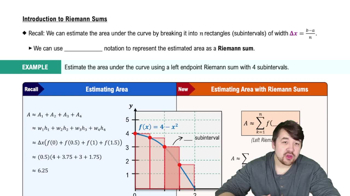
Riemann sums are a method for approximating the value of a definite integral by dividing the area under a curve into rectangles. The sum of the areas of these rectangles, calculated using sample points (like right endpoints), provides an estimate of the integral. As the number of rectangles increases and their width decreases, the Riemann sum approaches the exact value of the definite integral.
추천 영상:
가이드 코스
06:11
Introduction to Riemann Sums

Theorem 5.1 (Fundamental Theorem of Calculus)

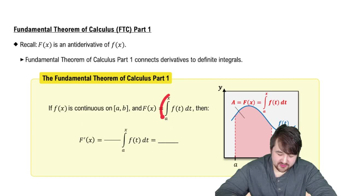
The Fundamental Theorem of Calculus connects differentiation and integration, stating that if a function is continuous on [a, b], then the definite integral of its derivative over that interval equals the difference in the values of the function at the endpoints. This theorem provides a powerful tool for evaluating definite integrals and establishes the relationship between the antiderivative and the area under the curve.
추천 영상:
가이드 코스
06:11
Fundamental Theorem of Calculus Part 1
관련 실천
교과서 질문

Use symmetry to explain why.

∫⁴₋₄ (5𝓍⁴ + 3𝓍³ + 2𝓍² + 𝓍 + 1) d𝓍 = 2 ∫₀⁴ (5𝓍⁴ + 2𝓍² + 𝓍 + 1) d𝓍 .

52
views

교과서 질문

Variations on the substitution method Evaluate the following integrals.                                                                                                        


 ∫ (𝒵 + 1) √(3𝒵 + 2) d𝒵

68
views
교과서 질문

Definite integrals Use a change of variables or Table 5.6 to evaluate the following definite integrals.                                                                                                                         


 ∫₂/₍₅√₃₎^²/⁵ d𝓍/ x√(25𝓍²― 1)

38
views
교과서 질문

Gateway Arch The Gateway Arch in St. Louis is 630 ft high and has a 630-ft base. Its shape can be modeled by the parabola y = 630 (1― (𝓍/315)²) . Find the average height of the arch above the ground.

469
views
교과서 질문

Limits of sums Use the definition of the definite integral to evaluate the following definite integrals. Use right Riemann sums and Theorem 5.1.


∫₀² (2𝓍 + 1) d𝓍

91
views
교과서 질문

Displacement from velocity The following functions describe the velocity of a car (in mi/hr) moving along a straight highway for a 3-hr interval. In each case, find the function that gives the displacement of the car over the interval [0,t], where 0 ≤ t ≤ 3.

v(t) = { 30 if 0 ≤ t ≤ 2

50 if 2 < t < 2.5

44 if 2.5 < t ≤ 3

98
views