Ch. 5 - Integration
Briggs - Calculus: Early Transcendentals 3rd Edition
Briggs3rd EditionCalculus: Early TranscendentalsISBN: 9780136847243당신이 사용하는 게 아니라요?교과서 변경
5장, 문제 5.1.73b

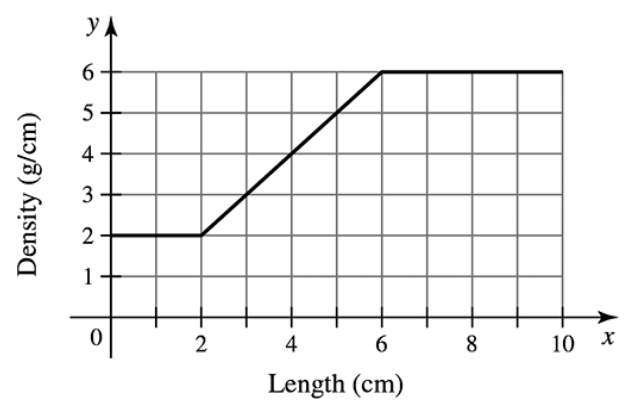
Mass from density A thin 10-cm rod is made of an alloy whose density varies along its length according to the function shown in the figure. Assume density is measured in units of g/cm. In Chapter 6, we show that the mass of the rod is the area under the density curve.
(b) Find the mass of the right half of the rod (5 ≤ x ≤ 10) .
Graph showing density in g/cm along a 10-cm rod, with varying density values plotted against length in cm.

검증된 단계별 안내
1
Step 1: Understand the problem. The mass of the rod is the area under the density curve. We are tasked with finding the mass of the right half of the rod, which corresponds to the interval 5 ≤ x ≤ 10.
Step 2: Analyze the graph. The density function is piecewise linear. From x = 5 to x = 6, the density increases linearly from 5 g/cm to 6 g/cm. From x = 6 to x = 10, the density remains constant at 6 g/cm.
Step 3: Break the interval into two subintervals: (a) x = 5 to x = 6, where the density is a linear function, and (b) x = 6 to x = 10, where the density is constant. Calculate the area under the curve for each subinterval separately.
Step 4: For the interval x = 5 to x = 6, the area is the area of a trapezoid. Use the formula for the area of a trapezoid: A = (1/2) * (base1 + base2) * height. Here, base1 = 5, base2 = 6, and height = 1 (difference in x-values).
Step 5: For the interval x = 6 to x = 10, the area is the area of a rectangle. Use the formula for the area of a rectangle: A = width * height. Here, width = 4 (difference in x-values) and height = 6 (density value). Add the areas from both subintervals to find the total mass of the right half of the rod.

비슷한 문제에 대한 검증된 영상 답변:

이 영상 해법은 위 문제에 도움이 된다고 튜터들이 추천한 것입니다.
영상 길이:
3m
도움이 되었나요?

주요 개념

질문에 올바르게 답하기 위해 반드시 이해해야 하는 핵심 개념들은 다음과 같습니다.

Density Function

A density function describes how mass is distributed along a given length. In this case, the density of the rod varies with its length, represented graphically. Understanding the density function is crucial for calculating the mass, as it provides the necessary values to integrate over the specified interval.
추천 영상:
가이드 코스
06:21
Properties of Functions

Integration

Integration is a fundamental concept in calculus used to find the area under a curve. In this context, the mass of the rod can be determined by integrating the density function over the specified interval (5 ≤ x ≤ 10). This process allows us to sum up the infinitesimal contributions of mass along the length of the rod.
추천 영상:
가이드 코스
06:18
Integration by Parts for Definite Integrals

Definite Integral

A definite integral calculates the accumulation of quantities over a specific interval. For this problem, it involves evaluating the integral of the density function from x = 5 to x = 10. The result gives the total mass of the right half of the rod, reflecting the varying density across that segment.
추천 영상:
가이드 코스
05:43
Definition of the Definite Integral
관련 실천
교과서 질문

Working with area functions Consider the function ƒ and the points a, b, and c.

(b) Graph ƒ and A.

ƒ(𝓍) = eˣ ; a = 0 , b = ln 2 , c = ln 4

50
views

교과서 질문

Area functions for linear functions Consider the following functions ƒ and real numbers a (see figure).


b) Verify that A'(𝓍) = ƒ(𝓍).


ƒ(t) = 4t + 2 , a = 0

47
views
교과서 질문

The following functions are positive and negative on the given interval.

ƒ(𝓍) = xe⁻ˣ on [-1,1]

(b) Approximate the net area bounded by the graph of f and the x-axis on the interval using a left, right, and midpoint Riemann sum with n = 4.

74
views
교과서 질문

Explain why or why not Determine whether the following statements are true and give an explanation or counterexample.                                                                          

                                                                                                                                                                                     (b) Suppose ƒ is a negative increasing function, for 𝓍 > 0 . Then the area function A(𝓍) = ∫₀ˣ ƒ(t) dt is a decreasing function of 𝓍 .

60
views
교과서 질문

{Use of Tech} Riemann sums for larger values of n Complete the following steps for the given function f and interval.


ƒ(𝓍) = x² ― 1 on [2,5] ; n = 75

(b) Based on the approximations found in part (a), estimate the area of the region bounded by the graph of f and the x-axis on the interval.

88
views
교과서 질문

{Use of Tech} Approximating net area The following functions are positive and negative on the given interval.

f(𝓍) = x³ on [-1,2]

(b) Approximate the net area bounded by the graph of f and the x-axis on the interval using a left, right, and midpoint Riemann sum with n = 4.

49
views