Ch. 5 - Integration
Briggs - Calculus: Early Transcendentals 3rd Edition
Briggs3rd EditionCalculus: Early TranscendentalsISBN: 9780136847243당신이 사용하는 게 아니라요?교과서 변경
5장, 문제 5.2.24b

{Use of Tech} Approximating net area The following functions are positive and negative on the given interval.
f(𝓍) = x³ on [-1,2]
(b) Approximate the net area bounded by the graph of f and the x-axis on the interval using a left, right, and midpoint Riemann sum with n = 4.

검증된 단계별 안내
1
Step 1: Understand the problem. You are tasked with approximating the net area bounded by the graph of f(x) = x³ and the x-axis on the interval [-1, 2] using Riemann sums (left, right, and midpoint) with n = 4 subintervals.
Step 2: Divide the interval [-1, 2] into n = 4 equal subintervals. The width of each subinterval, Δx, is calculated as Δx = (b - a) / n, where a = -1 and b = 2. Substitute the values to find Δx.
Step 3: Determine the x-values for the subintervals. For n = 4, the subintervals are [-1, -0.25], [-0.25, 0.5], [0.5, 1.25], and [1.25, 2]. Identify the left endpoints, right endpoints, and midpoints of each subinterval.
Step 4: Compute the Riemann sums. For each type of sum: (a) Left Riemann sum: Evaluate f(x) at the left endpoints of each subinterval and multiply by Δx. (b) Right Riemann sum: Evaluate f(x) at the right endpoints of each subinterval and multiply by Δx. (c) Midpoint Riemann sum: Evaluate f(x) at the midpoints of each subinterval and multiply by Δx.
Step 5: Add the contributions from each subinterval for the left, right, and midpoint Riemann sums. This will give you the approximate net area for each method. Note that the net area accounts for both positive and negative contributions of f(x) over the interval.

비슷한 문제에 대한 검증된 영상 답변:

이 영상 해법은 위 문제에 도움이 된다고 튜터들이 추천한 것입니다.
영상 길이:
4m
도움이 되었나요?

주요 개념

질문에 올바르게 답하기 위해 반드시 이해해야 하는 핵심 개념들은 다음과 같습니다.

Riemann Sums

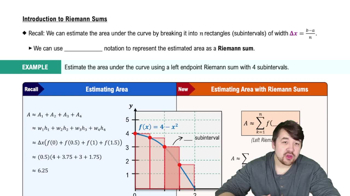
Riemann sums are a method for approximating the total area under a curve by dividing the region into smaller subintervals. Each subinterval's area is estimated using the function's value at specific points, such as the left endpoint, right endpoint, or midpoint. The sum of these areas provides an approximation of the net area between the curve and the x-axis over the specified interval.
추천 영상:
가이드 코스
06:11
Introduction to Riemann Sums

Net Area

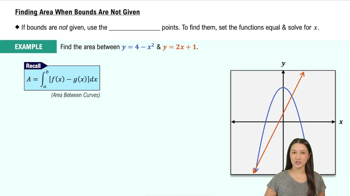
The net area refers to the total area between a curve and the x-axis, accounting for both positive and negative areas. When a function is above the x-axis, the area is considered positive, while areas below the x-axis are negative. The net area is calculated by subtracting the negative area from the positive area, providing a comprehensive measure of the total area over the given interval.
추천 영상:
05:06
Finding Area When Bounds Are Not Given

Interval Division

Interval division involves breaking down a continuous interval into smaller segments to facilitate calculations, such as Riemann sums. In this case, the interval [-1, 2] is divided into four equal parts, allowing for the evaluation of the function at specific points within each subinterval. This division is crucial for accurately approximating the area under the curve using the chosen Riemann sum method.
추천 영상:
08:44
Interval of Convergence
관련 실천
교과서 질문

Working with area functions Consider the function ƒ and the points a, b, and c.

(b) Graph ƒ and A.

ƒ(𝓍) = eˣ ; a = 0 , b = ln 2 , c = ln 4

50
views

교과서 질문

Area functions for linear functions Consider the following functions ƒ and real numbers a (see figure).


b) Verify that A'(𝓍) = ƒ(𝓍).


ƒ(t) = 4t + 2 , a = 0

47
views
교과서 질문

Suppose ƒ is an even function and ∫⁸₋₈ ƒ(𝓍) d𝓍 = 18

(b) Evaluate ∫₋₈⁸ 𝓍ƒ(𝓍) d𝓍 .

58
views
교과서 질문

The following functions are positive and negative on the given interval.

ƒ(𝓍) = xe⁻ˣ on [-1,1]

(b) Approximate the net area bounded by the graph of f and the x-axis on the interval using a left, right, and midpoint Riemann sum with n = 4.

74
views
교과서 질문

Explain why or why not Determine whether the following statements are true and give an explanation or counterexample.                                                                          

                                                                                                                                                                                     (b) Suppose ƒ is a negative increasing function, for 𝓍 > 0 . Then the area function A(𝓍) = ∫₀ˣ ƒ(t) dt is a decreasing function of 𝓍 .

60
views
교과서 질문

Mass from density A thin 10-cm rod is made of an alloy whose density varies along its length according to the function shown in the figure. Assume density is measured in units of g/cm. In Chapter 6, we show that the mass of the rod is the area under the density curve.

(b) Find the mass of the right half of the rod (5 ≤ x ≤ 10) .

46
views