Ch. 5 - Integration
Briggs - Calculus: Early Transcendentals 3rd Edition
Briggs3rd EditionCalculus: Early TranscendentalsISBN: 9780136847243당신이 사용하는 게 아니라요?교과서 변경
5장, 문제 5.5.15a

Use Table 5.6 to evaluate the following indefinite integrals.                                                                                                               
                                                                                                                                                                  
 (a) ∫ e¹⁰ˣ d𝓍

검증된 단계별 안내
1
Step 1: Recognize that the integral involves the exponential function e raised to a linear term (10x). The formula for the integral of e^(kx) is (1/k) * e^(kx) + C, where k is a constant and C is the constant of integration.
Step 2: Identify the constant k in the exponent. In this case, k = 10 because the exponent is 10x.
Step 3: Apply the formula for the integral of e^(kx). Substitute k = 10 into the formula, resulting in (1/10) * e^(10x) + C.
Step 4: Write the result in terms of the indefinite integral. The integral ∫ e^(10x) dx simplifies to (1/10) * e^(10x) + C.
Step 5: Remember to include the constant of integration (C) in your final answer, as this is an indefinite integral.

비슷한 문제에 대한 검증된 영상 답변:

이 영상 해법은 위 문제에 도움이 된다고 튜터들이 추천한 것입니다.
영상 길이:
1m
도움이 되었나요?

주요 개념

질문에 올바르게 답하기 위해 반드시 이해해야 하는 핵심 개념들은 다음과 같습니다.

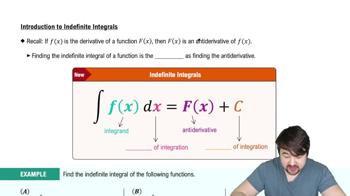
Indefinite Integrals

Indefinite integrals represent a family of functions whose derivative is the integrand. They are expressed with the integral sign followed by the function and the differential, and they include a constant of integration (C) since the derivative of a constant is zero. Understanding how to evaluate indefinite integrals is crucial for solving problems in calculus, as they provide the antiderivative of a function.
추천 영상:
가이드 코스
05:04
Introduction to Indefinite Integrals

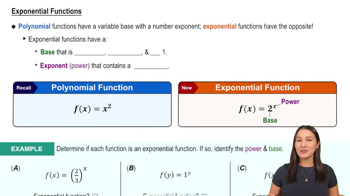
Exponential Functions

Exponential functions are mathematical functions of the form f(x) = a^x, where 'a' is a constant and 'x' is the variable. In calculus, the natural exponential function e^x is particularly important due to its unique property that the derivative of e^x is e^x itself. This property simplifies the process of integration, especially when dealing with integrals involving exponential terms.
추천 영상:
6:13
Exponential Functions

Integration Techniques

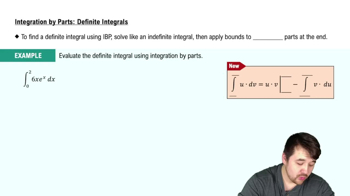
Integration techniques are methods used to evaluate integrals that may not be straightforward. Common techniques include substitution, integration by parts, and using integral tables. Familiarity with these techniques allows students to tackle a variety of integrals, including those involving exponential functions, and is essential for effectively solving calculus problems.
추천 영상:
가이드 코스
06:18
Integration by Parts for Definite Integrals
관련 실천
교과서 질문

Using properties of integrals Use the value of the first integral I to evaluate the two given integrals. 

I = ∫₀¹ (𝓍³ ― 2𝓍) d𝓍 = ―3/4

(a) ∫₀¹ (4𝓍―2𝓍³) d𝓍

110
views

교과서 질문

Area functions for linear functions Consider the following functions ƒ and real numbers a (see figure).

(a) Find and graph the area function A (𝓍) = ∫ₐˣ ƒ(t) dt .

ƒ(t) = 2t + 5 , a = 0

105
views
교과서 질문

Mass from density A thin 10-cm rod is made of an alloy whose density varies along its length according to the function shown in the figure. Assume density is measured in units of g/cm. In Chapter 6, we show that the mass of the rod is the area under the density curve.

(a) Find the mass of the left half of the rod (0 ≤ x ≤ 5) .

63
views
교과서 질문

Area functions The graph of ƒ is shown in the figure. Let A(x) = ∫₀ˣ ƒ(t) dt and F(x) = ∫₂ˣ ƒ(t) dt be two area functions for ƒ. Evaluate the following area functions.

(a) A(2)

66
views
교과서 질문

Area functions for the same linear function Let ƒ(t) = 2t ― 2 and consider the two area functions A (𝓍) = ∫₁ˣ ƒ(t) dt and F(𝓍) = ∫₄ˣ ƒ(t) dt .

(a) Evaluate A (2) and A (3). Then use geometry to find an expression for A (𝓍) , for 𝓍 ≥ 1 .

70
views
교과서 질문

Substitutions Suppose ƒ is an even function with ∫₀⁸ ƒ(𝓍) d𝓍 = 9 . Evaluate each integral.                                                                                                       

(a) ∫¹₋₁ 𝓍ƒ(𝓍²) d𝓍

44
views