Ch. 5 - Integration
Briggs - Calculus: Early Transcendentals 3rd Edition
Briggs3rd EditionCalculus: Early TranscendentalsISBN: 9780136847243당신이 사용하는 게 아니라요?교과서 변경
5장, 문제 5.3.20a

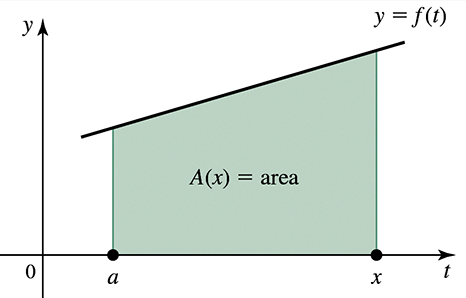
Area functions for linear functions Consider the following functions ƒ and real numbers a (see figure).
(a) Find and graph the area function A (𝓍) = ∫ₐˣ ƒ(t) dt .

ƒ(t) = 2t + 5 , a = 0

검증된 단계별 안내
1
Step 1: Understand the problem. The goal is to find the area function A(x) = ∫ₐˣ ƒ(t) dt, where ƒ(t) = 2t + 5 and a = 0. This represents the area under the curve of ƒ(t) from t = a to t = x.
Step 2: Set up the integral. Substitute the given function ƒ(t) = 2t + 5 into the integral: A(x) = ∫₀ˣ (2t + 5) dt.
Step 3: Break the integral into parts. Use the linearity of integration to separate the terms: A(x) = ∫₀ˣ 2t dt + ∫₀ˣ 5 dt.
Step 4: Compute each integral. For ∫₀ˣ 2t dt, use the power rule for integration: ∫ t^n dt = (t^(n+1))/(n+1). For ∫₀ˣ 5 dt, treat 5 as a constant and integrate: ∫ c dt = c * t.
Step 5: Combine the results and simplify. After evaluating the definite integrals, combine the terms to express A(x) as a function of x. This will give the area function A(x).

비슷한 문제에 대한 검증된 영상 답변:

이 영상 해법은 위 문제에 도움이 된다고 튜터들이 추천한 것입니다.
영상 길이:
2m
도움이 되었나요?

주요 개념

질문에 올바르게 답하기 위해 반드시 이해해야 하는 핵심 개념들은 다음과 같습니다.

Definite Integral

A definite integral represents the signed area under a curve between two points on the x-axis. It is denoted as ∫ₐˣ f(t) dt, where 'a' is the lower limit and 'x' is the upper limit. This concept is fundamental in calculating the area function A(x), which accumulates the area under the function f(t) from 'a' to 'x'.
추천 영상:
가이드 코스
05:43
Definition of the Definite Integral

Area Function

The area function A(x) is defined as the integral of a function f(t) from a fixed point 'a' to a variable point 'x'. It quantifies the total area under the curve of f(t) from 'a' to 'x'. In this case, with f(t) = 2t + 5, A(x) will yield a linear function representing the area as 'x' changes.
추천 영상:
05:06
Finding Area When Bounds Are Not Given

Graphing Area Functions

Graphing the area function A(x) involves plotting the accumulated area under the curve of f(t) as 'x' varies. The resulting graph typically shows how the area increases with 'x', reflecting the behavior of the original function. For linear functions like f(t) = 2t + 5, the area function will also be linear, making it easier to visualize the relationship between the two.
추천 영상:
가이드 코스
5:53
Graph of Sine and Cosine Function
관련 실천
교과서 질문

Using properties of integrals Use the value of the first integral I to evaluate the two given integrals. 

I = ∫₀¹ (𝓍³ ― 2𝓍) d𝓍 = ―3/4

(a) ∫₀¹ (4𝓍―2𝓍³) d𝓍

110
views

교과서 질문

Working with area functions Consider the function ƒ and the points a, b, and c.

(a) Find the area function A (𝓍) = ∫ₐˣ ƒ(t) dt using the Fundamental Theorem.

ƒ(𝓍) = cos 𝓍 ; a = 0 , b = π/2 , c = π

38
views
교과서 질문

Mass from density A thin 10-cm rod is made of an alloy whose density varies along its length according to the function shown in the figure. Assume density is measured in units of g/cm. In Chapter 6, we show that the mass of the rod is the area under the density curve.

(a) Find the mass of the left half of the rod (0 ≤ x ≤ 5) .

63
views
교과서 질문

Approximating areas Estimate the area of the region bounded by the graph of ƒ(𝓍) = x² + 2 and the x-axis on [0, 2] in the following ways.

(a) Divide [0, 2] into n = 4 subintervals and approximate the area of the region using a left Riemann sum. Illustrate the solution geometrically.

47
views
교과서 질문

Use Table 5.6 to evaluate the following indefinite integrals.                                                                                                               


 (a) ∫ e¹⁰ˣ d𝓍

78
views
교과서 질문

Area functions The graph of ƒ is shown in the figure. Let A(x) = ∫₀ˣ ƒ(t) dt and F(x) = ∫₂ˣ ƒ(t) dt be two area functions for ƒ. Evaluate the following area functions.

(a) A(2)

66
views