Ch. 6 - Applications of Integration
Briggs - Calculus: Early Transcendentals 3rd Edition
Briggs3rd EditionCalculus: Early TranscendentalsISBN: 9780136847243당신이 사용하는 게 아니라요?교과서 변경
6장, 문제 6.7.52

52–54. Force on a window A diving pool that is 4 m deep and full of water has a viewing window on one of its vertical walls. Find the force on the following windows. 


The window is a square, 0.5 m on a side, with the lower edge of the window on the bottom of the pool.

검증된 단계별 안내
1
Identify the physical principle involved: The force on the window is due to the water pressure acting over the area of the window. Water pressure increases with depth according to the formula \(P = \rho g h\), where \(\rho\) is the density of water, \(g\) is the acceleration due to gravity, and \(h\) is the depth below the surface.
Determine the depth range over which the window extends. Since the window is 0.5 m on each side and its lower edge is at the bottom of the pool (4 m deep), the top edge of the window is at a depth of \(4 - 0.5 = 3.5\) meters.
Express the pressure as a function of depth \(y\), where \(y\) measures the distance from the water surface downward. The pressure at depth \(y\) is \(P(y) = \rho g y\). The window extends from \(y = 3.5\) m to \(y = 4\) m.
Set up the integral to find the total force on the window by integrating the pressure over the area of the window. Since the window is vertical and 0.5 m wide, the differential force on a horizontal strip of the window at depth \(y\) with thickness \(dy\) is \(dF = P(y) \times \text{width} \times dy = \rho g y \times 0.5 \times dy\).
Integrate \(dF\) from \(y = 3.5\) to \(y = 4\) to find the total force: \(F = \int_{3.5}^{4} \rho g y \times 0.5 \, dy\). This integral will give the total force exerted by the water on the window.

비슷한 문제에 대한 검증된 영상 답변:

이 영상 해법은 위 문제에 도움이 된다고 튜터들이 추천한 것입니다.
영상 길이:
3m
도움이 되었나요?

주요 개념

질문에 올바르게 답하기 위해 반드시 이해해야 하는 핵심 개념들은 다음과 같습니다.

Hydrostatic Pressure

Hydrostatic pressure is the pressure exerted by a fluid at rest due to the force of gravity. It increases linearly with depth and is calculated as P = ρgh, where ρ is the fluid density, g is gravitational acceleration, and h is the depth below the surface.

Force on a Submerged Surface

The force exerted by a fluid on a submerged surface is found by integrating the pressure over the area. Since pressure varies with depth, the total force equals the pressure at the centroid of the surface times the area, accounting for the depth distribution.
추천 영상:
09:07
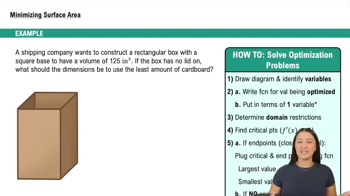
Example 1: Minimizing Surface Area

Centroid of a Rectangular Window

The centroid is the geometric center of a shape. For a rectangular window submerged vertically, the centroid's depth determines the average pressure acting on the window, which is essential for calculating the total hydrostatic force.
추천 영상:
13:49
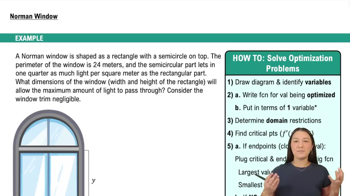
Example 4: Norman Window