Ch. 6 - Applications of Integration
Briggs - Calculus: Early Transcendentals 3rd Edition
Briggs3rd EditionCalculus: Early TranscendentalsISBN: 9780136847243당신이 사용하는 게 아니라요?교과서 변경
6장, 문제 6.6.17

Find the area of the surface generated when the given curve is revolved about the given axis.


y=1/4(e^2x+e^−2x), for −2≤x≤2; about the x-axis

검증된 단계별 안내
1
Step 1: Recall the formula for the surface area of a curve revolved about the x-axis. The formula is: A = 2π ∫[a,b] y √(1 + (dy/dx)^2) dx, where y is the function being revolved, and dy/dx is its derivative.
Step 2: Compute the derivative of the given function y = (1/4)(e^(2x) + e^(-2x)). Use the chain rule to find dy/dx. The derivative is: dy/dx = (1/4)(2e^(2x) - 2e^(-2x)).
Step 3: Simplify the expression for dy/dx. Factor out constants where possible: dy/dx = (1/2)(e^(2x) - e^(-2x)).
Step 4: Substitute y and dy/dx into the surface area formula. The integral becomes: A = 2π ∫[-2,2] (1/4)(e^(2x) + e^(-2x)) √(1 + ((1/2)(e^(2x) - e^(-2x)))^2) dx.
Step 5: Simplify the integrand as much as possible and set up the integral for evaluation. You may need to use algebraic manipulation and trigonometric identities to simplify further before solving the integral.

비슷한 문제에 대한 검증된 영상 답변:

이 영상 해법은 위 문제에 도움이 된다고 튜터들이 추천한 것입니다.
영상 길이:
9m
도움이 되었나요?

주요 개념

질문에 올바르게 답하기 위해 반드시 이해해야 하는 핵심 개념들은 다음과 같습니다.

Surface Area of Revolution

The surface area of a solid of revolution is calculated using the formula A = 2π ∫[a to b] y(x) √(1 + (dy/dx)²) dx, where y(x) is the function being revolved, and dy/dx is its derivative. This formula accounts for the curve's shape and the distance from the axis of rotation, allowing us to find the total surface area generated by revolving the curve around the specified axis.
추천 영상:
09:07
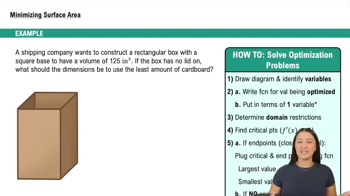
Example 1: Minimizing Surface Area

Parametric Derivatives

To find the derivative dy/dx for the function y = 1/4(e^(2x) + e^(-2x)), we apply differentiation rules. The derivative is essential for the surface area formula, as it represents the slope of the curve at any point, which affects the surface area when the curve is revolved around an axis.
추천 영상:
08:02
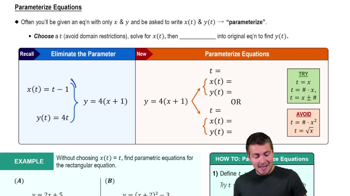
Parameterizing Equations

Definite Integrals

Definite integrals are used to calculate the area under a curve between two points, in this case, from x = -2 to x = 2. The integral provides the accumulated value of the function over the specified interval, which is crucial for determining the total surface area generated by the revolution of the curve.
추천 영상:
가이드 코스
05:43
Definition of the Definite Integral