

Ch. 6 - Applications of Integration
Briggs - Calculus: Early Transcendentals 3rd Edition
Briggs3rd EditionCalculus: Early TranscendentalsISBN: 9780136847243당신이 사용하는 게 아니라요?교과서 변경
6장, 문제 6.1.24c

Cycling distance A cyclist rides down a long straight road with a velocity (in m/min) given by v(t) = 400−20t, for 0≤t≤10, where t is measured in minutes.


c. How far has the cyclist traveled when her velocity is 250 m/min?

검증된 단계별 안내
1
Identify the given velocity function: \(v(t) = 400 - 20t\), where \(t\) is in minutes and \(v(t)\) is in meters per minute.
Find the time \(t\) when the velocity is 250 m/min by setting \(v(t) = 250\) and solving for \(t\): \(400 - 20t = 250\).
Once you find the time \(t\), recall that the distance traveled is the integral of velocity over time, so the distance \(s(t)\) from \(t=0\) to this time is given by \(s(t) = \int_0^t v(\tau) \, d\tau\).
Set up the integral with the velocity function: \(s(t) = \int_0^t (400 - 20\tau) \, d\tau\).
Evaluate the integral to find the distance traveled up to the time when velocity is 250 m/min.

비슷한 문제에 대한 검증된 영상 답변:

이 영상 해법은 위 문제에 도움이 된다고 튜터들이 추천한 것입니다.
영상 길이:
3m

주요 개념

질문에 올바르게 답하기 위해 반드시 이해해야 하는 핵심 개념들은 다음과 같습니다.

Velocity and its Relation to Displacement

Velocity is the rate of change of displacement with respect to time. To find the distance traveled, we analyze the velocity function over time, noting that displacement is the integral of velocity. Understanding how velocity changes helps determine the position at any given time.
추천 영상:
가이드 코스
04:16
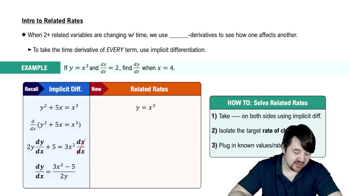
Intro To Related Rates

Solving for Time from Velocity

Given a velocity function v(t), finding when the velocity equals a specific value involves solving an equation for t. This step is crucial to identify the exact time at which the cyclist's velocity reaches 250 m/min, which then allows calculation of the distance traveled up to that time.
추천 영상:
가이드 코스
10:17
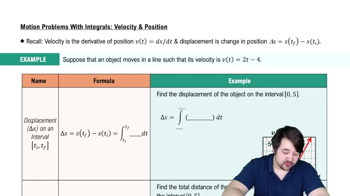
Using The Velocity Function

Definite Integration to Find Distance

Distance traveled over a time interval is found by integrating the velocity function with respect to time between the initial and final times. This process sums the infinitesimal displacements, providing the total distance covered when the velocity reaches the specified value.
추천 영상:
가이드 코스
05:43
Definition of the Definite Integral
관련 실천
교과서 질문

Bike race Theo and Sasha start at the same place on a straight road, riding bikes with the following velocities (measured in mi/hr). Assume t is measured in hours.

Theo: vT(t)=10, for t≥0

Sasha: vS(t)=15t, for 0≤t≤1, and vS(t)=15, for t>1


c. If the riders ride for 2 hr, who rides farther? Interpret your answer geometrically using the graphs of part (a). 

33
views
교과서 질문

Probe speed A data collection probe is dropped from a stationary balloon, and it falls with a velocity (in m/s) given by v(t) = 9.8t, neglecting air resistance. After 10 s, a chute deploys and the probe immediately slows to a constant speed of 10 m/s, which it maintains until it enters the ocean.


c. If the probe was released from an altitude of 3 km, when does it enter the ocean?

46
views
교과서 질문

Determine whether the following statements are true and give an explanation or counterexample.


c. ∫₀¹(x−x^2) dx=∫₀¹(√y−y) dy

54
views
교과서 질문

Day hike The velocity (in mi/hr) of a hiker walking along a straight trail is given by v(t) = 3 sin² πt/2, for 0≤t≤4. Assume s(0)=0 and t is measured in hours. 


c. What is the hiker’s position at t=3?

51
views
교과서 질문

13–16. Displacement from velocity Consider an object moving along a line with the given velocity v. Assume time t is measured in seconds and velocities have units of m/s.


c. Find the distance traveled over the given interval.


v(t) = 3t²−6t on [0, 3]

85
views
교과서 질문

Flying into a headwind The velocity (in mi/hr) of an airplane flying into a headwind is given by v(t) = 30(16−t²), for 0≤t≤3. Assume s(0)=0 and t is measured in hours.


c. How far has the airplane traveled at the instant its velocity reaches 400 mi/hr?

53
views