

Ch. 6 - Applications of Integration
Briggs - Calculus: Early Transcendentals 3rd Edition
Briggs3rd EditionCalculus: Early TranscendentalsISBN: 9780136847243당신이 사용하는 게 아니라요?교과서 변경
6장, 문제 6.1.3a

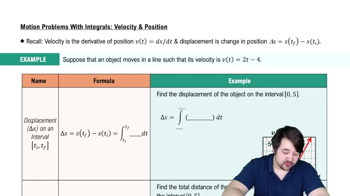
Given the velocity function of an object moving along a line, explain how definite integrals can be used to find the displacement of the object.

검증된 단계별 안내
1
Understand that the velocity function \(v(t)\) gives the rate of change of the object's position with respect to time, i.e., \(v(t) = \frac{ds}{dt}\), where \(s(t)\) is the position function.
Recall that displacement over a time interval \([a, b]\) is the change in position, which can be found by integrating the velocity function over that interval.
Set up the definite integral of the velocity function from \(a\) to \(b\): \(\int_{a}^{b} v(t) \, dt\).
Interpret this integral as the net area under the velocity curve between \(t = a\) and \(t = b\), where areas above the time-axis contribute positively and areas below contribute negatively to displacement.
Evaluate the definite integral to find the displacement, which represents how far and in what direction the object has moved from time \(a\) to time \(b\).

비슷한 문제에 대한 검증된 영상 답변:

이 영상 해법은 위 문제에 도움이 된다고 튜터들이 추천한 것입니다.
영상 길이:
3m
도움이 되었나요?

주요 개념

질문에 올바르게 답하기 위해 반드시 이해해야 하는 핵심 개념들은 다음과 같습니다.

Velocity Function

The velocity function describes the rate of change of an object's position with respect to time. It can be positive or negative, indicating direction along a line. Understanding velocity is essential because it directly relates to how the position changes over time.
추천 영상:
가이드 코스
10:17
Using The Velocity Function

Definite Integral as Net Change

A definite integral of a velocity function over a time interval calculates the net change in position, or displacement. It sums the signed areas under the velocity curve, accounting for direction, thus providing the overall movement from start to end time.
추천 영상:
가이드 코스
05:43
Definition of the Definite Integral

Displacement vs. Distance

Displacement is the net change in position, which can be positive, negative, or zero, depending on direction. It differs from total distance traveled, which sums all movement regardless of direction. Definite integrals of velocity yield displacement, not total distance.
추천 영상:
가이드 코스
08:56
Using The Acceleration Function Example 1
관련 실천
교과서 질문

Use the region R that is bounded by the graphs of y=1+√x,x=4, and y=1 complete the exercises.


Region R is revolved about the x-axis to form a solid of revolution whose cross sections are washers.


b. What is the inner radius of a cross section of the solid at a point x in [0, 4]?

57
views
교과서 질문

Let R be the region bounded by the curve y=cos^−1x and the x-axis on [0, 1]. A solid of revolution is obtained by revolving R about the y-axis (see figures). 


b. Find an expression for the area A(y) of a cross section of the solid at a point y in [0,π/2]. 

45
views
교과서 질문

Emptying a water trough A water trough has a semicircular cross section with a radius of 0.25 m and a length of 3 m (see figure).

a. How much work is required to pump the water out of the trough (to the level of the top of the trough) when it is full?

65
views
교과서 질문

A vertical spring A 10-kg mass is attached to a spring that hangs vertically and is stretched 2 m from the equilibrium position of the spring. Assume a linear spring with F(x) = kx.

a. How much work is required to compress the spring and lift the mass 0.5 m?

62
views
교과서 질문

17–22. Position from velocity Consider an object moving along a line with the given velocity v and initial position.


a. Determine the position function, for t≥0, using the antiderivative method


v(t) = 6−2t on [0, 5]; s(0)=0

50
views
교과서 질문

Oscillating growth rates Some species have growth rates that oscillate with an (approximately) constant period P. Consider the growth rate function N'(t) = r+A sin 2πt/P, where A and r are constants with units of individuals/yr, and t is measured in years. A species becomes extinct if its population ever reaches 0 after t=0.


b. Suppose P=10, A=20, and r=0. If the initial population is N(0)=100, does the population ever become extinct? Explain.

51
views