
Ch. 7 - Logarithmic, Exponential Functions, and Hyperbolic Functions
Briggs - Calculus: Early Transcendentals 3rd Edition
Briggs3rd EditionCalculus: Early TranscendentalsISBN: 9780136847243당신이 사용하는 게 아니라요?교과서 변경
7장, 문제 7.R.13

10–19. Derivatives Find the derivatives of the following functions.


f(t) = cosh t sinh t

검증된 단계별 안내
1
Recall the product rule for derivatives: if you have a function \(f(t) = u(t) v(t)\), then its derivative is \(f'(t) = u'(t) v(t) + u(t) v'(t)\).
Identify the two functions in the product: \(u(t) = \cosh t\) and \(v(t) = \sinh t\).
Find the derivatives of each function separately: \(\frac{d}{dt} \cosh t = \sinh t\) and \(\frac{d}{dt} \sinh t = \cosh t\).
Apply the product rule: \(f'(t) = (\sinh t)(\sinh t) + (\cosh t)(\cosh t)\).
Simplify the expression if possible, using hyperbolic identities such as \(\cosh^2 t - \sinh^2 t = 1\).

비슷한 문제에 대한 검증된 영상 답변:

이 영상 해법은 위 문제에 도움이 된다고 튜터들이 추천한 것입니다.
영상 길이:
3m
도움이 되었나요?

주요 개념

질문에 올바르게 답하기 위해 반드시 이해해야 하는 핵심 개념들은 다음과 같습니다.

Hyperbolic Functions

Hyperbolic functions, such as sinh(t) and cosh(t), are analogs of trigonometric functions but based on hyperbolas. They have unique properties and identities, like cosh²(t) - sinh²(t) = 1, which are useful in differentiation and integration.
추천 영상:
가이드 코스
5:50
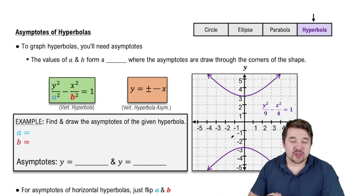
Asymptotes of Hyperbolas

Product Rule for Differentiation

The product rule states that the derivative of a product of two functions u(t) and v(t) is u'(t)v(t) + u(t)v'(t). This rule is essential when differentiating functions like f(t) = cosh(t) * sinh(t), where both factors depend on t.
추천 영상:
05:18
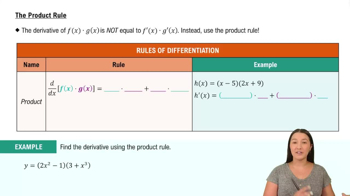
The Product Rule

Derivatives of Hyperbolic Functions

The derivatives of basic hyperbolic functions are: d/dt[sinh(t)] = cosh(t) and d/dt[cosh(t)] = sinh(t). Knowing these derivatives allows you to apply the product rule correctly to find the derivative of functions involving hyperbolic terms.
추천 영상:
가이드 코스
5:50
Asymptotes of Hyperbolas