
Surface area of a catenoid When the catenary y = a cosh x/a is revolved about the x-axis, it sweeps out a surface of revolution called a catenoid. Find the area of the surface generated when y = cosh x on [–ln 2, ln 2] is rotated about the x-axis.
Ch. 7 - Logarithmic, Exponential Functions, and Hyperbolic Functions
모든 교과서
Briggs 3rd Edition
Ch. 7 - Logarithmic, Exponential Functions, and Hyperbolic Functions
문제 7.R.1c
Briggs 3rd Edition
Ch. 7 - Logarithmic, Exponential Functions, and Hyperbolic Functions
문제 7.R.1c7장, 문제 7.R.1c
Explain why or why not Determine whether the following statements are true and give an explanation or counterexample.
c. ln xy = (ln x)(ln y)
검증된 단계별 안내1
Recall the logarithm property for the product of two positive numbers: \(\ln(xy) = \ln x + \ln y\). This is a fundamental identity in logarithms.
Compare the given statement \(\ln xy = (\ln x)(\ln y)\) with the known property. The statement suggests that the logarithm of a product equals the product of the logarithms, which differs from the sum in the known property.
To test the statement, consider specific positive values for \(x\) and \(y\), for example, \(x=2\) and \(y=3\). Calculate both sides: \(\ln(2 \times 3)\) and \((\ln 2)(\ln 3)\) to see if they are equal.
Since \(\ln(6)\) is approximately \(1.79\), and \((\ln 2)(\ln 3)\) is approximately \(0.48\), the two sides are not equal, providing a counterexample.
Conclude that the statement \(\ln xy = (\ln x)(\ln y)\) is false because the logarithm of a product is the sum of the logarithms, not their product.

비슷한 문제에 대한 검증된 영상 답변:
이 영상 해법은 위 문제에 도움이 된다고 튜터들이 추천한 것입니다.
영상 길이:
1m도움이 되었나요?
주요 개념
질문에 올바르게 답하기 위해 반드시 이해해야 하는 핵심 개념들은 다음과 같습니다.
Properties of Logarithms
Logarithms have specific properties that simplify expressions, such as ln(xy) = ln(x) + ln(y). Understanding these properties helps determine the validity of logarithmic equations.
추천 영상:
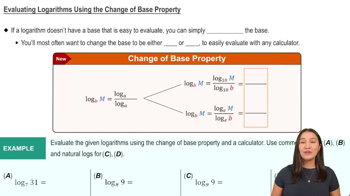
Change of Base Property
Difference Between Addition and Multiplication
In logarithmic identities, multiplication inside the log translates to addition outside, not multiplication. Recognizing this distinction is crucial to avoid incorrect assumptions like ln(xy) = (ln x)(ln y).
추천 영상:
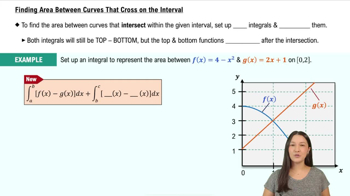
Finding Area Between Curves that Cross on the Interval
Counterexamples in Mathematical Proofs
A single counterexample disproves a general statement. Testing the equation with specific values of x and y can show whether ln(xy) = (ln x)(ln y) holds true or not.
추천 영상:
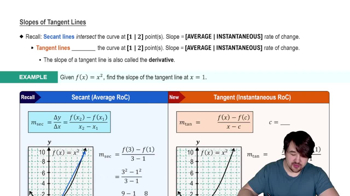
Slopes of Tangent Lines
관련 실천
교과서 질문
120
views
교과서 질문
63–66. Calculator limits Use a calculator to make a table similar to Table 7.1 to approximate the following limits. Confirm your result with l’Hôpital’s Rule.
limₕ→₀ (1 + 3h)^{2/h}
31
views
교과서 질문
10–19. Derivatives Find the derivatives of the following functions.
f(t) = cosh t sinh t
34
views
교과서 질문
27–28. Curve sketching Use the graphing techniques of Section 4.4 to graph the following functions on their domains. Identify local extreme points, inflection points, concavity, and end behavior. Use a graphing utility only to check your work.
f(x) = ln x – ln² x
69
views
교과서 질문
22–36. Derivatives Find the derivatives of the following functions.
f(x) = x sinh⁻¹ x − √(x² + 1)
94
views
교과서 질문
10–19. Derivatives Find the derivatives of the following functions.
f(x) = tanh⁻¹(cos x)
28
views