Ch. 7 - Logarithmic, Exponential Functions, and Hyperbolic Functions
Briggs - Calculus: Early Transcendentals 3rd Edition
Briggs3rd EditionCalculus: Early TranscendentalsISBN: 9780136847243당신이 사용하는 게 아니라요?교과서 변경
7장, 문제 7.3.38b

37–38. Caffeine After an individual drinks a beverage containing caffeine, the amount of caffeine in the bloodstream can be modeled by an exponential decay function, with a half-life that depends on several factors, including age and body weight. For the sake of simplicity, assume the caffeine in the following drinks immediately enters the bloodstream upon consumption.


An individual consumes two cups of coffee, each containing 90 mg of caffeine, two hours apart. Assume the half-life of caffeine for this individual is 5.7 hours.


b. Determine the amount of caffeine in the bloodstream 1 hour after drinking the second cup of coffee.

검증된 단계별 안내
1
Identify the exponential decay model for caffeine amount: the amount remaining after time \(t\) hours is given by \(A(t) = A_0 \times \left(\frac{1}{2}\right)^{\frac{t}{h}}\), where \(A_0\) is the initial amount of caffeine, and \(h\) is the half-life (5.7 hours in this case).
Calculate the amount of caffeine remaining from the first cup 3 hours after consumption, since the second cup is consumed 2 hours after the first, and we want the amount 1 hour after the second cup (total 2 + 1 = 3 hours after the first cup). Use \(t=3\) hours for the first cup.
Calculate the amount of caffeine remaining from the second cup 1 hour after consumption, so use \(t=1\) hour for the second cup.
Add the amounts of caffeine remaining from both cups at the 1 hour mark after the second cup to find the total caffeine in the bloodstream at that time.
Express the total caffeine amount as \(A_{total} = 90 \times \left(\frac{1}{2}\right)^{\frac{3}{5.7}} + 90 \times \left(\frac{1}{2}\right)^{\frac{1}{5.7}}\) without calculating the numerical value.

비슷한 문제에 대한 검증된 영상 답변:

이 영상 해법은 위 문제에 도움이 된다고 튜터들이 추천한 것입니다.
영상 길이:
5m
도움이 되었나요?

주요 개념

질문에 올바르게 답하기 위해 반드시 이해해야 하는 핵심 개념들은 다음과 같습니다.

Exponential Decay Function

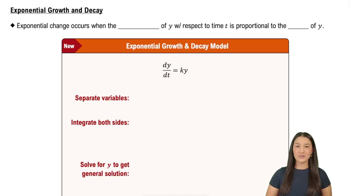
Exponential decay describes processes where quantities decrease at rates proportional to their current value. In this context, caffeine concentration decreases over time following the formula A(t) = A_0 * (1/2)^(t/h), where A_0 is the initial amount, t is time elapsed, and h is the half-life.
추천 영상:
09:29
Exponential Growth & Decay

Half-Life

Half-life is the time required for a substance to reduce to half its initial amount. For caffeine, it indicates how quickly the body metabolizes it. Knowing the half-life allows calculation of remaining caffeine after any time period using exponential decay.
추천 영상:
6:32
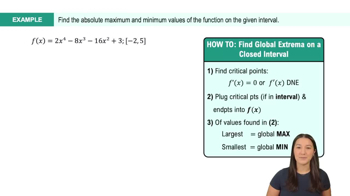
Finding Global Extrema (Extreme Value Theorem) Example 3

Superposition of Multiple Doses

When multiple doses are taken at different times, the total amount in the bloodstream is the sum of the remaining amounts from each dose. Each dose decays independently according to the exponential decay model, and their contributions must be added to find the total caffeine level.
추천 영상:
4:22
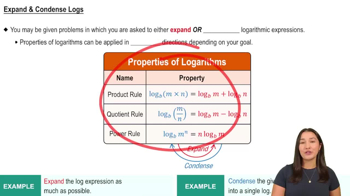
Expand & Condense Log Expressions
관련 실천
교과서 질문

Energy consumption On the first day of the year (t=0), a city uses electricity at a rate of 2000 MW. That rate is projected to increase at a rate of 1.3% per year.


b. Find the total energy (in MW-yr) used by the city over four full years beginning at t=0.

41
views
교과서 질문

Overtaking City A has a current population of 500,000 people and grows at a rate of 3%/yr. City B has a current population of 300,000 and grows at a rate of 5%/yr.

b. Suppose City C has a current population of y₀ < 500,000 and a growth rate of p > 3%/yr. What is the relationship between y₀ and p such that Cities A and C have the same population in 10 years?

46
views
교과서 질문

Projection sensitivity

According to the 2014 national population projections published by the U.S. Census Bureau, the U.S. population is projected to be 334.4 million in 2020 with an estimated growth rate of 0.79%/yr.

b. Suppose the actual growth rate is instead 0.7%. What are the resulting doubling time and projected 2050 population?

39
views
교과서 질문

Definitions of hyperbolic sine and cosine Complete the following steps to prove that when the x- and y-coordinates of a point on the hyperbola x² - y² = 1 are defined as cosh t and sinh t, respectively, where t is twice the area of the shaded region in the figure, x and y can be expressed as

x = cosh t = (eᵗ + e⁻ᵗ) / 2 and y = sinh t = (eᵗ - e⁻ᵗ) / 2.


b. In Chapter 8, the formula for the integral in part (a) is derived:

∫ √(z² − 1) dz = (z/2)√(z² − 1) − (1/2) ln|z + √(z² − 1)| + C.

Evaluate this integral on the interval [1, x], explain why the absolute value can be dropped, and combine the result with part (a) to show that:

t = ln(x + √(x² − 1)).

96
views
교과서 질문

Many formulas There are several ways to express the indefinite integral of sech x.


b. Show that ∫ sech x dx = sin⁻¹ (tanh x) + C. (Hint: Show that sech x = sech² x / √(1 − tanh² x) and then make a change of variables.)

69
views
교과서 질문

"Integral formula Carry out the following steps to derive the formula ∫ csch x dx = ln |tanh(x / 2)| + C (Theorem 7.6).


b. Use the identity for sinh(2u) to show that 2 / sinh(2u) = sech² u / tanh u."

66
views