
Ch. 7 - Logarithmic, Exponential Functions, and Hyperbolic Functions
Briggs - Calculus: Early Transcendentals 3rd Edition
Briggs3rd EditionCalculus: Early TranscendentalsISBN: 9780136847243당신이 사용하는 게 아니라요?교과서 변경
7장, 문제 7.3.112b

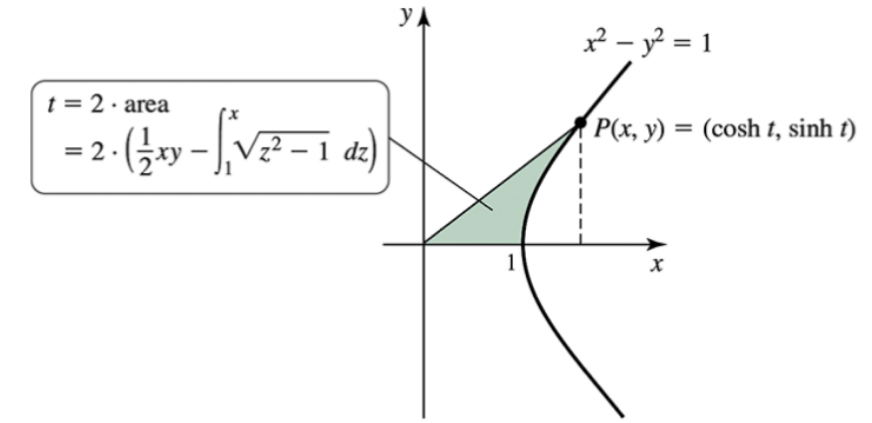
Definitions of hyperbolic sine and cosine Complete the following steps to prove that when the x- and y-coordinates of a point on the hyperbola x² - y² = 1 are defined as cosh t and sinh t, respectively, where t is twice the area of the shaded region in the figure, x and y can be expressed as
x = cosh t = (eᵗ + e⁻ᵗ) / 2 and y = sinh t = (eᵗ - e⁻ᵗ) / 2.


Graph of hyperbola x² - y² = 1 with shaded area and point P(x, y) = (cosh t, sinh t) illustrating t as twice the area.


b. In Chapter 8, the formula for the integral in part (a) is derived:
∫ √(z² − 1) dz = (z/2)√(z² − 1) − (1/2) ln|z + √(z² − 1)| + C.
Evaluate this integral on the interval [1, x], explain why the absolute value can be dropped, and combine the result with part (a) to show that:
t = ln(x + √(x² − 1)).

검증된 단계별 안내
1
Start by expressing the parameter \( t \) as twice the shaded area, which is given by the formula: \[ t = 2 \left( \frac{1}{2} x y - \int_1^x \sqrt{z^2 - 1} \, dz \right) \]. This represents the area of the triangle minus the area under the curve from 1 to \( x \).
Recognize that the point \( P(x, y) \) lies on the hyperbola \( x^2 - y^2 = 1 \), and the coordinates are defined as \( x = \cosh t \) and \( y = \sinh t \). This means \( y = \sqrt{x^2 - 1} \) because \( y^2 = x^2 - 1 \).
Use the integral formula provided: \[ \int \sqrt{z^2 - 1} \, dz = \frac{z}{2} \sqrt{z^2 - 1} - \frac{1}{2} \ln|z + \sqrt{z^2 - 1}| + C \]. Evaluate this definite integral from 1 to \( x \) by substituting the limits into the antiderivative.
Explain why the absolute value in the logarithm can be dropped: since \( x \geq 1 \) and \( \sqrt{x^2 - 1} \geq 0 \), the expression inside the logarithm, \( x + \sqrt{x^2 - 1} \), is always positive, so \( |x + \sqrt{x^2 - 1}| = x + \sqrt{x^2 - 1} \).
Combine the evaluated integral with the expression for \( t \) from step 1, simplify the terms, and show that \( t = \ln(x + \sqrt{x^2 - 1}) \). This links the parameter \( t \) to the coordinates on the hyperbola and completes the proof.

비슷한 문제에 대한 검증된 영상 답변:

이 영상 해법은 위 문제에 도움이 된다고 튜터들이 추천한 것입니다.
영상 길이:
2m
도움이 되었나요?

주요 개념

질문에 올바르게 답하기 위해 반드시 이해해야 하는 핵심 개념들은 다음과 같습니다.

Hyperbolic Functions (sinh and cosh)

Hyperbolic sine (sinh) and cosine (cosh) are analogs of the trigonometric sine and cosine but for a hyperbola. They are defined as sinh t = (e^t - e^(-t))/2 and cosh t = (e^t + e^(-t))/2. These functions satisfy the identity cosh² t - sinh² t = 1, which corresponds to the equation of the hyperbola x² - y² = 1.
추천 영상:
가이드 코스
5:50
Asymptotes of Hyperbolas

Area Interpretation and Parametrization of the Hyperbola

The parameter t is defined as twice the area of the shaded region bounded by the hyperbola, the x-axis, and the vertical line at x. This geometric interpretation links the hyperbolic functions to the integral of √(z² - 1), providing a way to parametrize points on the hyperbola as (cosh t, sinh t).
추천 영상:
08:02
Parameterizing Equations

Integral of √(z² - 1) and Logarithmic Expression

The integral ∫√(z² - 1) dz evaluates to (z/2)√(z² - 1) - (1/2) ln|z + √(z² - 1)| + C. Evaluating this from 1 to x and dropping the absolute value (since x ≥ 1) leads to the expression t = ln(x + √(x² - 1)), connecting the parameter t to x and thus to cosh t.
추천 영상:
7:30
Logarithms Introduction
관련 실천
교과서 질문

Acceleration, velocity, position Suppose the acceleration of an object moving along a line is given by a(t) = -k v(t), where k is a positive constant and v is the object's velocity. Assume the initial velocity and position are given by v(0) = 10 and s(0) = 0, respectively.

c. Use the fact that dv/dt = (dv/ds)(ds/dt) (by the Chain Rule) to find the velocity as a function of position.

108
views
교과서 질문

Energy consumption On the first day of the year (t=0), a city uses electricity at a rate of 2000 MW. That rate is projected to increase at a rate of 1.3% per year.


b. Find the total energy (in MW-yr) used by the city over four full years beginning at t=0.

41
views
교과서 질문

Explain why or why not Determine whether the following statements are true and give an explanation or counterexample.

c. ln(1 + √2) = −ln(−1 + √2)

53
views
교과서 질문

37–38. Caffeine After an individual drinks a beverage containing caffeine, the amount of caffeine in the bloodstream can be modeled by an exponential decay function, with a half-life that depends on several factors, including age and body weight. For the sake of simplicity, assume the caffeine in the following drinks immediately enters the bloodstream upon consumption.


An individual consumes two cups of coffee, each containing 90 mg of caffeine, two hours apart. Assume the half-life of caffeine for this individual is 5.7 hours.


b. Determine the amount of caffeine in the bloodstream 1 hour after drinking the second cup of coffee.

92
views
교과서 질문

Many formulas There are several ways to express the indefinite integral of sech x.


b. Show that ∫ sech x dx = sin⁻¹ (tanh x) + C. (Hint: Show that sech x = sech² x / √(1 − tanh² x) and then make a change of variables.)

69
views
교과서 질문

Power lines A power line is attached at the same height to two utility poles that are separated by a distance of 100 ft; the power line follows the curve ƒ(x) = a cosh x/a. Use the following steps to find the value of a that produces a sag of 10 ft midway between the poles. Use a coordinate system that places the poles at x = ±50.

c. Use your answer in part (b) to find a, and then compute the length of the power line.

32
views