
Ch. 8 - Integration Techniques
Briggs - Calculus: Early Transcendentals 3rd Edition
Briggs3rd EditionCalculus: Early TranscendentalsISBN: 9780136847243당신이 사용하는 게 아니라요?교과서 변경
8장, 문제 8.9.101d

101. Many methods needed Show that the integral from ∫(from 0 to ∞)(sqrt(x) * ln x) / (1 + x)^2 dx equals pi, following these steps
d. Evaluate the remaining integral using the change of variables z = sqrt(x)

검증된 단계별 안내
1
Start with the integral after previous simplifications, which should be of the form \(\int_0^{\infty} \frac{\sqrt{x} \ln x}{(1+x)^2} \, dx\).
Apply the substitution \(z = \sqrt{x}\), which implies \(x = z^2\). Then, compute the differential \(dx\) in terms of \(dz\): \(dx = 2z \, dz\).
Rewrite the integral in terms of \(z\) by substituting \(x = z^2\), \(\sqrt{x} = z\), \(\ln x = \ln(z^2) = 2 \ln z\), and \(dx = 2z \, dz\). The integral becomes \(\int_0^{\infty} \frac{z \cdot 2 \ln z}{(1 + z^2)^2} \cdot 2z \, dz\).
Simplify the integrand by combining terms: \(z \cdot 2 \ln z \cdot 2z = 4 z^2 \ln z\), so the integral is \(\int_0^{\infty} \frac{4 z^2 \ln z}{(1 + z^2)^2} \, dz\).
Now, the integral is expressed in terms of \(z\) and can be evaluated using appropriate methods such as integration by parts or recognizing it as a standard integral form.

비슷한 문제에 대한 검증된 영상 답변:

이 영상 해법은 위 문제에 도움이 된다고 튜터들이 추천한 것입니다.
영상 길이:
4m
도움이 되었나요?

주요 개념

질문에 올바르게 답하기 위해 반드시 이해해야 하는 핵심 개념들은 다음과 같습니다.

Change of Variables (Substitution) in Integration

This technique involves replacing the original variable with a new variable to simplify the integral. By setting z = sqrt(x), we rewrite the integral in terms of z, which often makes the integral easier to evaluate. It requires adjusting the differential dx accordingly and changing the limits of integration.
추천 영상:
04:27
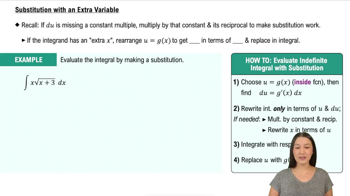
Substitution With an Extra Variable

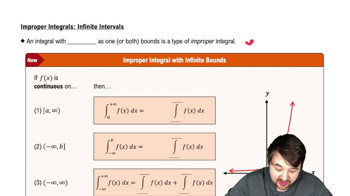
Improper Integrals over Infinite Intervals

Integrals with limits extending to infinity are called improper integrals. Evaluating them requires understanding limits and convergence. Here, the integral from 0 to ∞ must be handled carefully, ensuring the integral converges and applying appropriate techniques to evaluate it.
추천 영상:
11:11
Improper Integrals: Infinite Intervals

Logarithmic Functions within Integrals

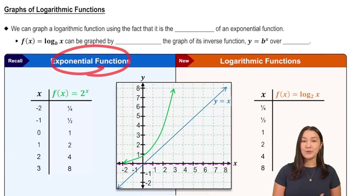
Integrals involving logarithmic terms, such as ln(x), often require special attention due to their behavior near zero and infinity. Understanding properties of logarithms and how they interact with other functions in the integrand is essential for simplifying and evaluating the integral.
추천 영상:
5:26
Graphs of Logarithmic Functions
관련 실천
교과서 질문

The Eiffel Tower Property Let R be the region between the curves y = e^(-c·x) and y = -e^(-c·x) on the interval [a, ∞), where a ≥ 0 and c > 0.

The center of mass of R is located at (x̄, 0), where x̄ = [∫(a to ∞) x·e^(-c·x) dx] / [∫(a to ∞) e^(-c·x) dx]

(The profile of the Eiffel Tower is modeled by these two exponential curves; see the Guided Project "The exponential Eiffel Tower")

d. Prove this property holds for any a ≥ 0 and c > 0:

The tangent lines to y = ±e^(-c·x) at x = a always intersect at R's center of mass

(Source: P. Weidman and I. Pinelis, Comptes Rendu, Mechanique, 332, 571-584, 2004)

33
views
교과서 질문

66–71. {Use of Tech} Estimating error Refer to Theorem 8.1 in the following exercises.

69. Let f(x) = sin(eˣ).

d. Find an upper bound on the absolute error in the estimate found in part (a) using Theorem 8.1.

50
views
교과서 질문

66–71. {Use of Tech} Estimating error Refer to Theorem 8.1 in the following exercises.

66. Let f(x) = cos(x²).

d. Use Theorem 8.1 to find an upper bound on the absolute error in the estimate found in part (a).

51
views
교과서 질문

Explain why or why not Determine whether the following statements are true and give an explanation or counterexample.

d. Using the substitution u = tan(x) in ∫ (tan²x / (tan x - 1)) dx leads to ∫ (u² / (u - 1)) du.

41
views
교과서 질문

 Explain why or why not Determine whether the following statements are true and give an explanation or counterexample.

d. ∫(1/eˣ) dx = ln eˣ + C.

44
views
교과서 질문

91. [Use of Tech] Regions bounded by exponentials Let a > 0 and let R be the region bounded by the graph of y = e^(-a·x) and the x-axis

on the interval [b, ∞).

c. Find the minimum value b* such that when b > b*, there exists some a > 0 where A(a,b) = 2.

36
views