

Ch. 8 - Integration Techniques
Briggs - Calculus: Early Transcendentals 3rd Edition
Briggs3rd EditionCalculus: Early TranscendentalsISBN: 9780136847243당신이 사용하는 게 아니라요?교과서 변경
8장, 문제 8.9.91c

91. [Use of Tech] Regions bounded by exponentials Let a > 0 and let R be the region bounded by the graph of y = e^(-a·x) and the x-axis
on the interval [b, ∞).
c. Find the minimum value b* such that when b > b*, there exists some a > 0 where A(a,b) = 2.

검증된 단계별 안내
1
First, understand the region R is bounded by the curve \(y = e^{-a \cdot x}\) and the x-axis over the interval \([b, \infty)\). The area \(A(a,b)\) of this region is given by the integral of the function from \(b\) to infinity: \[A(a,b) = \int_{b}^{\infty} e^{-a \cdot x} \, dx\]
Next, compute the integral \(A(a,b)\). Since \(a > 0\), the integral converges and can be evaluated as an improper integral: \[A(a,b) = \lim_{t \to \infty} \int_{b}^{t} e^{-a \cdot x} \, dx\] Use the antiderivative of \(e^{-a x}\), which is \(-\frac{1}{a} e^{-a x}\).
Evaluate the definite integral: \[A(a,b) = \lim_{t \to \infty} \left[-\frac{1}{a} e^{-a x} \right]_{x=b}^{x=t} = \lim_{t \to \infty} \left(-\frac{1}{a} e^{-a t} + \frac{1}{a} e^{-a b} \right)\] Since \(a > 0\), \(e^{-a t} \to 0\) as \(t \to \infty\), so the area simplifies to \[A(a,b) = \frac{1}{a} e^{-a b}\]
The problem asks to find the minimum value \(b^*\) such that for any \(b > b^*\), there exists some \(a > 0\) with \(A(a,b) = 2\). Set up the equation: \[\frac{1}{a} e^{-a b} = 2\] Rewrite it as \[e^{-a b} = 2a\]
To find \(b^*\), consider the function \(f(a) = 2a e^{a b}\). For fixed \(b\), the equation \(e^{-a b} = 2a\) can be rearranged to \(1 = 2a e^{a b}\). We want to find the smallest \(b\) such that this equation has a positive solution \(a\). Analyze the function \(g(a) = 2a e^{a b}\) for \(a > 0\) and find its minimum value with respect to \(a\). Then, find \(b^*\) such that the minimum of \(g(a)\) equals 1. This involves taking the derivative of \(g(a)\) with respect to \(a\), setting it to zero to find critical points, and solving for \(b\) in terms of \(a\). This will give the minimal \(b^*\).

비슷한 문제에 대한 검증된 영상 답변:

이 영상 해법은 위 문제에 도움이 된다고 튜터들이 추천한 것입니다.
영상 길이:
7m
도움이 되었나요?

주요 개념

질문에 올바르게 답하기 위해 반드시 이해해야 하는 핵심 개념들은 다음과 같습니다.

Definite Integral and Area Under a Curve

The definite integral calculates the area between a curve and the x-axis over a specified interval. For y = e^{-a·x}, integrating from b to infinity gives the total area under the exponential decay curve, which is essential for expressing A(a,b) and analyzing its behavior.
추천 영상:
가이드 코스
05:43
Definition of the Definite Integral

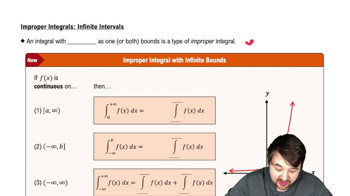
Improper Integrals and Convergence

Integrals with infinite limits, like from b to ∞, are improper and require evaluating limits to determine convergence. Understanding when the integral converges and how it depends on parameters a and b is crucial to finding values where the area equals a specific number.
추천 영상:
가이드 코스
11:11
Improper Integrals: Infinite Intervals

Parameter Dependence and Optimization

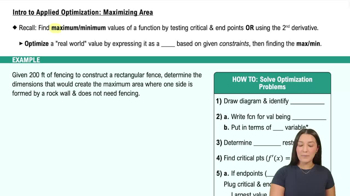
The problem involves finding a minimum b* such that for b > b*, there exists an a > 0 making the area equal to 2. This requires analyzing how the integral's value changes with parameters a and b, and using algebraic or calculus methods to solve for the critical threshold b*.
추천 영상:
10:13
Intro to Applied Optimization: Maximizing Area
관련 실천
교과서 질문

109. Escape velocity and black holes The work required to launch an object from the surface of Earth to outer space is given by W = ∫ from R to ∞ of F(x) dx, where R = 6370 km is the approximate radius of Earth, F(x) = (GMm)/x² is the gravitational force between Earth and the object, G is the gravitational constant, M is the mass of Earth, m is the mass of the object, and GM = 4 × 10¹⁴ m³/s².

c. The French scientist Laplace anticipated the existence of black holes in the 18th century with the following argument: If a body has an escape velocity that equals or exceeds the speed of light, c = 300,000 km/s, then light cannot escape the body and it cannot be seen. Show that such a body has a radius R ≤ 2GM/c². For Earth to be a black hole, what would its radius need to be?

53
views
교과서 질문

66–71. {Use of Tech} Estimating error Refer to Theorem 8.1 in the following exercises.

69. Let f(x) = sin(eˣ).

d. Find an upper bound on the absolute error in the estimate found in part (a) using Theorem 8.1.

50
views
교과서 질문

45–48. {Use of Tech} Trapezoid Rule and Simpson’s Rule Consider the following integrals and the given values of n.

47. ∫(1 to e) (1/x) dx; n = 50

c. Compute the absolute errors in the Trapezoid Rule and Simpson’s Rule with 2n subintervals.

62
views
교과서 질문

Computing areas On the interval [0,2], the graphs of f(x)=x²/3 and g(x)=x²(9−x²)^(-1/2) have similar shapes.

c. Which region has greater area?

64
views
교과서 질문

101. Many methods needed Show that the integral from ∫(from 0 to ∞)(sqrt(x) * ln x) / (1 + x)^2 dx equals pi, following these steps

d. Evaluate the remaining integral using the change of variables z = sqrt(x)

79
views
교과서 질문

 Explain why or why not Determine whether the following statements are true and give an explanation or counterexample.

d. ∫(1/eˣ) dx = ln eˣ + C.

44
views