

108. Draining a tank Water is drained from a 3000-gal tank at a rate that starts at 100 gal/hr and decreases continuously by 5%/hr. If the drain is left open indefinitely, how much water drains from the tank? Can a full tank be emptied at this rate?
Ch. 8 - Integration Techniques
8장, 문제 8.8.64
64. (Use of Tech) Normal distribution of movie lengths
A study revealed that the lengths of U.S. movies are normally distributed with a mean of 110 minutes and a standard deviation of 22 minutes. This means that the fraction of movies with lengths between a and b minutes (with a < b) is given by the integral:
(1/(22√(2π))) ∫[a to b] e^(-((x-110)/22)²/2) dx.
What percentage of U.S. movies are between 1 hr and 1.5 hr long (60-90 min)?
검증된 단계별 안내1
Step 1: Recognize that the problem involves calculating the percentage of movies within a certain range using the normal distribution formula. The integral provided represents the probability density function for a normal distribution.
Step 2: Convert the given time range (60 to 90 minutes) into the integral bounds 'a' and 'b'. Here, 'a' = 60 and 'b' = 90.
Step 3: Standardize the bounds using the z-score formula: z = (x - μ) / σ, where μ is the mean (110 minutes) and σ is the standard deviation (22 minutes). Compute the z-scores for both bounds: z₁ = (60 - 110) / 22 and z₂ = (90 - 110) / 22.
Step 4: Use a technology tool (such as a graphing calculator or software like Python, MATLAB, or WolframAlpha) to evaluate the integral of the normal distribution function between the standardized z-scores. Alternatively, use the cumulative distribution function (CDF) of the standard normal distribution to find the probabilities corresponding to z₁ and z₂, and subtract P(z₁) from P(z₂).
Step 5: Multiply the resulting probability by 100 to convert it into a percentage. This percentage represents the fraction of U.S. movies with lengths between 60 and 90 minutes.

비슷한 문제에 대한 검증된 영상 답변:
이 영상 해법은 위 문제에 도움이 된다고 튜터들이 추천한 것입니다.
영상 길이:
12m도움이 되었나요?
주요 개념
질문에 올바르게 답하기 위해 반드시 이해해야 하는 핵심 개념들은 다음과 같습니다.
Normal Distribution
Normal distribution is a probability distribution that is symmetric about the mean, depicting that data near the mean are more frequent in occurrence than data far from the mean. It is characterized by its bell-shaped curve, defined by its mean and standard deviation. In this context, the lengths of U.S. movies follow a normal distribution with a mean of 110 minutes and a standard deviation of 22 minutes, which allows for the calculation of probabilities for different ranges of movie lengths.
추천 영상:
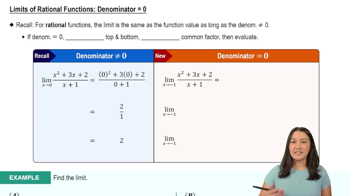
Limits of Rational Functions: Denominator = 0
Standard Normal Variable
A standard normal variable is a normal random variable that has been standardized to have a mean of 0 and a standard deviation of 1. This is achieved through the transformation z = (x - μ) / σ, where μ is the mean and σ is the standard deviation. In the context of the movie lengths, converting the lengths to a standard normal variable allows us to use standard normal distribution tables or software to find probabilities associated with specific ranges of movie lengths.
추천 영상:
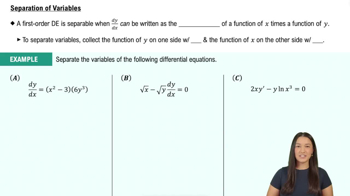
Separation of Variables
Definite Integral
A definite integral calculates the accumulation of quantities, such as area under a curve, between two specified limits. In this case, the integral represents the probability of movie lengths falling between 60 and 90 minutes. Evaluating this integral involves finding the area under the normal distribution curve between these two points, which corresponds to the percentage of movies that fall within this length range.
추천 영상:
Definition of the Definite Integral
관련 실천
교과서 질문
38
views
교과서 질문
76–83. Preliminary steps The following integrals require a preliminary step such as a change of variables before using the method of partial fractions. Evaluate these integrals.
76. ∫ [cosθ / (sin³θ - 4sinθ)] dθ
44
views
교과서 질문
Visual proof Let F(x)=∫₀ˣ √(a²−t²) dt. The figure shows that F(x)= area of sector OAB+ area of triangle OBC.
a. Use the figure to prove that
F(x) = (a² sin ⁻¹(x/a))/2 + x√(a²−x²)/2
b. Conclude that ∫ √(a²−x²) dx = (a² sin ⁻¹(x/a))/2 + x√(a²−x²)/2 + C.
47
views
교과서 질문
9–40. Integration by parts Evaluate the following integrals using integration by parts.
40. ∫ e^√x dx
48
views
교과서 질문
7–84. Evaluate the following integrals.
25. ∫ [1 / (x√(1 - x²))] dx
89
views
교과서 질문
7–58. Improper integrals Evaluate the following integrals or state that they diverge.
50. ∫ (from 0 to 9) 1/(x - 1)¹ᐟ³ dx
71
views
