Ch. 8 - Integration Techniques
Briggs - Calculus: Early Transcendentals 3rd Edition
Briggs3rd EditionCalculus: Early TranscendentalsISBN: 9780136847243당신이 사용하는 게 아니라요?교과서 변경
8장, 문제 8.9.108

108. Draining a tank Water is drained from a 3000-gal tank at a rate that starts at 100 gal/hr and decreases continuously by 5%/hr. If the drain is left open indefinitely, how much water drains from the tank? Can a full tank be emptied at this rate? 

검증된 단계별 안내
1
Identify the initial rate of draining water from the tank, which is given as 100 gallons per hour. This is the starting value of the rate function, denoted as \(R(0) = 100\) gal/hr.
Recognize that the rate decreases continuously by 5% per hour. This means the rate function \(R(t)\) can be modeled as an exponential decay function: \(R(t) = 100 \times (1 - 0.05)^t = 100 \times 0.95^t\), where \(t\) is time in hours.
To find the total amount of water drained over an indefinite period, set up the integral of the rate function from \(t=0\) to \(t=\infty\): \(\displaystyle \int_0^{\infty} R(t) \, dt = \int_0^{\infty} 100 \times 0.95^t \, dt\).
Rewrite the integral using the exponential function with natural logarithm for easier integration: \(0.95^t = e^{t \ln(0.95)}\), so the integral becomes \(\int_0^{\infty} 100 e^{t \ln(0.95)} \, dt\).
Evaluate the improper integral by integrating \(100 e^{t \ln(0.95)}\) with respect to \(t\) from 0 to infinity, and interpret the result to determine if the total drained water exceeds the tank's capacity of 3000 gallons.

비슷한 문제에 대한 검증된 영상 답변:

이 영상 해법은 위 문제에 도움이 된다고 튜터들이 추천한 것입니다.
영상 길이:
4m
도움이 되었나요?

주요 개념

질문에 올바르게 답하기 위해 반드시 이해해야 하는 핵심 개념들은 다음과 같습니다.

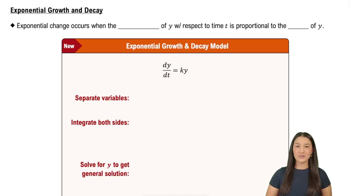
Exponential Decay

Exponential decay describes a quantity that decreases at a rate proportional to its current value. In this problem, the draining rate decreases by 5% per hour, meaning the rate follows an exponential decay model, often expressed as R(t) = R_0 * e^(-kt), where k is the decay constant.
추천 영상:
09:29
Exponential Growth & Decay

Integration of Rate Functions

To find the total amount of water drained over time, you integrate the rate function with respect to time. This accumulates the volume drained from the start until any given time, allowing calculation of total drained water as the integral of the decreasing flow rate.
추천 영상:
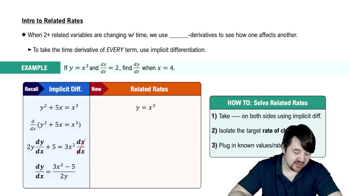
04:16
Intro To Related Rates

Limit of an Improper Integral

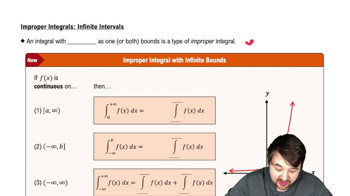
Since the drain is left open indefinitely, the total drained water is the limit of the integral as time approaches infinity. Evaluating this improper integral determines whether the tank can be fully emptied or if some water remains due to the decreasing rate.
추천 영상:
11:11
Improper Integrals: Infinite Intervals
관련 실천
교과서 질문

76–83. Preliminary steps The following integrals require a preliminary step such as a change of variables before using the method of partial fractions. Evaluate these integrals.

76. ∫ [cosθ / (sin³θ - 4sinθ)] dθ

44
views

교과서 질문

Visual proof Let F(x)=∫₀ˣ √(a²−t²) dt. The figure shows that F(x)= area of sector OAB+ area of triangle OBC.

a. Use the figure to prove that

F(x) = (a² sin ⁻¹(x/a))/2 + x√(a²−x²)/2

b. Conclude that ∫ √(a²−x²) dx = (a² sin ⁻¹(x/a))/2 + x√(a²−x²)/2 + C.

47
views
교과서 질문

{Use of Tech} Using the integral of sec³u By reduction formula 4 in Section 8.3,

∫sec³u du = 1/2 (sec u tan u + ln |sec u + tan u|) + C


Graph the following functions and find the area under the curve on the given interval.

f(x) = (9 - x²) ⁻², [0, 3/2]

55
views
교과서 질문

102–106. Laplace transforms A powerful tool in solving problems in engineering and physics is the Laplace transform. Given a function f(t), the Laplace transform is a new function F(s) defined by F(s) = ∫[0 to ∞] e^(-st) f(t) dt, where we assume s is a positive real number. For example, to find the Laplace transform of f(t) = e^(-t), the following improper integral is evaluated using integration by parts:

F(s) = ∫[0 to ∞] e^(-st) e^(-t) dt = ∫[0 to ∞] e^(-(s+1)t) dt = 1/(s+1).

Verify the following Laplace transforms, where a is a real number.

106. f(t) = cos(at) → F(s) = s/(s² + a²)

47
views
교과서 질문

64. (Use of Tech) Normal distribution of movie lengths

A study revealed that the lengths of U.S. movies are normally distributed with a mean of 110 minutes and a standard deviation of 22 minutes. This means that the fraction of movies with lengths between a and b minutes (with a < b) is given by the integral:

(1/(22√(2π))) ∫[a to b] e^(-((x-110)/22)²/2) dx.

What percentage of U.S. movies are between 1 hr and 1.5 hr long (60-90 min)?

73
views
교과서 질문

7–84. Evaluate the following integrals.

25. ∫ [1 / (x√(1 - x²))] dx

89
views