Ch. 8 - Integration Techniques
Briggs - Calculus: Early Transcendentals 3rd Edition
Briggs3rd EditionCalculus: Early TranscendentalsISBN: 9780136847243당신이 사용하는 게 아니라요?교과서 변경
8장, 문제 8.8.67b

66–71. {Use of Tech} Estimating error Refer to Theorem 8.1 in the following exercises.
67. Let f(x) = √(x³ + 1).
b. Calculate f''(x).

검증된 단계별 안내
1
Step 1: Recall the function f(x) = √(x³ + 1). To calculate f''(x), we first need to find f'(x), the first derivative of f(x). Use the chain rule for differentiation since f(x) involves a composition of functions.
Step 2: Start by differentiating the outer function √(u), where u = x³ + 1. The derivative of √(u) is (1 / (2√(u))) * du/dx. Substitute u = x³ + 1 into this formula.
Step 3: Differentiate the inner function x³ + 1 with respect to x. The derivative of x³ is 3x², and the derivative of 1 is 0. Therefore, du/dx = 3x².
Step 4: Combine the results from Step 2 and Step 3 to find f'(x). Substitute du/dx = 3x² into the formula for the derivative of √(u). This gives f'(x) = (1 / (2√(x³ + 1))) * 3x².
Step 5: To find f''(x), differentiate f'(x) = (3x² / (2√(x³ + 1))) using the quotient rule. The quotient rule states that if h(x) = g(x) / k(x), then h'(x) = (g'(x)k(x) - g(x)k'(x)) / [k(x)]². Apply this rule carefully to f'(x), treating the numerator and denominator separately.

비슷한 문제에 대한 검증된 영상 답변:

이 영상 해법은 위 문제에 도움이 된다고 튜터들이 추천한 것입니다.
영상 길이:
5m
도움이 되었나요?

주요 개념

질문에 올바르게 답하기 위해 반드시 이해해야 하는 핵심 개념들은 다음과 같습니다.

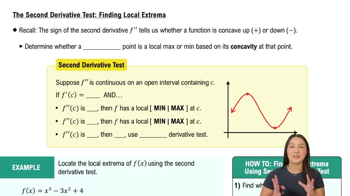
Second Derivative

The second derivative of a function, denoted as f''(x), measures the rate of change of the first derivative, f'(x). It provides information about the concavity of the function: if f''(x) is positive, the function is concave up, and if negative, it is concave down. This concept is crucial for understanding the behavior of functions and for applications in optimization and curve sketching.
추천 영상:
06:02
The Second Derivative Test: Finding Local Extrema

Theorem 8.1

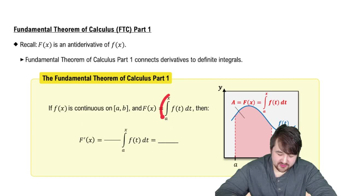
Theorem 8.1 typically refers to a specific theorem in calculus that deals with estimating errors in approximations, often related to Taylor series or numerical methods. Understanding this theorem is essential for evaluating how closely a function can be approximated by its derivatives, which is particularly relevant when calculating the second derivative and assessing the accuracy of such calculations.
추천 영상:
06:11
Fundamental Theorem of Calculus Part 1

Function Composition and Roots

The function f(x) = √(x³ + 1) involves both composition and roots. Understanding how to differentiate composite functions and apply the chain rule is vital for finding derivatives. Additionally, recognizing how to manipulate roots and powers is necessary for simplifying expressions and performing calculations accurately, especially when deriving higher-order derivatives.
추천 영상:
3:48
Evaluate Composite Functions - Special Cases