Ch. 8 - Integration Techniques
Briggs - Calculus: Early Transcendentals 3rd Edition
Briggs3rd EditionCalculus: Early TranscendentalsISBN: 9780136847243당신이 사용하는 게 아니라요?교과서 변경
8장, 문제 8.8.71b

66–71. {Use of Tech} Estimating error Refer to Theorem 8.1 in the following exercises.
71. Let f(x) = √(sin x).
b. Find an upper bound on the absolute error in the estimate from part (a) using Theorem 8.1. (Hint: |f''''(x)| ≤ 1 on [1,2].)

검증된 단계별 안내
1
Step 1: Recall Theorem 8.1, which provides a formula for estimating the error in a Taylor polynomial approximation. The error bound is given by: |Rn(x)|M(n+1)!|x-a|^n+1, where M is the maximum value of the absolute derivative of order n+1 on the interval [a, x].
Step 2: Identify the function f(x) = √(sin x) and the interval [1, 2]. The problem states that |f''''(x)| ≤ 1 on this interval, which means M = 1 for the fourth derivative.
Step 3: Determine the degree of the Taylor polynomial used in part (a). If the polynomial is of degree n, the error bound involves the (n+1)-th derivative. For this problem, we are using the fourth derivative, so n = 3.
Step 4: Substitute the values into the error formula. Using n = 3, M = 1, and the interval [1, 2], the error bound becomes: |R3(x)|14!|x-1|^4.
Step 5: Simplify the factorial term and the power term. Factorial calculations involve multiplying integers up to the given number, so 4! = 4 × 3 × 2 × 1 = 24. The error bound simplifies to: |R3(x)|124|x-1|^4. Evaluate this expression for the specific x-value used in part (a) to find the upper bound on the error.

비슷한 문제에 대한 검증된 영상 답변:

이 영상 해법은 위 문제에 도움이 된다고 튜터들이 추천한 것입니다.
영상 길이:
3m
도움이 되었나요?

주요 개념

질문에 올바르게 답하기 위해 반드시 이해해야 하는 핵심 개념들은 다음과 같습니다.

Theorem 8.1 (Taylor's Theorem)

Theorem 8.1, commonly known as Taylor's Theorem, provides a way to approximate a function using its derivatives at a specific point. It states that a function can be expressed as a Taylor series, and the remainder term quantifies the error in this approximation. Understanding this theorem is crucial for estimating the accuracy of polynomial approximations of functions.
추천 영상:
06:11
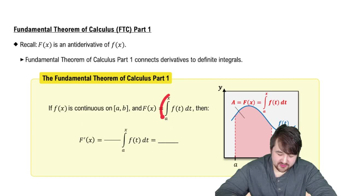
Fundamental Theorem of Calculus Part 1

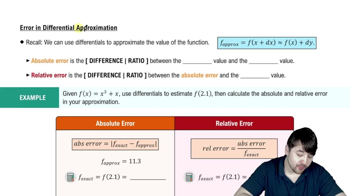
Absolute Error

Absolute error measures the difference between the true value of a function and its approximation. It is defined as the absolute value of the difference between the actual function value and the estimated value. In the context of Theorem 8.1, finding an upper bound on the absolute error helps in assessing how close the approximation is to the actual function over a specified interval.
추천 영상:
04:57
Determining Error and Relative Error

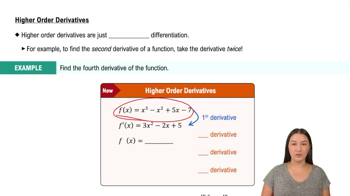
Higher-Order Derivatives

Higher-order derivatives are derivatives of a function taken multiple times. In the context of Taylor's Theorem, the behavior of these derivatives, particularly the fourth derivative in this case, is essential for determining the error bound. The hint provided in the question indicates that the fourth derivative of the function is bounded by 1 on the interval [1,2], which is key to calculating the upper bound on the absolute error.
추천 영상:
02:42
Higher Order Derivatives