Ch. 8 - Integration Techniques
Briggs - Calculus: Early Transcendentals 3rd Edition
Briggs3rd EditionCalculus: Early TranscendentalsISBN: 9780136847243당신이 사용하는 게 아니라요?교과서 변경
8장, 문제 8.9.42

7–58. Improper integrals Evaluate the following integrals or state that they diverge.
42. ∫ (from 3 to 4) 1/(x-3)³ᐟ² dx

검증된 단계별 안내
1
Identify the type of improper integral: The integrand is \( \frac{1}{(x-3)^{3/2}} \), and the lower limit of integration is \( x=3 \), where the denominator becomes zero, indicating a potential vertical asymptote and an improper integral at the lower limit.
Rewrite the integral as a limit to handle the improper behavior at \( x=3 \): Express the integral as \( \lim_{t \to 3^+} \int_{t}^{4} \frac{1}{(x-3)^{3/2}} \, dx \). This allows us to evaluate the integral over a domain where the function is defined and then take the limit as \( t \) approaches 3 from the right.
Find the antiderivative of the integrand: Use the power rule for integration by rewriting \( (x-3)^{-3/2} \) and integrating with respect to \( x \). Recall that \( \int (x-a)^n \, dx = \frac{(x-a)^{n+1}}{n+1} + C \) for \( n \neq -1 \).
Evaluate the definite integral from \( t \) to 4 using the antiderivative found in the previous step.
Take the limit as \( t \to 3^+ \) of the evaluated integral to determine if the improper integral converges or diverges.

비슷한 문제에 대한 검증된 영상 답변:

이 영상 해법은 위 문제에 도움이 된다고 튜터들이 추천한 것입니다.
영상 길이:
4m
도움이 되었나요?

주요 개념

질문에 올바르게 답하기 위해 반드시 이해해야 하는 핵심 개념들은 다음과 같습니다.

Improper Integrals

Improper integrals involve integrals with infinite limits or integrands that become unbounded within the interval. To evaluate them, we use limits to approach the problematic point and determine if the integral converges or diverges.
추천 영상:
11:11
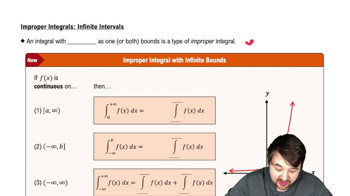
Improper Integrals: Infinite Intervals

Behavior of Functions Near Singularities

When the integrand has a singularity (like a division by zero) inside the interval, we analyze the function's behavior near that point. Understanding how the function behaves near the singularity helps decide if the integral converges or diverges.
추천 영상:
5:46
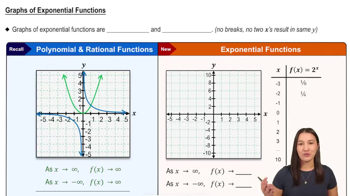
Graphs of Exponential Functions

Evaluating Limits for Convergence

To evaluate an improper integral, we replace the problematic bound with a variable and take the limit as it approaches the singularity. If the limit exists and is finite, the integral converges; otherwise, it diverges.
추천 영상:
07:51
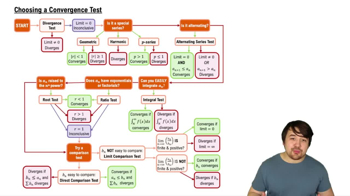
Choosing a Convergence Test
관련 실천
교과서 질문

Visual proof Let F(x)=∫₀ˣ √(a²−t²) dt. The figure shows that F(x)= area of sector OAB+ area of triangle OBC.

a. Use the figure to prove that

F(x) = (a² sin ⁻¹(x/a))/2 + x√(a²−x²)/2

b. Conclude that ∫ √(a²−x²) dx = (a² sin ⁻¹(x/a))/2 + x√(a²−x²)/2 + C.

47
views
교과서 질문

{Use of Tech} Using the integral of sec³u By reduction formula 4 in Section 8.3,

∫sec³u du = 1/2 (sec u tan u + ln |sec u + tan u|) + C


Graph the following functions and find the area under the curve on the given interval.

f(x) = (9 - x²) ⁻², [0, 3/2]

55
views
교과서 질문

102–106. Laplace transforms A powerful tool in solving problems in engineering and physics is the Laplace transform. Given a function f(t), the Laplace transform is a new function F(s) defined by F(s) = ∫[0 to ∞] e^(-st) f(t) dt, where we assume s is a positive real number. For example, to find the Laplace transform of f(t) = e^(-t), the following improper integral is evaluated using integration by parts:

F(s) = ∫[0 to ∞] e^(-st) e^(-t) dt = ∫[0 to ∞] e^(-(s+1)t) dt = 1/(s+1).

Verify the following Laplace transforms, where a is a real number.

106. f(t) = cos(at) → F(s) = s/(s² + a²)

47
views
교과서 질문

87-92. An integrand with trigonometric functions in the numerator and denominator can often be converted to a rational function using the substitution u = tan(x/2) or, equivalently, x = 2 tan⁻¹u. The following relations are used in making this change of variables.

A: dx = 2/(1 + u²) du

B: sin x = 2u/(1 + u²)

C: cos x = (1 - u²)/(1 + u²)

88. Evaluate ∫ dx/(2 + cos x).

88
views
교과서 질문

9–61. Trigonometric integrals Evaluate the following integrals.

38. ∫ tan⁵θ sec⁴θ dθ

57
views
교과서 질문

7–84. Evaluate the following integrals.

62. ∫ from 0 to π/2 √(1 + cosθ) dθ

83
views