Ch. 8 - Integration Techniques
Briggs - Calculus: Early Transcendentals 3rd Edition
Briggs3rd EditionCalculus: Early TranscendentalsISBN: 9780136847243당신이 사용하는 게 아니라요?교과서 변경
8장, 문제 8.1.44

7–64. Integration review Evaluate the following integrals.
44. ∫ from 0 to √3 of (6x³) / √(x² + 1) dx

검증된 단계별 안내
1
Step 1: Recognize the integral ∫ from 0 to √3 of (6x³) / √(x² + 1) dx. Notice that the integrand involves a rational function with a square root in the denominator. This suggests substitution might simplify the integral.
Step 2: Use the substitution u = x² + 1. Compute the derivative of u with respect to x: du/dx = 2x, or equivalently, du = 2x dx. This substitution will simplify the square root term and the denominator.
Step 3: Rewrite the limits of integration in terms of u. When x = 0, u = 0² + 1 = 1. When x = √3, u = (√3)² + 1 = 4. The integral bounds are now transformed from x = 0 to x = √3 into u = 1 to u = 4.
Step 4: Substitute into the integral. Replace x² with (u - 1) (from the substitution u = x² + 1), and replace dx with du/2x. The integral becomes ∫ from 1 to 4 of (6x³) / √u * (du / 2x). Simplify the expression by canceling x terms where possible.
Step 5: Simplify the integral further. After substitution and simplification, the integral should now be expressed entirely in terms of u. Evaluate the resulting integral using standard integration techniques, such as power rule or other applicable methods.

비슷한 문제에 대한 검증된 영상 답변:

이 영상 해법은 위 문제에 도움이 된다고 튜터들이 추천한 것입니다.
영상 길이:
7m
도움이 되었나요?

주요 개념

질문에 올바르게 답하기 위해 반드시 이해해야 하는 핵심 개념들은 다음과 같습니다.

Definite Integrals

A definite integral calculates the accumulation of a quantity, represented as the area under a curve, between two specified limits. In this case, the integral from 0 to √3 indicates that we are interested in the area under the curve of the function (6x³) / √(x² + 1) from x = 0 to x = √3.
추천 영상:
가이드 코스
05:43
Definition of the Definite Integral

Integration Techniques

To evaluate integrals, various techniques can be employed, such as substitution, integration by parts, or trigonometric identities. For the given integral, recognizing the appropriate method, such as substitution, can simplify the process of finding the antiderivative of the function.
추천 영상:
가이드 코스
06:18
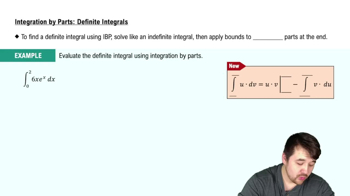
Integration by Parts for Definite Integrals

Fundamental Theorem of Calculus

The Fundamental Theorem of Calculus links differentiation and integration, stating that if F is an antiderivative of f on an interval [a, b], then the definite integral of f from a to b is F(b) - F(a). This theorem is essential for evaluating the definite integral after finding the antiderivative of the integrand.
추천 영상:
가이드 코스
06:11
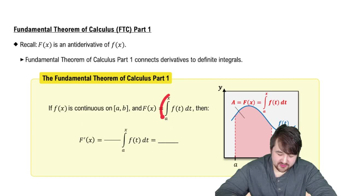
Fundamental Theorem of Calculus Part 1