Ch. 8 - Integration Techniques
Briggs - Calculus: Early Transcendentals 3rd Edition
Briggs3rd EditionCalculus: Early TranscendentalsISBN: 9780136847243당신이 사용하는 게 아니라요?교과서 변경
8장, 문제 8.8.36

River flow rates
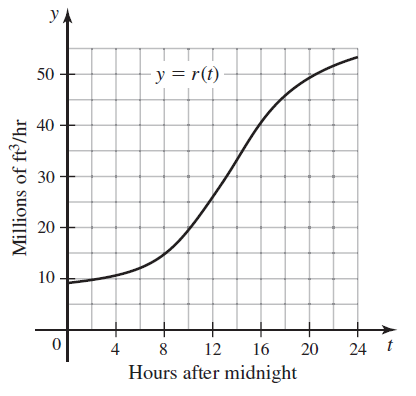
The following figure shows the discharge rate r(t) of the Snoqualmie River near Carnation, Washington, starting on a February day when the air temperature was rising. The variable t is the number of hours after midnight, r(t) is given in millions of cubic feet per hour, and ∫(0 to 24) r(t) dt equals the total amount of water that flows by the town of Carnation over a 24-hour period. Estimate ∫(0 to 24) r(t) dt using the Trapezoidal Rule and Simpson's Rule with the following values of n.


gra
n = 6

검증된 단계별 안내
1
Step 1: Understand the problem. We are tasked with estimating the integral ∫(0 to 24) r(t) dt, which represents the total amount of water that flows by the town over a 24-hour period. We will use the Trapezoidal Rule and Simpson's Rule with n = 6 subdivisions.
Step 2: Divide the interval [0, 24] into n = 6 equal subintervals. The width of each subinterval, denoted as h, is calculated as h = (24 - 0) / 6 = 4 hours.
Step 3: Identify the values of r(t) at the endpoints and intermediate points of the subintervals. From the graph, approximate r(t) at t = 0, 4, 8, 12, 16, 20, and 24. These values will be used in both the Trapezoidal Rule and Simpson's Rule.
Step 4: Apply the Trapezoidal Rule formula: ∫(a to b) f(x) dx ≈ (h/2) * [f(x₀) + 2f(x₁) + 2f(x₂) + ... + 2f(xₙ₋₁) + f(xₙ)], where x₀, x₁, ..., xₙ are the points in the interval. Substitute the values of r(t) and h into this formula.
Step 5: Apply Simpson's Rule formula: ∫(a to b) f(x) dx ≈ (h/3) * [f(x₀) + 4f(x₁) + 2f(x₂) + 4f(x₃) + ... + 4f(xₙ₋₁) + f(xₙ)], where x₀, x₁, ..., xₙ are the points in the interval. Substitute the values of r(t) and h into this formula.

비슷한 문제에 대한 검증된 영상 답변:

이 영상 해법은 위 문제에 도움이 된다고 튜터들이 추천한 것입니다.
영상 길이:
4m
도움이 되었나요?

주요 개념

질문에 올바르게 답하기 위해 반드시 이해해야 하는 핵심 개념들은 다음과 같습니다.

Definite Integral

A definite integral represents the accumulation of quantities, such as area under a curve, over a specified interval. In this context, ∫(0 to 24) r(t) dt calculates the total volume of water that flows past a point over a 24-hour period, where r(t) is the discharge rate of the river. Understanding definite integrals is crucial for estimating total quantities from rates.
추천 영상:
가이드 코스
05:43
Definition of the Definite Integral

Trapezoidal Rule

The Trapezoidal Rule is a numerical method used to approximate the value of a definite integral. It works by dividing the area under the curve into trapezoids rather than rectangles, providing a better approximation of the area. This method is particularly useful when the function is not easily integrable or when only discrete data points are available, as in the case of river flow rates.
추천 영상:
5:50
Power Rules

Simpson's Rule

Simpson's Rule is another numerical technique for estimating the value of a definite integral, which uses parabolic segments to approximate the area under a curve. It is generally more accurate than the Trapezoidal Rule, especially for functions that are smooth and continuous. This method requires an even number of intervals and is beneficial for estimating the total water flow when given discrete data points.
추천 영상:
5:50
Power Rules