

Ch. 9 - Differential Equations
Briggs - Calculus: Early Transcendentals 3rd Edition
Briggs3rd EditionCalculus: Early TranscendentalsISBN: 9780136847243당신이 사용하는 게 아니라요?교과서 변경
9장, 문제 9.2.19c

17–20. Increasing and decreasing solutions Consider the following differential equations. A detailed direction field is not needed.


c. Which initial conditions y(0) = A lead to solutions that are increasing in time? Decreasing?


y'(t) = cos y for |y| ≤ π

검증된 단계별 안내
1
First, understand that the differential equation is given by \(y'(t) = \cos y\), where \(y\) depends on \(t\) and \(|y| \leq \pi\).
Recall that the sign of \(y'(t)\) determines whether the solution \(y(t)\) is increasing or decreasing at time \(t\). Specifically, if \(y'(t) > 0\), then \(y(t)\) is increasing; if \(y'(t) < 0\), then \(y(t)\) is decreasing.
Since \(y'(t) = \cos y\), analyze the values of \(\cos y\) for \(y\) in the interval \([-\pi, \pi]\). Identify where \(\cos y\) is positive, zero, or negative.
Determine the initial conditions \(y(0) = A\) such that \(\cos A > 0\) (leading to increasing solutions) and \(\cos A < 0\) (leading to decreasing solutions). Also note the points where \(\cos A = 0\), which correspond to equilibrium solutions where \(y(t)\) does not change.
Summarize the intervals of \(A\) where solutions increase or decrease based on the sign of \(\cos A\), considering the periodic and even nature of the cosine function within the given domain.

비슷한 문제에 대한 검증된 영상 답변:

이 영상 해법은 위 문제에 도움이 된다고 튜터들이 추천한 것입니다.
영상 길이:
3m
도움이 되었나요?

주요 개념

질문에 올바르게 답하기 위해 반드시 이해해야 하는 핵심 개념들은 다음과 같습니다.

Differential Equations and Initial Conditions

A differential equation relates a function and its derivatives. The initial condition y(0) = A specifies the starting value of the solution, which influences the behavior of the solution curve over time. Understanding how initial values affect solutions is key to predicting whether the solution increases or decreases.
추천 영상:
04:00
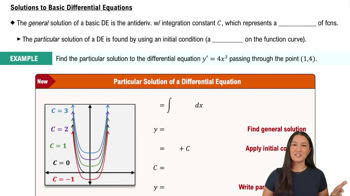
Solutions to Basic Differential Equations

Sign of the Derivative and Monotonicity

The sign of y'(t) determines whether the solution y(t) is increasing or decreasing. If y'(t) > 0, the solution is increasing; if y'(t) < 0, it is decreasing. Analyzing the expression y'(t) = cos y helps identify intervals of y where the solution grows or shrinks.
추천 영상:

Properties of the Cosine Function on the Interval |y| ≤ π

Cosine varies between -1 and 1 and is positive on (-π/2, π/2) and negative on (π/2, π) and (-π, -π/2). Since y'(t) = cos y, the sign of cos y depends on y's value, which determines whether the solution increases or decreases. Recognizing these intervals is essential for classifying initial conditions.
추천 영상:
가이드 코스
06:21
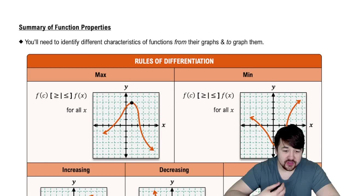
Properties of Functions
관련 실천
교과서 질문

33–36. {Use of Tech} Computing Euler approximations Use a calculator or computer program to carry out the following steps.

c. Repeating parts (a) and (b) using half the time step used in those calculations, again find an approximation to y(T).


y′(t) = 6 - 2y, y(0) = -1; Δt = 0.2, T = 3; y(t) = 3 - 4e⁻²ᵗ

44
views
교과서 질문

{Use of Tech} Logistic equation for an epidemic When an infected person is introduced into a closed and otherwise healthy community, the number of people who contract the disease (in the absence of any intervention) may be modeled by the logistic equation

 dP/dt=kP(1−P/A),P0=P_0, 

where K is a positive infection rate, A is the number of people in the community, and P0 is the number of infected people at t=0. The model also assumes no recovery. 


c. For a fixed value of K and A, describe the long-term behavior of the solutions, for any P0 with 0<P0<A. 

53
views
교과서 질문

46–48. Analyzing models The following models were discussed in Section 9.1 and reappear in later sections of this chapter. In each case, carry out the indicated analysis using direction fields.


Drug infusion The delivery of a drug (such as an antibiotic) through an intravenous line may be modeled by the differential equation m′(t)+km(t)=I, where m(t) is the mass of the drug in the blood at time t≥0, K is a constant that describes the rate at which the drug is absorbed, and I is the infusion rate. Let I=10mg/hr and k=0.05 hr^−1.

c. What is the equilibrium solution?

66
views
교과서 질문

[Use of Tech] Analysis of a separable equation Consider the differential equation yy'(t) = ½eᵗ + t and carry out the following analysis.

c. Graph the solutions in part (b) and describe their behavior as t increases. 

43
views
교과서 질문

{Use of Tech} Free fall An object in free fall may be modeled by assuming the only forces at work are the gravitational force and air resistance. By Newton’s Second Law of Motion (mass end . acceleration = the sum of external forces), the velocity of the object satisfies the differential equation 


m · v'(t) = mg + f(v)

mass | acceleration | external forces


where f is a function that models the air resistance (assuming the positive direction is downward). One common assumption (often used for motion in air) is that f(v)=−kv^2, for t≥0, where k>0 is a drag coefficient.


c. Find the solution of this separable equation assuming v(0)=0 and 0<v²<g/a. 

61
views
교과서 질문

Direction field analysis Consider the first-order initial value problem y'(t)=ay+b,y(0)=A for t≥0 where a, b, and A are real numbers.

c. Draw a representative direction field in the case that a<0. Show that if A>−b/a, then the solution decreases for t≥0, and that if A<−b/a, then the solution increases for t≥0.

42
views