Ch. 9 - Differential Equations
Briggs - Calculus: Early Transcendentals 3rd Edition
Briggs3rd EditionCalculus: Early TranscendentalsISBN: 9780136847243당신이 사용하는 게 아니라요?교과서 변경
9장, 문제 9.3.54c

[Use of Tech] Analysis of a separable equation Consider the differential equation yy'(t) = ½eᵗ + t and carry out the following analysis.
c. Graph the solutions in part (b) and describe their behavior as t increases. 

검증된 단계별 안내
1
Recall the differential equation given: \(y \cdot y'(t) = \frac{1}{2} e^{t} + t\). From part (b), you should have found the general solution \(y(t)\) by separating variables and integrating both sides.
To graph the solutions, first express \(y'(t)\) explicitly by dividing both sides by \(y\): \(y'(t) = \frac{\frac{1}{2} e^{t} + t}{y}\). However, since you have the implicit or explicit form of \(y(t)\) from part (b), use that expression to plot \(y\) against \(t\).
Use a graphing tool or software to plot the solution curves for various initial conditions. This will help visualize how \(y(t)\) behaves as \(t\) increases.
Analyze the behavior of the solutions as \(t \to \infty\). Consider the dominant terms in the solution and how the exponential \(e^{t}\) and the linear term \(t\) influence the growth or decay of \(y(t)\).
Describe the qualitative behavior: Does \(y(t)\) grow without bound, approach a finite limit, or oscillate? Note how different initial conditions affect the long-term behavior of the solutions.

비슷한 문제에 대한 검증된 영상 답변:

이 영상 해법은 위 문제에 도움이 된다고 튜터들이 추천한 것입니다.
영상 길이:
5m
도움이 되었나요?

주요 개념

질문에 올바르게 답하기 위해 반드시 이해해야 하는 핵심 개념들은 다음과 같습니다.

Separable Differential Equations

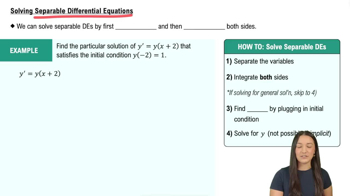
A separable differential equation can be written so that all terms involving the dependent variable y are on one side and all terms involving the independent variable t are on the other. This allows integration of both sides separately to find the general solution. Recognizing and manipulating the equation into this form is essential for solving it.
추천 영상:
06:06
Solving Separable Differential Equations

Behavior of Solutions and Graphing

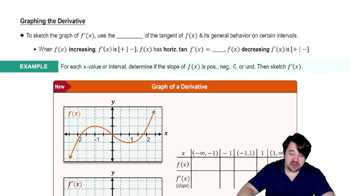
Analyzing the behavior of solutions involves understanding how the function y(t) changes as t increases, including growth, decay, or approaching asymptotes. Graphing solutions helps visualize these trends and identify long-term behavior, stability, or oscillations, which is crucial for interpreting the differential equation's implications.
추천 영상:
가이드 코스
06:15
Graphing The Derivative

Initial Conditions and Particular Solutions

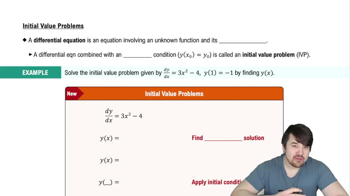
Initial conditions specify the value of the solution at a particular point, allowing determination of a unique particular solution from the general family. This is important for graphing specific solution curves and accurately describing their behavior over time, as different initial values can lead to different solution trajectories.
추천 영상:
가이드 코스
05:03
Initial Value Problems
관련 실천
교과서 질문

Another second-order equation Consider the differential equation y''(t) + k²y(t) = 0, where k is a positive real number.

c. Give the general solution of the equation for arbitrary k > 0 and verify your conjecture.

101
views

교과서 질문

Solving Bernoulli equations Use the method outlined in Exercise 43 to solve the following Bernoulli equations.


c. y′(t) + y = √y

106
views
교과서 질문

{Use of Tech} Fish harvesting A fish hatchery has 500 fish at t=0, when harvesting begins at a rate of b>0fish/year The fish population is modeled by the initial value problem y′(t)=0.01y−b,y(0)=500 where t is measured in years.


c. Graph the solution in the case that b=60fish/year. Describe the solution.

36
views
교과서 질문

17–20. Increasing and decreasing solutions Consider the following differential equations. A detailed direction field is not needed.


c. Which initial conditions y(0) = A lead to solutions that are increasing in time? Decreasing?


y'(t) = cos y for |y| ≤ π

37
views
교과서 질문

{Use of Tech} Free fall An object in free fall may be modeled by assuming the only forces at work are the gravitational force and air resistance. By Newton’s Second Law of Motion (mass end . acceleration = the sum of external forces), the velocity of the object satisfies the differential equation 


m · v'(t) = mg + f(v)

mass | acceleration | external forces


where f is a function that models the air resistance (assuming the positive direction is downward). One common assumption (often used for motion in air) is that f(v)=−kv^2, for t≥0, where k>0 is a drag coefficient.


c. Find the solution of this separable equation assuming v(0)=0 and 0<v²<g/a. 

61
views
교과서 질문

Direction field analysis Consider the first-order initial value problem y'(t)=ay+b,y(0)=A for t≥0 where a, b, and A are real numbers.

c. Draw a representative direction field in the case that a<0. Show that if A>−b/a, then the solution decreases for t≥0, and that if A<−b/a, then the solution increases for t≥0.

42
views