
Ch. 9 - Differential Equations
Briggs - Calculus: Early Transcendentals 3rd Edition
Briggs3rd EditionCalculus: Early TranscendentalsISBN: 9780136847243당신이 사용하는 게 아니라요?교과서 변경
9장, 문제 9.1.27

21–32. Finding general solutions Find the general solution of each differential equation. Use C,C1,C2... to denote arbitrary constants.
u''(x) = 55x⁹ + 36x⁷ - 21x⁵ + 10x⁻³

검증된 단계별 안내
1
Recognize that the given differential equation is a second-order ordinary differential equation of the form \(u''(x) = f(x)\), where \(f(x) = 55x^{9} + 36x^{7} - 21x^{5} + 10x^{-3}\).
To find the general solution \(u(x)\), integrate the right-hand side function \(f(x)\) twice with respect to \(x\). The first integration will give \(u'(x)\), and the second integration will give \(u(x)\).
Perform the first integration: calculate \(u'(x) = \int (55x^{9} + 36x^{7} - 21x^{5} + 10x^{-3}) \, dx\). Integrate each term separately using the power rule for integration, which states \(\int x^{n} \, dx = \frac{x^{n+1}}{n+1} + C\) for \(n \neq -1\).
After finding \(u'(x)\), perform the second integration: calculate \(u(x) = \int u'(x) \, dx\). Again, integrate each term separately and add a new arbitrary constant of integration.
Combine the results to write the general solution as \(u(x) = \) (the expression from the second integration) \(+ C_1 x + C_2\), where \(C_1\) and \(C_2\) are arbitrary constants representing the general solution's family.

비슷한 문제에 대한 검증된 영상 답변:

이 영상 해법은 위 문제에 도움이 된다고 튜터들이 추천한 것입니다.
영상 길이:
4m
도움이 되었나요?

주요 개념

질문에 올바르게 답하기 위해 반드시 이해해야 하는 핵심 개념들은 다음과 같습니다.

Second-Order Differential Equations

A second-order differential equation involves the second derivative of an unknown function. Solving such equations means finding a function whose second derivative satisfies the given equation. The general solution includes all possible functions that fit the equation, often expressed with arbitrary constants.
추천 영상:
07:39
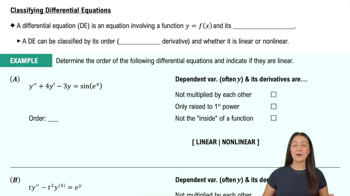
Classifying Differential Equations

Integration to Find General Solutions

To solve u''(x) = f(x), integrate the right-hand side twice with respect to x. Each integration introduces an arbitrary constant, reflecting the family of solutions. This process transforms the differential equation into an explicit formula for u(x).
추천 영상:
05:11
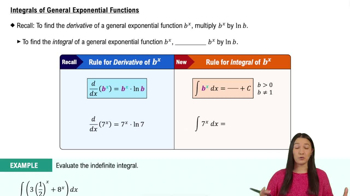
Integrals of General Exponential Functions

Handling Polynomial and Negative Powers in Integration

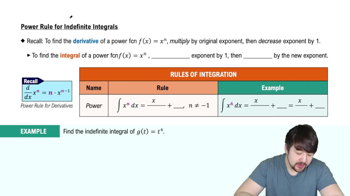
When integrating terms like x⁹ or x⁻³, apply the power rule: ∫x^n dx = x^(n+1)/(n+1) for n ≠ -1. For negative powers, ensure the integral is defined and carefully add constants. This technique is essential for integrating the given right-hand side accurately.
추천 영상:
04:04
Power Rule for Indefinite Integrals