
Ch. 9 - Differential Equations
Briggs - Calculus: Early Transcendentals 3rd Edition
Briggs3rd EditionCalculus: Early TranscendentalsISBN: 9780136847243당신이 사용하는 게 아니라요?교과서 변경
9장, 문제 9.2.33b

33–36. {Use of Tech} Computing Euler approximations Use a calculator or computer program to carry out the following steps.
b. Using the exact solution (also given), find the error in the approximation to y(T) (only at the right endpoint of the time interval).


y′(t) = -2y, y(0) = 1; Δt = 0.2, T = 2; y(t) = e⁻²ᵗ

검증된 단계별 안내
1
Identify the differential equation and initial condition: \(y'(t) = -2y\), with \(y(0) = 1\).
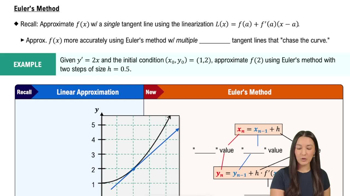
Set up Euler's method formula for approximating the solution: \(y_{n+1} = y_n + \Delta t \cdot f(t_n, y_n)\), where \(f(t, y) = -2y\).
Calculate the number of steps needed to reach \(T = 2\) using the step size \(\Delta t = 0.2\): \(N = \frac{T - 0}{\Delta t} = \frac{2}{0.2} = 10\) steps.
Iteratively apply Euler's method starting from \(y_0 = 1\) to compute \(y_1, y_2, \ldots, y_{10}\) using the formula from step 2.
Find the exact solution at \(T=2\) using the given formula \(y(2) = e^{-2 \cdot 2} = e^{-4}\), then calculate the error as \(|y_{10} - y(2)|\).

비슷한 문제에 대한 검증된 영상 답변:

이 영상 해법은 위 문제에 도움이 된다고 튜터들이 추천한 것입니다.
영상 길이:
9m
도움이 되었나요?

주요 개념

질문에 올바르게 답하기 위해 반드시 이해해야 하는 핵심 개념들은 다음과 같습니다.

Euler's Method

Euler's Method is a numerical technique to approximate solutions of first-order differential equations. It uses a step size Δt to iteratively estimate the value of y at discrete points by moving along the slope given by y′(t). This method is simple but can accumulate error depending on the step size and interval length.
추천 영상:
07:33
Euler's Method

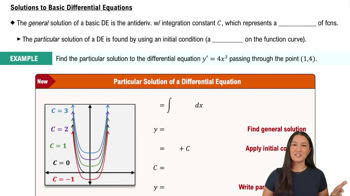
Exact Solution of Differential Equations

The exact solution is the precise function that satisfies the differential equation and initial condition. For y′(t) = -2y with y(0) = 1, the exact solution is y(t) = e⁻²ᵗ. Knowing the exact solution allows comparison with numerical approximations to evaluate their accuracy.
추천 영상:
04:00
Solutions to Basic Differential Equations

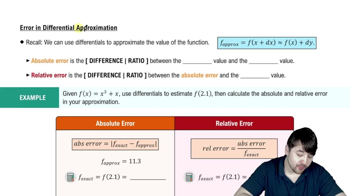
Error Analysis in Numerical Methods

Error analysis involves calculating the difference between the numerical approximation and the exact solution at a specific point, here at t = T. This helps assess the accuracy of the approximation and understand how step size and method choice affect the result.
추천 영상:
가이드 코스
04:57
Determining Error and Relative Error
관련 실천
교과서 질문

23–26. Stirred tank reactions For each of the following stirred tank reactions, carry out the following analysis.

b. Solve the initial value problem.


A 500-L tank is initially filled with pure water. A copper sulfate solution with a concentration of 20 g/L flows into the tank at a rate of 4 L/min. The thoroughly mixed solution is drained from the tank at a rate of 4 L/min.

39
views
교과서 질문

27–30. Predator-prey models Consider the following pairs of differential equations that model a predator-prey system with populations x and y. In each case, carry out the following steps.

b. Find the lines along which x'(t) = 0. Find the lines along which y'(t) = 0.


x′(t) = 2x − 4xy, y′(t) = −y + 2xy

40
views
교과서 질문

17–20. Increasing and decreasing solutions Consider the following differential equations. A detailed direction field is not needed.


b. In what regions are solutions increasing? Decreasing?


y'(t) = (y−1)(1+y)

47
views
교과서 질문

Properties of stirred tank solutions


b. Verify that M(0) = M₀

48
views
교과서 질문

Explain why or why not Determine whether the following statements are true and give an explanation or counterexample.

b. Euler’s method is used to compute exact values of the solution of an initial value problem. 

62
views
교과서 질문

Explain why or why not Determine whether the following statements are true and give an explanation or counterexample.


b. The solution of a stirred tank initial value problem always approaches a constant as t→∞

56
views