
Ch. 9 - Differential Equations
Briggs - Calculus: Early Transcendentals 3rd Edition
Briggs3rd EditionCalculus: Early TranscendentalsISBN: 9780136847243당신이 사용하는 게 아니라요?교과서 변경
9장, 문제 9.5.31b

Explain why or why not Determine whether the following statements are true and give an explanation or counterexample.


b. The solution of a stirred tank initial value problem always approaches a constant as t→∞

검증된 단계별 안내
1
Step 1: Understand the problem context. A stirred tank initial value problem typically models the concentration or temperature in a tank over time, often described by a differential equation with an initial condition.
Step 2: Recall that the long-term behavior of solutions to differential equations depends on the nature of the equation, especially whether it has stable equilibrium points.
Step 3: Consider that if the system has a stable equilibrium (a constant solution where the derivative is zero), then solutions starting near that equilibrium will approach it as \(t \to \infty\).
Step 4: However, if the system is non-autonomous, or if the equilibrium is unstable or does not exist, the solution may not approach a constant; it could oscillate, grow without bound, or behave otherwise.
Step 5: Therefore, to determine if the solution always approaches a constant, analyze the specific differential equation governing the stirred tank problem, check for equilibrium points and their stability, and provide a counterexample if such conditions are not met.

비슷한 문제에 대한 검증된 영상 답변:

이 영상 해법은 위 문제에 도움이 된다고 튜터들이 추천한 것입니다.
영상 길이:
3m
도움이 되었나요?

주요 개념

질문에 올바르게 답하기 위해 반드시 이해해야 하는 핵심 개념들은 다음과 같습니다.

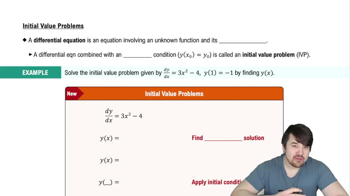
Initial Value Problems (IVPs)

An initial value problem involves solving a differential equation with a given starting condition. The solution describes how a system evolves over time from that initial state, and understanding IVPs is essential to analyze the behavior of solutions as time progresses.
추천 영상:
가이드 코스
05:03
Initial Value Problems

Long-term Behavior and Stability of Solutions

This concept examines whether solutions to differential equations approach a steady state, oscillate, or diverge as time goes to infinity. Stability analysis helps determine if solutions settle to constants or exhibit other behaviors, which is crucial for assessing the statement about the solution approaching a constant.
추천 영상:
05:21
Finding Limits by Direct Substitution

Properties of Stirred Tank Models

Stirred tank problems often model mixing processes using differential equations that may have equilibrium points. Understanding the physical setup and mathematical formulation helps predict if the concentration or state variables stabilize or not, informing whether the solution approaches a constant as time increases.
추천 영상:
가이드 코스
06:21
Properties of Functions
관련 실천
교과서 질문

33–36. {Use of Tech} Computing Euler approximations Use a calculator or computer program to carry out the following steps.

b. Using the exact solution (also given), find the error in the approximation to y(T) (only at the right endpoint of the time interval).


y′(t) = -2y, y(0) = 1; Δt = 0.2, T = 2; y(t) = e⁻²ᵗ

49
views
교과서 질문

Properties of stirred tank solutions


b. Verify that M(0) = M₀

48
views
교과서 질문

Explain why or why not Determine whether the following statements are true and give an explanation or counterexample.

b. Euler’s method is used to compute exact values of the solution of an initial value problem. 

62
views
교과서 질문

Blowup in finite time Consider the initial value problem y'(t) = yⁿ + 1, y(0) = y₀, where n is a positive integer.

b. Solve the initial value problem with n = 2 and y₀ = 1/√2.

89
views
교과서 질문

38–43. Equilibrium solutions A differential equation of the form y′(t)=f(y) is said to be autonomous (the function f depends only on y). The constant function y=y0 is an equilibrium solution of the equation provided f(y0)=0 (because then y'(t)=0 and the solution remains constant for all t). Note that equilibrium solutions correspond to horizontal lines in the direction field. Note also that for autonomous equations, the direction field is independent of t. Carry out the following analysis on the given equations.

b. Sketch the direction field, for t≥0.


y′(t) = 2y + 4

67
views
교과서 질문

38–43. Equilibrium solutions A differential equation of the form y′(t)=f(y) is said to be autonomous (the function f depends only on y). The constant function y=y0 is an equilibrium solution of the equation provided f(y0)=0 (because then y'(t)=0 and the solution remains constant for all t). Note that equilibrium solutions correspond to horizontal lines in the direction field. Note also that for autonomous equations, the direction field is independent of t. Carry out the following analysis on the given equations.

b. Sketch the direction field, for t≥0. 


y′(t) = 6 - 2y

25
views