
Ch. 9 - Differential Equations
Briggs - Calculus: Early Transcendentals 3rd Edition
Briggs3rd EditionCalculus: Early TranscendentalsISBN: 9780136847243당신이 사용하는 게 아니라요?교과서 변경
9장, 문제 9.2.39c

38–43. Equilibrium solutions A differential equation of the form y′(t)=f(y) is said to be autonomous (the function f depends only on y). The constant function y=y0 is an equilibrium solution of the equation provided f(y0)=0 (because then y'(t)=0 and the solution remains constant for all t). Note that equilibrium solutions correspond to horizontal lines in the direction field. Note also that for autonomous equations, the direction field is independent of t. Carry out the following analysis on the given equations.
c. Sketch the solution curve that corresponds to the initial condition y0=1. 


y′(t) = 6 - 2y

검증된 단계별 안내
1
Identify the given autonomous differential equation: \(y'(t) = 6 - 2y\).
Find the equilibrium solution(s) by setting the right-hand side equal to zero: solve \(6 - 2y = 0\) for \(y\).
Determine the equilibrium value \(y_0\) where \(y'(t) = 0\), which corresponds to a constant solution \(y(t) = y_0\).
Analyze the behavior of solutions near the equilibrium by considering the sign of \(y'(t)\) when \(y\) is slightly less than or greater than \(y_0\).
Sketch the solution curve starting from the initial condition \(y(0) = 1\) by considering whether the solution moves toward or away from the equilibrium and the slope given by \(y'(t) = 6 - 2y\) at \(y=1\).

비슷한 문제에 대한 검증된 영상 답변:

이 영상 해법은 위 문제에 도움이 된다고 튜터들이 추천한 것입니다.
영상 길이:
3m

주요 개념

질문에 올바르게 답하기 위해 반드시 이해해야 하는 핵심 개념들은 다음과 같습니다.

Autonomous Differential Equations

An autonomous differential equation has the form y'(t) = f(y), where the rate of change depends only on y, not explicitly on t. This means the behavior of solutions depends solely on the current value of y, making the direction field time-invariant and simplifying analysis of solution curves.
추천 영상:
07:39
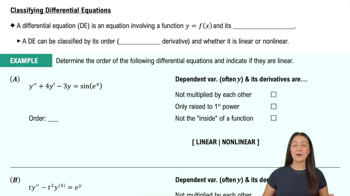
Classifying Differential Equations

Equilibrium Solutions

Equilibrium solutions occur when y'(t) = f(y) = 0, meaning the solution y(t) remains constant over time. These correspond to horizontal lines in the direction field and represent steady states where the system does not change, providing key reference points for sketching solution behavior.
추천 영상:
04:00
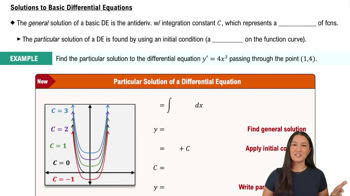
Solutions to Basic Differential Equations

Solution Curves and Initial Conditions

Given an initial condition y(0) = y0, the solution curve is the unique function satisfying the differential equation and starting at y0. Sketching this curve involves understanding how y changes over time from y0, guided by the slope field and equilibrium points to predict increasing or decreasing trends.
추천 영상:
가이드 코스
05:03
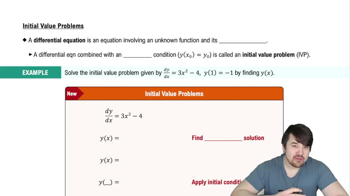
Initial Value Problems
관련 실천
교과서 질문

38–43. Equilibrium solutions A differential equation of the form y′(t)=f(y) is said to be autonomous (the function f depends only on y). The constant function y=y0 is an equilibrium solution of the equation provided f(y0)=0 (because then y'(t)=0 and the solution remains constant for all t). Note that equilibrium solutions correspond to horizontal lines in the direction field. Note also that for autonomous equations, the direction field is independent of t. Carry out the following analysis on the given equations.

c. Sketch the solution curve that corresponds to the initial condition y0=1. 


y′(t) = 2y + 4

51
views
교과서 질문

27–30. Predator-prey models Consider the following pairs of differential equations that model a predator-prey system with populations x and y. In each case, carry out the following steps.

c. Find the equilibrium points for the system.


x′(t) = −3x + xy, y′(t) = 2y − xy

40
views
교과서 질문

52-56. In this section, several models are presented and the solution of the associated differential equation is given. Later in the chapter, we present methods for solving these differential equations.


(Use of Tech) Chemical rate equations The reaction of certain chemical compounds can be modeled using a differential equation of the form y'(t) = -kyⁿ(t), where y(t) is the concentration of the compound, for t ≥ 0, k > 0 is a constant that determines the speed of the reaction, and n is a positive integer called the order of the reaction. Assume the initial concentration of the compound is y(0) = y₀ > 0.


c. Let y₀ = 1 and k = 0.1. Graph the first-order and second-order solutions found in parts (a) and (b). Compare the two reactions. 

48
views
교과서 질문

Another second-order equation Consider the differential equation y''(t) + k²y(t) = 0, where k is a positive real number.

c. Give the general solution of the equation for arbitrary k > 0 and verify your conjecture.

101
views
교과서 질문

Solving Bernoulli equations Use the method outlined in Exercise 43 to solve the following Bernoulli equations.


c. y′(t) + y = √y

106
views
교과서 질문

Cooling time Suppose an object with an initial temperature of T₀ > 0 is put in surroundings with an ambient temperature of A, where A < T₀/2. Let t₁/₂ be the time required for the object to cool to T₀/2.


c. Why is the condition A < T₀/2 needed?

49
views