
Ch. 9 - Differential Equations
Briggs - Calculus: Early Transcendentals 3rd Edition
Briggs3rd EditionCalculus: Early TranscendentalsISBN: 9780136847243당신이 사용하는 게 아니라요?교과서 변경
9장, 문제 9.4.38c

Cooling time Suppose an object with an initial temperature of T₀ > 0 is put in surroundings with an ambient temperature of A, where A < T₀/2. Let t₁/₂ be the time required for the object to cool to T₀/2.


c. Why is the condition A < T₀/2 needed?

검증된 단계별 안내
1
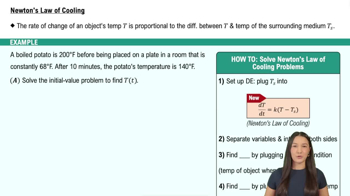
Recall that the cooling process is often modeled by Newton's Law of Cooling, which states that the rate of change of the temperature \(T(t)\) of the object is proportional to the difference between its temperature and the ambient temperature \(A\). Mathematically, this is expressed as: \[\frac{dT}{dt} = -k (T - A)\] where \(k > 0\) is a constant related to the cooling rate.
The solution to this differential equation with initial condition \(T(0) = T_0\) is: \[T(t) = A + (T_0 - A) e^{-k t}\] This shows that the temperature approaches the ambient temperature \(A\) as time \(t\) increases.
The time \(t_{1/2}\) is defined as the time when the temperature reaches half of the initial temperature, i.e., when \(T(t_{1/2}) = \frac{T_0}{2}\). Substitute this into the solution: \[\frac{T_0}{2} = A + (T_0 - A) e^{-k t_{1/2}}\]
To solve for \(t_{1/2}\), isolate the exponential term: \[e^{-k t_{1/2}} = \frac{\frac{T_0}{2} - A}{T_0 - A}\] For this expression to make sense (specifically, for the right side to be positive and less than 1), the numerator \(\frac{T_0}{2} - A\) must be positive. This requires that \[A < \frac{T_0}{2}\]
Therefore, the condition \(A < \frac{T_0}{2}\) is needed to ensure that the temperature \(\frac{T_0}{2}\) is actually between the ambient temperature \(A\) and the initial temperature \(T_0\). Without this condition, the object cannot cool down to \(\frac{T_0}{2}\) because the ambient temperature is already higher or equal to that value.

비슷한 문제에 대한 검증된 영상 답변:

이 영상 해법은 위 문제에 도움이 된다고 튜터들이 추천한 것입니다.
영상 길이:
4m
도움이 되었나요?

주요 개념

질문에 올바르게 답하기 위해 반드시 이해해야 하는 핵심 개념들은 다음과 같습니다.

Newton's Law of Cooling

Newton's Law of Cooling states that the rate of change of an object's temperature is proportional to the difference between its temperature and the ambient temperature. This law models how objects cool or warm over time, typically leading to an exponential decay toward the ambient temperature.
추천 영상:
10:44
Newton's Law of Cooling

Exponential Decay and Temperature Limits

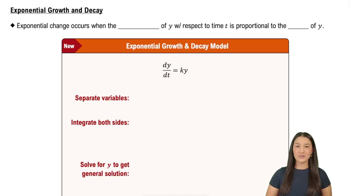
The temperature of a cooling object approaches the ambient temperature asymptotically, never going below it. Understanding exponential decay helps explain why the object’s temperature decreases over time but stabilizes at the ambient temperature, which sets a lower bound for cooling.
추천 영상:
09:29
Exponential Growth & Decay

Importance of the Condition A < T₀/2

The condition A < T₀/2 ensures that the ambient temperature is lower than half the initial temperature, making it possible for the object to cool down to T₀/2. If A were greater or equal to T₀/2, the object could never reach that temperature since it cannot cool below the ambient temperature.
추천 영상:
02:44
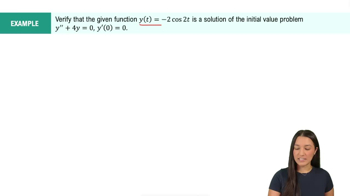
Verifying Solutions of Differential Equations Example 2
관련 실천
교과서 질문

38–43. Equilibrium solutions A differential equation of the form y′(t)=f(y) is said to be autonomous (the function f depends only on y). The constant function y=y0 is an equilibrium solution of the equation provided f(y0)=0 (because then y'(t)=0 and the solution remains constant for all t). Note that equilibrium solutions correspond to horizontal lines in the direction field. Note also that for autonomous equations, the direction field is independent of t. Carry out the following analysis on the given equations.

c. Sketch the solution curve that corresponds to the initial condition y0=1. 


y′(t) = 2y + 4

51
views
교과서 질문

38–43. Equilibrium solutions A differential equation of the form y′(t)=f(y) is said to be autonomous (the function f depends only on y). The constant function y=y0 is an equilibrium solution of the equation provided f(y0)=0 (because then y'(t)=0 and the solution remains constant for all t). Note that equilibrium solutions correspond to horizontal lines in the direction field. Note also that for autonomous equations, the direction field is independent of t. Carry out the following analysis on the given equations.

c. Sketch the solution curve that corresponds to the initial condition y0=1. 


y′(t) = 6 - 2y

55
views
교과서 질문

{Use of Tech} Free fall Using th e background given in Exercise 47, assume the resistance is given by f(v)=−Rv, for t≥0, where R>0 is a drag coefficient (an assumption often made for a heavy medium such as water or oil).


c. Find the solution of this separable equation assuming v(0)=0 and 0<v<g/b.

51
views
교과서 질문

27–30. Predator-prey models Consider the following pairs of differential equations that model a predator-prey system with populations x and y. In each case, carry out the following steps.

c. Find the equilibrium points for the system.


x′(t) = −3x + xy, y′(t) = 2y − xy

40
views
교과서 질문

52-56. In this section, several models are presented and the solution of the associated differential equation is given. Later in the chapter, we present methods for solving these differential equations.


(Use of Tech) Chemical rate equations The reaction of certain chemical compounds can be modeled using a differential equation of the form y'(t) = -kyⁿ(t), where y(t) is the concentration of the compound, for t ≥ 0, k > 0 is a constant that determines the speed of the reaction, and n is a positive integer called the order of the reaction. Assume the initial concentration of the compound is y(0) = y₀ > 0.


c. Let y₀ = 1 and k = 0.1. Graph the first-order and second-order solutions found in parts (a) and (b). Compare the two reactions. 

48
views
교과서 질문

Solving Bernoulli equations Use the method outlined in Exercise 43 to solve the following Bernoulli equations.


c. y′(t) + y = √y

106
views