Ch. 9 - Differential Equations
Briggs - Calculus: Early Transcendentals 3rd Edition
Briggs3rd EditionCalculus: Early TranscendentalsISBN: 9780136847243당신이 사용하는 게 아니라요?교과서 변경
9장, 문제 9.2.40a

38–43. Equilibrium solutions A differential equation of the form y′(t)=f(y) is said to be autonomous (the function f depends only on y). The constant function y=y0 is an equilibrium solution of the equation provided f(y0)=0 (because then y'(t)=0 and the solution remains constant for all t). Note that equilibrium solutions correspond to horizontal lines in the direction field. Note also that for autonomous equations, the direction field is independent of t. Carry out the following analysis on the given equations.
a. Find the equilibrium solutions. 


y′(t) = y(2 - y)

검증된 단계별 안내
1
Identify the given autonomous differential equation: \(y'(t) = y(2 - y)\).
Recall that equilibrium solutions occur where the derivative \(y'(t)\) is zero, meaning the function \(y(t)\) does not change over time.
Set the right-hand side of the differential equation equal to zero to find equilibrium points: \(y(2 - y) = 0\).
Solve the equation \(y(2 - y) = 0\) by factoring or using the zero product property, which gives the values of \(y\) where the derivative is zero.
The solutions to this equation are the equilibrium solutions \(y = 0\) and \(y = 2\), representing constant solutions where the slope field is horizontal.

비슷한 문제에 대한 검증된 영상 답변:

이 영상 해법은 위 문제에 도움이 된다고 튜터들이 추천한 것입니다.
영상 길이:
1m

주요 개념

질문에 올바르게 답하기 위해 반드시 이해해야 하는 핵심 개념들은 다음과 같습니다.

Autonomous Differential Equations

An autonomous differential equation is one where the derivative y' depends only on the variable y, not explicitly on the independent variable t. This means the rate of change of y depends solely on y itself, simplifying analysis and allowing the direction field to be independent of t.
추천 영상:
07:39
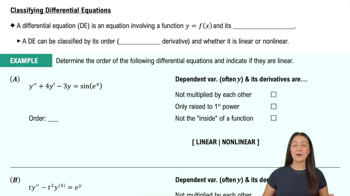
Classifying Differential Equations

Equilibrium Solutions

Equilibrium solutions occur when y'(t) = 0, meaning the function y(t) remains constant over time. For autonomous equations y' = f(y), equilibrium solutions are found by solving f(y) = 0. These solutions correspond to horizontal lines in the direction field.
추천 영상:
04:00
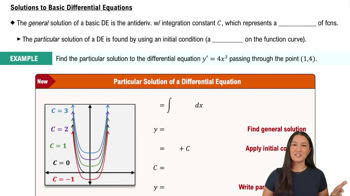
Solutions to Basic Differential Equations

Stability of Equilibrium Solutions

Stability refers to whether solutions near an equilibrium tend to move towards or away from it over time. By analyzing the sign of f(y) around equilibrium points, one can determine if the equilibrium is stable (attracting), unstable (repelling), or semi-stable.
추천 영상:
04:00
Solutions to Basic Differential Equations
관련 실천
교과서 질문

Explain why or why not Determine whether the following statements are true and give an explanation or counterexample.

a. The differential equation y′+2y=t is first-order, linear, and separable.

47
views

교과서 질문

29–32. {Use of Tech} Errors in Euler’s method Consider the following initial value problems.


a. Find the approximations to y(0.2) and y(0.4) using Euler’s method with time steps of Δt = 0.2, 0.1, 0.05, and 0.025.


y′(t) = y/2, y(0) = 2; y(t) = 2eᵗᐟ²

69
views
교과서 질문

{Use of Tech} Logistic equation for an epidemic When an infected person is introduced into a closed and otherwise healthy community, the number of people who contract the disease (in the absence of any intervention) may be modeled by the logistic equation

dP/dt=kP(1−P/A),P0=P_0,

where K is a positive infection rate, A is the number of people in the community, and P0 is the number of infected people at t=0. The model also assumes no recovery.

a. Find the solution of the initial value problem, for t≥0, in terms of K, A, and P0.

50
views
교과서 질문

Explain why or why not Determine whether the following statements are true and give an explanation or counterexample.

d. The direction field for the differential equation y′(t)=t+y(t) is plotted in the ty-plane.

34
views
교과서 질문

27–30. Predator-prey models Consider the following pairs of differential equations that model a predator-prey system with populations x and y. In each case, carry out the following steps.

a. Identify which equation corresponds to the predator and which corresponds to the prey.


x′(t) = −3x + xy, y′(t) = 2y − xy

72
views
교과서 질문

Stirred tank reaction A 100-L tank is filled with pure water when an inflow pipe is opened and a sugar solution with a concentration of 20 gm/L flows into the tank at a rate of 0.5 L/min. The solution is thoroughly mixed and flows out of the tank at a rate of 0.5 L/min.


c. At what time does the mass of sugar reach 95% of its steady-state level?

52
views