Ch. 9 - Differential Equations
Briggs - Calculus: Early Transcendentals 3rd Edition
Briggs3rd EditionCalculus: Early TranscendentalsISBN: 9780136847243당신이 사용하는 게 아니라요?교과서 변경
9장, 문제 9.RE.1d

Explain why or why not Determine whether the following statements are true and give an explanation or counterexample.
d. The direction field for the differential equation y′(t)=t+y(t) is plotted in the ty-plane.

검증된 단계별 안내
1
Recall that a direction field (or slope field) for a differential equation of the form \(y'(t) = f(t, y)\) is a graphical representation that shows the slope of the solution curve at each point \((t, y)\) in the \(ty\)-plane.
In this problem, the differential equation is \(y'(t) = t + y(t)\), where the slope at any point depends on both the independent variable \(t\) and the dependent variable \(y\).
Since the slope depends on both \(t\) and \(y\), the direction field must be plotted in the \(ty\)-plane, where the horizontal axis represents \(t\) and the vertical axis represents \(y\).
At each point \((t, y)\) in this plane, a small line segment is drawn with slope equal to \(t + y\), visually indicating the direction of the solution curve passing through that point.
Therefore, the statement is true because the direction field for \(y'(t) = t + y(t)\) is indeed plotted in the \(ty\)-plane.

비슷한 문제에 대한 검증된 영상 답변:

이 영상 해법은 위 문제에 도움이 된다고 튜터들이 추천한 것입니다.
영상 길이:
2m
도움이 되었나요?

주요 개념

질문에 올바르게 답하기 위해 반드시 이해해야 하는 핵심 개념들은 다음과 같습니다.

Direction Fields for Differential Equations

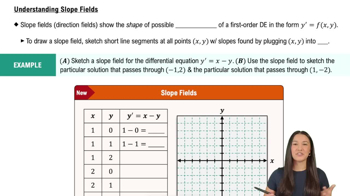
A direction field (or slope field) is a graphical representation of a first-order differential equation, showing small line segments with slopes given by the equation at various points. It helps visualize the behavior of solutions without solving the equation explicitly.
추천 영상:
05:45
Understanding Slope Fields

Independent and Dependent Variables in Differential Equations

In a differential equation y'(t) = f(t, y), t is the independent variable (often representing time), and y(t) is the dependent variable. The direction field is typically plotted in the plane with axes representing these variables, usually the t-y plane.
추천 영상:
07:39
Classifying Differential Equations

Interpreting the ty-plane vs. t-y Plane

The notation 'ty-plane' can be ambiguous; the standard convention is to plot the direction field in the t-y plane, where the horizontal axis is t and the vertical axis is y. Understanding this helps determine if the statement about plotting in the 'ty-plane' is correct or not.
추천 영상:
04:47
Introduction to Parametric Equations
관련 실천
교과서 질문

Explain why or why not Determine whether the following statements are true and give an explanation or counterexample.

a. The differential equation y′+2y=t is first-order, linear, and separable.

47
views

교과서 질문

Logistic growth in India The population of India was 435 million in 1960 (t=0) and 487 million in 1965 (t=5). The projected population for 2050 is 1.57 billion.

b. Use the solution of the logistic equation and the 2050 projected population to determine the carrying capacity.

52
views
교과서 질문

2–10. General solutions Use the method of your choice to find the general solution of the following differential equations.

y′(t) = √(y/t)

34
views
교과서 질문

38–43. Equilibrium solutions A differential equation of the form y′(t)=f(y) is said to be autonomous (the function f depends only on y). The constant function y=y0 is an equilibrium solution of the equation provided f(y0)=0 (because then y'(t)=0 and the solution remains constant for all t). Note that equilibrium solutions correspond to horizontal lines in the direction field. Note also that for autonomous equations, the direction field is independent of t. Carry out the following analysis on the given equations.

a. Find the equilibrium solutions. 


y′(t) = y(2 - y)

84
views
교과서 질문

27–30. Predator-prey models Consider the following pairs of differential equations that model a predator-prey system with populations x and y. In each case, carry out the following steps.

a. Identify which equation corresponds to the predator and which corresponds to the prey.


x′(t) = −3x + xy, y′(t) = 2y − xy

72
views
교과서 질문

Stirred tank reaction A 100-L tank is filled with pure water when an inflow pipe is opened and a sugar solution with a concentration of 20 gm/L flows into the tank at a rate of 0.5 L/min. The solution is thoroughly mixed and flows out of the tank at a rate of 0.5 L/min.


c. At what time does the mass of sugar reach 95% of its steady-state level?

52
views