Ch. 9 - Differential Equations
Briggs - Calculus: Early Transcendentals 3rd Edition
Briggs3rd EditionCalculus: Early TranscendentalsISBN: 9780136847243당신이 사용하는 게 아니라요?교과서 변경
9장, 문제 9.2.39b

38–43. Equilibrium solutions A differential equation of the form y′(t)=f(y) is said to be autonomous (the function f depends only on y). The constant function y=y0 is an equilibrium solution of the equation provided f(y0)=0 (because then y'(t)=0 and the solution remains constant for all t). Note that equilibrium solutions correspond to horizontal lines in the direction field. Note also that for autonomous equations, the direction field is independent of t. Carry out the following analysis on the given equations.
b. Sketch the direction field, for t≥0. 


y′(t) = 6 - 2y

검증된 단계별 안내
1
Identify that the given differential equation is autonomous because the right-hand side depends only on y: \(y'(t) = 6 - 2y\).
Find the equilibrium solution(s) by setting \(y'(t) = 0\), which means solving \(6 - 2y = 0\) for \(y\).
Solve the equation \(6 - 2y = 0\) to find the equilibrium value(s) \(y_0\) where the slope of the solution is zero, indicating horizontal lines in the direction field.
To sketch the direction field for \(t \geq 0\), choose several values of \(y\) and compute the slope \(y'(t) = 6 - 2y\) at each of these points. Since the equation is autonomous, the slope depends only on \(y\), not on \(t\).
Draw short line segments at points \((t, y)\) with \(t \geq 0\) where the slope of each segment corresponds to the value of \(6 - 2y\). Include the equilibrium solution as a horizontal line where the slope is zero.

비슷한 문제에 대한 검증된 영상 답변:

이 영상 해법은 위 문제에 도움이 된다고 튜터들이 추천한 것입니다.
영상 길이:
2m

주요 개념

질문에 올바르게 답하기 위해 반드시 이해해야 하는 핵심 개념들은 다음과 같습니다.

Autonomous Differential Equations

An autonomous differential equation is one where the derivative y' depends only on the variable y, not explicitly on the independent variable t. This means the rate of change of y depends solely on y's current value, simplifying analysis and allowing direction fields to be independent of t.
추천 영상:
07:39
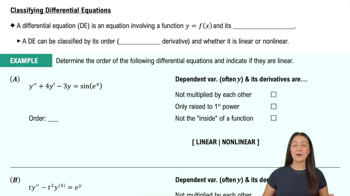
Classifying Differential Equations

Equilibrium Solutions

Equilibrium solutions occur when y' = 0, meaning the function f(y) equals zero at some y = y0. These solutions are constant functions where the system remains steady over time, represented as horizontal lines in the direction field.
추천 영상:
04:00
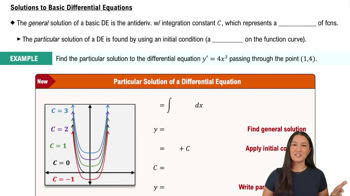
Solutions to Basic Differential Equations

Direction Fields (Slope Fields)

A direction field is a graphical tool showing slopes y' = f(y) at various points (t, y). For autonomous equations, slopes depend only on y, so the field consists of horizontal slices with constant slopes, helping visualize solution behavior without solving the equation explicitly.
추천 영상:
05:45
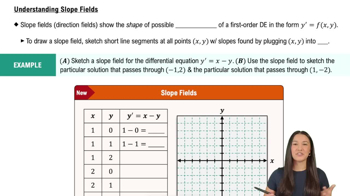
Understanding Slope Fields
관련 실천
교과서 질문

Explain why or why not Determine whether the following statements are true and give an explanation or counterexample.


b. The solution of a stirred tank initial value problem always approaches a constant as t→∞

56
views

교과서 질문

Blowup in finite time Consider the initial value problem y'(t) = yⁿ + 1, y(0) = y₀, where n is a positive integer.

b. Solve the initial value problem with n = 2 and y₀ = 1/√2.

89
views
교과서 질문

38–43. Equilibrium solutions A differential equation of the form y′(t)=f(y) is said to be autonomous (the function f depends only on y). The constant function y=y0 is an equilibrium solution of the equation provided f(y0)=0 (because then y'(t)=0 and the solution remains constant for all t). Note that equilibrium solutions correspond to horizontal lines in the direction field. Note also that for autonomous equations, the direction field is independent of t. Carry out the following analysis on the given equations.

b. Sketch the direction field, for t≥0.


y′(t) = 2y + 4

67
views
교과서 질문

{Use of Tech} Tumor growth The Gompertz growth equation is often used to model the growth of tumors. Let M(t) be the mass of a tumor at time t≥0. The relevant initial value problem is 

dM/dt=−rM ln(M/K),M(0)=M0, 

where r and K are positive constants and 0<M0<K.

b. Solve the initial value problem and graph the solution for r=1,K=4, and M0=1. Describe the growth pattern of the tumor. Is the growth unbounded? If not, what is the limiting size of the tumor? 

55
views
교과서 질문

23–26. Stirred tank reactions For each of the following stirred tank reactions, carry out the following analysis.

b. Solve the initial value problem.


A one-million-liter pond is contaminated by a chemical pollutant with a concentration of 20 g/L. The source of the pollutant is removed, and pure water is allowed to flow into the pond at a rate of 1200 L/hr. Assuming the pond is thoroughly mixed and drained at a rate of 1200 L/hr, how long does it take to reduce the concentration of the solution in the pond to 10% of the initial value?

59
views
교과서 질문

17–20. Increasing and decreasing solutions Consider the following differential equations. A detailed direction field is not needed.


b. In what regions are solutions increasing? Decreasing?


y'(t) = y(y+3)(4-y)

70
views