Ch. 9 - Differential Equations
Briggs - Calculus: Early Transcendentals 3rd Edition
Briggs3rd EditionCalculus: Early TranscendentalsISBN: 9780136847243당신이 사용하는 게 아니라요?교과서 변경
9장, 문제 9.1.9

7–16. Verifying general solutions Verify that the given function is a solution of the differential equation that follows it. Assume C, C1, C2 and C3 are arbitrary constants.
y(t) = C₁ sin4t + C₂ cos4t; y''(t) + 16y(t) = 0

검증된 단계별 안내
1
Identify the given function and the differential equation: the function is \(y(t) = C_1 \sin 4t + C_2 \cos 4t\), and the differential equation is \(y''(t) + 16y(t) = 0\).
Compute the first derivative \(y'(t)\) of the function using the chain rule: differentiate each term with respect to \(t\).
Compute the second derivative \(y''(t)\) by differentiating \(y'(t)\) again with respect to \(t\).
Substitute \(y(t)\) and \(y''(t)\) into the differential equation \(y''(t) + 16y(t)\) and simplify the expression.
Check if the simplified expression equals zero for all \(t\), which verifies that the given function is indeed a solution to the differential equation.

비슷한 문제에 대한 검증된 영상 답변:

이 영상 해법은 위 문제에 도움이 된다고 튜터들이 추천한 것입니다.
영상 길이:
3m
도움이 되었나요?

주요 개념

질문에 올바르게 답하기 위해 반드시 이해해야 하는 핵심 개념들은 다음과 같습니다.

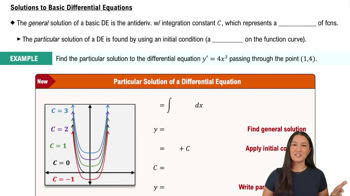
General Solution of a Differential Equation

The general solution of a differential equation includes all possible solutions and typically contains arbitrary constants. It represents the complete set of functions that satisfy the equation, allowing for initial conditions to specify a unique solution.
추천 영상:
04:00
Solutions to Basic Differential Equations

Verification by Substitution

To verify a solution, substitute the given function and its derivatives into the differential equation. If the equation holds true for all values in the domain, the function is a valid solution.
추천 영상:
04:27
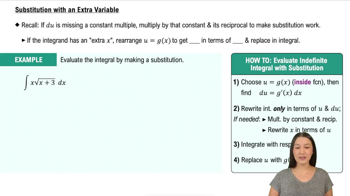
Substitution With an Extra Variable

Second Derivative and Trigonometric Functions

Calculating the second derivative of trigonometric functions like sine and cosine involves applying differentiation rules twice. For example, the second derivative of sin(kt) is -k² sin(kt), which is essential in solving and verifying solutions of differential equations involving harmonic motion.
추천 영상:
06:35
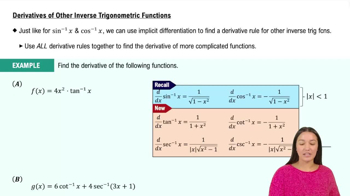
Derivatives of Other Inverse Trigonometric Functions
관련 실천
교과서 질문

17–32. Solving initial value problems Determine whether the following equations are separable. If so, solve the initial value problem.

y'(t) = y³sin t, y(0) = 1

59
views

교과서 질문

17–20. Verifying solutions of initial value problems Verify that the given function y is a solution of the initial value problem that follows it.

y(t) = 8t⁶ - 3; ty'(t) - 6y(t) = 18, y(1) = 5

80
views
교과서 질문

5–10. First-order linear equations Find the general solution of the following equations.


v'(y) − v/2 = 14

49
views
교과서 질문

Orthogonal trajectories Use the method in Exercise 44 to find the orthogonal trajectories for the family of circles x² + y² = a²

110
views
교과서 질문

45–48. General first-order linear equations Consider the general first-order linear equation y'(t)+a(t)y(t)=f(t). This equation can be solved, in principle, by defining the integrating factor p(t)=exp(∫a(t)dt). Here is how the integrating factor works. Multiply both sides of the equation by p (which is always positive) and show that the left side becomes an exact derivative. Therefore, the equation becomes


p(t)(y′(t) + a(t)y(t)) = d/dt(p(t)y(t)) = p(t)f(t).


Now integrate both sides of the equation with respect to t to obtain the solution. Use this method to solve the following initial value problems. Begin by computing the required integrating factor.


y′(t) + (2t)/(t² + 1)y(t) = 1 + 3t², y(1) = 4

75
views
교과서 질문

21–32. Finding general solutions Find the general solution of each differential equation. Use C,C1,C2... to denote arbitrary constants.

y'(t) = t lnt + 1

38
views