Ch. 9 - Differential Equations
Briggs - Calculus: Early Transcendentals 3rd Edition
Briggs3rd EditionCalculus: Early TranscendentalsISBN: 9780136847243당신이 사용하는 게 아니라요?교과서 변경
9장, 문제 9.1.30

21–32. Finding general solutions Find the general solution of each differential equation. Use C,C1,C2... to denote arbitrary constants.
y'(t) = t lnt + 1

검증된 단계별 안내
1
Recognize that the given differential equation is a first-order ordinary differential equation of the form \(y'(t) = f(t)\), where \(f(t) = t \ln t + 1\).
To find the general solution, integrate both sides with respect to \(t\): \(y(t) = \int (t \ln t + 1) \, dt + C\), where \(C\) is an arbitrary constant.
Split the integral into two parts: \(\int t \ln t \, dt\) and \(\int 1 \, dt\).
Use integration by parts to solve \(\int t \ln t \, dt\). Let \(u = \ln t\) and \(dv = t \, dt\), then find \(du\) and \(v\) accordingly.
After computing the integrals, combine the results and add the constant \(C\) to write the general solution \(y(t)\).

비슷한 문제에 대한 검증된 영상 답변:

이 영상 해법은 위 문제에 도움이 된다고 튜터들이 추천한 것입니다.
영상 길이:
3m
도움이 되었나요?

주요 개념

질문에 올바르게 답하기 위해 반드시 이해해야 하는 핵심 개념들은 다음과 같습니다.

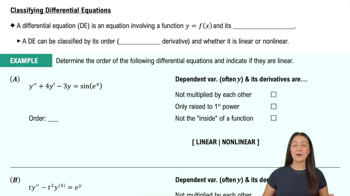
Ordinary Differential Equations (ODEs)

An ordinary differential equation relates a function and its derivatives with respect to one variable. Solving an ODE involves finding a function that satisfies the equation, often including arbitrary constants representing a family of solutions.
추천 영상:
07:39
Classifying Differential Equations

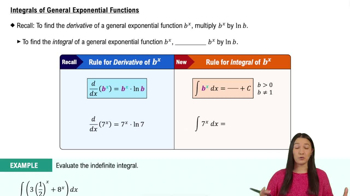
Integration of Functions

To solve first-order ODEs like y'(t) = f(t), we integrate the right-hand side with respect to t. Integration reverses differentiation and introduces an arbitrary constant, representing the general solution's family.
추천 영상:
05:11
Integrals of General Exponential Functions

Properties of Logarithmic Functions

Understanding the natural logarithm function ln(t) and its behavior is essential when integrating expressions like t ln(t). Techniques such as integration by parts are often used to integrate products involving logarithms.
추천 영상:
06:21
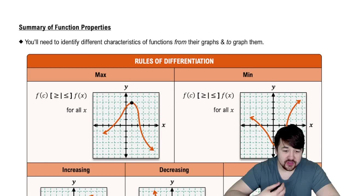
Properties of Functions
관련 실천
교과서 질문

17–32. Solving initial value problems Determine whether the following equations are separable. If so, solve the initial value problem.

y'(t) = y³sin t, y(0) = 1

59
views

교과서 질문

7–16. Verifying general solutions Verify that the given function is a solution of the differential equation that follows it. Assume C, C1, C2 and C3 are arbitrary constants.

u(t) = C₁eᵗ + C₂teᵗ; u''(t) - 2u'(t) + u(t) = 0

41
views
교과서 질문

7–16. Verifying general solutions Verify that the given function is a solution of the differential equation that follows it. Assume C, C1, C2 and C3 are arbitrary constants.

y(t) = C₁ sin4t + C₂ cos4t; y''(t) + 16y(t) = 0

52
views
교과서 질문

5–10. First-order linear equations Find the general solution of the following equations.


v'(y) − v/2 = 14

49
views
교과서 질문

Orthogonal trajectories Use the method in Exercise 44 to find the orthogonal trajectories for the family of circles x² + y² = a²

110
views
교과서 질문

45–48. General first-order linear equations Consider the general first-order linear equation y'(t)+a(t)y(t)=f(t). This equation can be solved, in principle, by defining the integrating factor p(t)=exp(∫a(t)dt). Here is how the integrating factor works. Multiply both sides of the equation by p (which is always positive) and show that the left side becomes an exact derivative. Therefore, the equation becomes


p(t)(y′(t) + a(t)y(t)) = d/dt(p(t)y(t)) = p(t)f(t).


Now integrate both sides of the equation with respect to t to obtain the solution. Use this method to solve the following initial value problems. Begin by computing the required integrating factor.


y′(t) + (2t)/(t² + 1)y(t) = 1 + 3t², y(1) = 4

75
views