
Ch.12 - Parametric and Polar Curves
Briggs - Calculus: Early Transcendentals 3rd Edition
Briggs3rd EditionCalculus: Early TranscendentalsISBN: 9780136847243당신이 사용하는 게 아니라요?교과서 변경
12장, 문제 12.2.30

25–30. Converting coordinates Express the following polar coordinates in Cartesian coordinates.


(4, 5π)

검증된 단계별 안내
1
Recall the formulas to convert polar coordinates \((r, \theta)\) to Cartesian coordinates \((x, y)\): \(x = r \cos(\theta)\) \(y = r \sin(\theta)\)
Identify the given polar coordinates: \(r = 4\) and \(\theta = 5\pi\).
Substitute the values into the conversion formulas: \(x = 4 \cos(5\pi)\) \(y = 4 \sin(5\pi)\)
Use the periodic properties of trigonometric functions to simplify \(\cos(5\pi)\) and \(\sin(5\pi)\). Remember that \(\cos(\theta)\) and \(\sin(\theta)\) have periods of \(2\pi\).
Calculate the simplified values of \(x\) and \(y\) to express the Cartesian coordinates corresponding to the given polar coordinates.

비슷한 문제에 대한 검증된 영상 답변:

이 영상 해법은 위 문제에 도움이 된다고 튜터들이 추천한 것입니다.
영상 길이:
2m
도움이 되었나요?

주요 개념

질문에 올바르게 답하기 위해 반드시 이해해야 하는 핵심 개념들은 다음과 같습니다.

Polar Coordinates

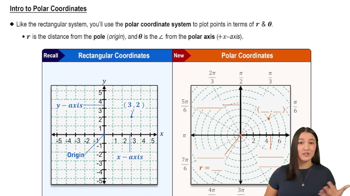
Polar coordinates represent a point in the plane using a radius and an angle, denoted as (r, θ), where r is the distance from the origin and θ is the angle measured from the positive x-axis. Understanding this system is essential for converting to Cartesian coordinates.
추천 영상:
05:32
Intro to Polar Coordinates

Conversion Formulas from Polar to Cartesian

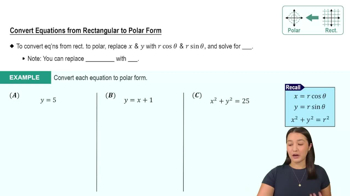
To convert polar coordinates (r, θ) to Cartesian coordinates (x, y), use the formulas x = r cos(θ) and y = r sin(θ). These formulas translate the radius and angle into horizontal and vertical distances on the Cartesian plane.
추천 영상:
3:37
Convert Equations from Rectangular to Polar

Angle Measurement and Trigonometric Values

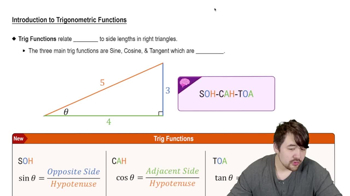
Angles in polar coordinates are often given in radians. Knowing how to evaluate trigonometric functions like sine and cosine at specific angles, such as multiples of π, is crucial for accurate conversion to Cartesian coordinates.
추천 영상:
6:04
Introduction to Trigonometric Functions
관련 실천
교과서 질문

53–56. Circular motion Find parametric equations that describe the circular path of the following objects. For Exercises 53–55, assume (x, y) denotes the position of the object relative to the origin at the center of the circle. Use the units of time specified in the problem. There are many ways to describe any circle.


A bicyclist rides counterclockwise with constant speed around a circular velodrome track with a radius of 50 m, completing one lap in 24 seconds.

47
views
교과서 질문

39–50. Equations of ellipses and hyperbolas Find an equation of the following ellipses and hyperbolas, assuming the center is at the origin. 


A hyperbola with vertices (±4, 0) and foci (±6, 0)

60
views
교과서 질문

Second derivative Assume a curve is given by the parametric equations x=f(t) and y=g(t), where f and g are twice differentiable. Use the Chain Rule to show that y″x=(fʹ(t)g″(t)−gʹ(t)f″(t))/(fʹ(t))³.  

43
views
교과서 질문

57–64. Graphing polar curves Graph the following equations. Use a graphing utility to check your work and produce a final graph.


r² = 4 sin θ  

54
views
교과서 질문

Air drop—inverse problem A plane traveling horizontally at 100 m/s over flat ground at an elevation of 4000 m must drop an emergency packet on a target on the ground. The trajectory of the packet is given by

x = 100t, y = −4.9t² + 4000, t ≥ 0

where the origin is the point on the ground directly beneath the plane at the moment of the release. How many horizontal meters before the target should the packet be released in order to hit the target?

47
views
교과서 질문

63–74. Arc length of polar curves Find the length of the following polar curves.


{Use of Tech} The complete limaçon r=4−2cosθ

24
views