
Ch.12 - Parametric and Polar Curves
Briggs - Calculus: Early Transcendentals 3rd Edition
Briggs3rd EditionCalculus: Early TranscendentalsISBN: 9780136847243당신이 사용하는 게 아니라요?교과서 변경
12장, 문제 12.2.35

31–36. Converting coordinates Express the following Cartesian coordinates in polar coordinates in at least two different ways.


(-4, 4√3)

검증된 단계별 안내
1
Recall the formulas to convert Cartesian coordinates \((x, y)\) to polar coordinates \((r, \theta)\): \(r = \sqrt{x^2 + y^2}\) and \(\theta = \arctan\left(\frac{y}{x}\right)\), but be careful with the quadrant of the point when determining \(\theta\).
Calculate the radius \(r\) using the given coordinates \(x = -4\) and \(y = 4\sqrt{3}\): \(r = \sqrt{(-4)^2 + (4\sqrt{3})^2}\).
Find the angle \(\theta\) by computing \(\arctan\left(\frac{y}{x}\right) = \arctan\left(\frac{4\sqrt{3}}{-4}\right)\), then adjust \(\theta\) to the correct quadrant since \(x\) is negative and \(y\) is positive (which places the point in the second quadrant).
Express the polar coordinates as \((r, \theta)\) where \(r\) is the radius found in step 2 and \(\theta\) is the angle found in step 3, typically in radians.
For the second method, use the fact that \(\theta\) can also be expressed as \(\pi - |\arctan(\frac{y}{|x|})|\) to directly find the angle in the second quadrant, then write the polar coordinates again as \((r, \theta)\).

비슷한 문제에 대한 검증된 영상 답변:

이 영상 해법은 위 문제에 도움이 된다고 튜터들이 추천한 것입니다.
영상 길이:
3m
도움이 되었나요?

주요 개념

질문에 올바르게 답하기 위해 반드시 이해해야 하는 핵심 개념들은 다음과 같습니다.

Cartesian and Polar Coordinate Systems

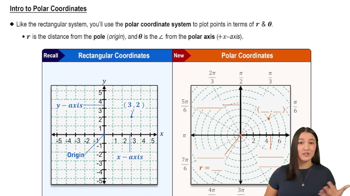
Cartesian coordinates represent points using (x, y) values on perpendicular axes, while polar coordinates describe points by a distance from the origin (r) and an angle (θ) from the positive x-axis. Understanding both systems is essential for converting between them.
추천 영상:
05:32
Intro to Polar Coordinates

Conversion Formulas Between Cartesian and Polar Coordinates

To convert from Cartesian (x, y) to polar (r, θ), use r = √(x² + y²) to find the radius and θ = arctan(y/x) to find the angle. Adjustments to θ may be needed depending on the quadrant where the point lies.
추천 영상:
05:32
Intro to Polar Coordinates

Multiple Representations of Polar Coordinates

Polar coordinates are not unique; the same point can be represented by different pairs (r, θ) by adding or subtracting full rotations (2π) to the angle or by using negative radius values with adjusted angles. Recognizing these variations helps express coordinates in multiple valid ways.
추천 영상:
05:32
Intro to Polar Coordinates