
Ch.12 - Parametric and Polar Curves
Briggs - Calculus: Early Transcendentals 3rd Edition
Briggs3rd EditionCalculus: Early TranscendentalsISBN: 9780136847243당신이 사용하는 게 아니라요?교과서 변경
12장, 문제 12.2.109

Subtle symmetry Without using a graphing utility, determine the symmetries (if any) of the curve r=4-sin (θ/2)

검증된 단계별 안내
1
Recall that to determine symmetries of a polar curve \(r = f(\theta)\), we check for symmetry about the polar axis, the line \(\theta = \frac{\pi}{2}\), and the pole (origin).
For symmetry about the polar axis (the horizontal axis), replace \(\theta\) by \(-\theta\) and check if the equation remains unchanged or can be manipulated to the original form. That is, check if \(r = 4 - \sin\left(\frac{-\theta}{2}\right)\) simplifies to the original \(r\).
For symmetry about the line \(\theta = \frac{\pi}{2}\) (vertical axis), replace \(\theta\) by \(\pi - \theta\) and check if the equation remains unchanged or can be manipulated to the original form. That is, check if \(r = 4 - \sin\left(\frac{\pi - \theta}{2}\right)\) simplifies to the original \(r\).
For symmetry about the pole (origin), replace \(r\) by \(-r\) and \(\theta\) by \(\theta + \pi\), and check if the equation holds. That is, check if \(-r = 4 - \sin\left(\frac{\theta + \pi}{2}\right)\) can be rearranged to the original equation.
Analyze the results from these substitutions to conclude which symmetries the curve has based on whether the equation remains equivalent after each transformation.

비슷한 문제에 대한 검증된 영상 답변:

이 영상 해법은 위 문제에 도움이 된다고 튜터들이 추천한 것입니다.
영상 길이:
4m
도움이 되었나요?

주요 개념

질문에 올바르게 답하기 위해 반드시 이해해야 하는 핵심 개념들은 다음과 같습니다.

Polar Coordinates and Polar Equations

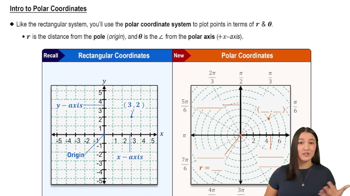
Polar coordinates represent points using a radius and an angle, with equations expressing relationships between r (radius) and θ (angle). Understanding how to interpret and manipulate polar equations is essential for analyzing curves defined in this system.
추천 영상:
05:32
Intro to Polar Coordinates

Symmetry in Polar Graphs

Symmetry in polar graphs can be tested by checking if the equation remains unchanged under transformations: θ replaced by -θ (symmetry about the polar axis), θ replaced by π - θ (symmetry about the vertical line θ = π/2), or r replaced by -r with θ replaced by θ + π (symmetry about the pole).
추천 영상:
05:32
Intro to Polar Coordinates

Trigonometric Function Properties

Understanding the properties of sine functions, especially with angle transformations like θ/2, helps determine how the function behaves under angle shifts or reflections. This is crucial for testing symmetry without graphing tools.
추천 영상:
가이드 코스
06:21
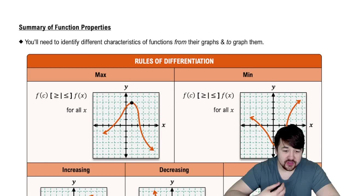
Properties of Functions
관련 실천
교과서 질문

85–87. Grazing goat problems Consider the following sequence of problems related to grazing goats tied to a rope. (See the Guided Project Grazing goat problems.)


A circular corral of unit radius is enclosed by a fence. A goat is outside the corral and tied to the fence with a rope of length 0≤a ≤ π (see figure). What is the area of the region (outside the corral) that the goat can reach?


47
views
교과서 질문

31–36. Converting coordinates Express the following Cartesian coordinates in polar coordinates in at least two different ways.


(-4, 4√3)

81
views
교과서 질문

63–74. Arc length of polar curves Find the length of the following polar curves.


The spiral r = θ², for 0 ≤ θ ≤ 2π

66
views
교과서 질문

23–24. Radar Airplanes are equipped with transponders that allow air traffic controllers to see their locations on radar screens. Radar gives the distance of the plane from the radar station (located at the origin) and the angular position of the plane, typically measured in degrees clockwise from north.

A plane is 50 miles from a radar station at an angle of 10 dgeree clockwise from north. Find polar coordinates for the location of the plane.

53
views
교과서 질문

9–13. Graph the points with the following polar coordinates. Give two alternative representations of the points in polar coordinates.


(-1, -π/3)

70
views
교과서 질문

49–52. Cartesian-to-polar coordinates Convert the following equations to polar coordinates.


(x - 1)² + y² = 1

71
views