Ch.12 - Parametric and Polar Curves
Briggs - Calculus: Early Transcendentals 3rd Edition
Briggs3rd EditionCalculus: Early TranscendentalsISBN: 9780136847243당신이 사용하는 게 아니라요?교과서 변경
12장, 문제 12.R.56a

53–57. Conic sections
a. Determine whether the following equations describe a parabola, an ellipse, or a hyperbola.
x²/4 + y²/25 = 1

검증된 단계별 안내
1
Identify the general form of the conic section equation. The given equation is \( \frac{x^2}{4} + \frac{y^2}{25} = 1 \). This resembles the standard form of conic sections centered at the origin.
Recall the standard forms: - Ellipse: \( \frac{x^2}{a^2} + \frac{y^2}{b^2} = 1 \) - Hyperbola: \( \frac{x^2}{a^2} - \frac{y^2}{b^2} = 1 \) or \( -\frac{x^2}{a^2} + \frac{y^2}{b^2} = 1 \) - Parabola: Usually involves only one squared term, e.g., \( y^2 = 4ax \) or \( x^2 = 4ay \).
Compare the given equation to these forms. Since both \( x^2 \) and \( y^2 \) terms are positive and added together, and the equation equals 1, it matches the form of an ellipse.
Note the denominators: \(4\) and \(25\) represent \(a^2\) and \(b^2\) respectively, which are positive constants, confirming the ellipse shape.
Conclude that the equation \( \frac{x^2}{4} + \frac{y^2}{25} = 1 \) describes an ellipse.

비슷한 문제에 대한 검증된 영상 답변:

이 영상 해법은 위 문제에 도움이 된다고 튜터들이 추천한 것입니다.
영상 길이:
4m
도움이 되었나요?

주요 개념

질문에 올바르게 답하기 위해 반드시 이해해야 하는 핵심 개념들은 다음과 같습니다.

Conic Sections

Conic sections are curves obtained by intersecting a plane with a double-napped cone. The main types are parabolas, ellipses, and hyperbolas, each defined by specific algebraic equations and geometric properties.
추천 영상:
가이드 코스
5:33
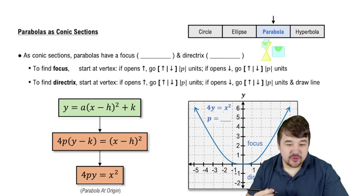
Parabolas as Conic Sections

Standard Form of Conic Equations

Each conic section has a standard equation form: ellipses and hyperbolas involve sums or differences of squared terms set equal to 1, while parabolas have a single squared term. Recognizing these forms helps identify the conic type.
추천 영상:
가이드 코스
5:18
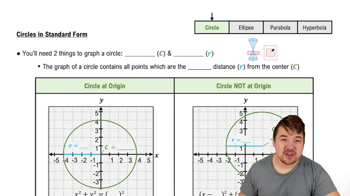
Circles in Standard Form

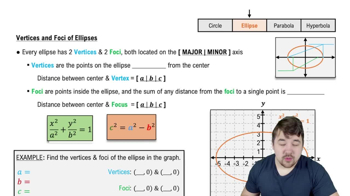
Ellipse Identification Criteria

An ellipse equation typically has the form (x²/a²) + (y²/b²) = 1 with both denominators positive and the sum of squared terms. This distinguishes it from hyperbolas, which have a subtraction, and parabolas, which have only one squared term.
추천 영상:
가이드 코스
5:30
Foci and Vertices of an Ellipse